

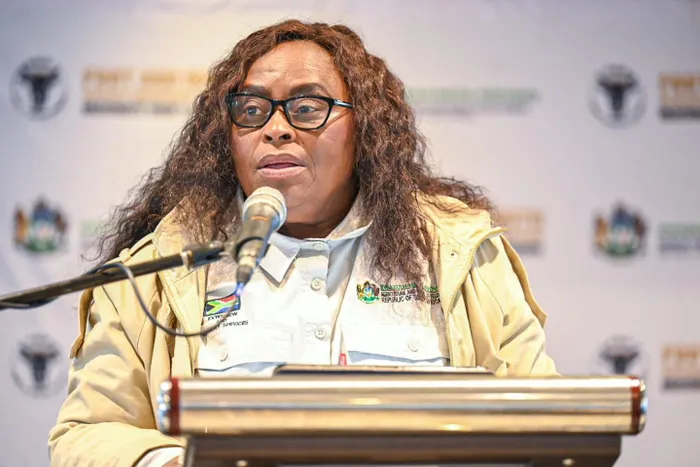
KZN Department of Agriculture and Rural Development MEC Thembeni kaMadlopha-Mthethwa has outlined the province's Foot and Mouth Disease vaccination strategy.
Image: KZN Department of Agriculture and Rural Development
Following the landing of the foot and mouth disease (FMD) vaccines, KwaZulu-Natal Department of Agriculture and Rural Development MEC Thembeni kaMadlopha-Mthethwa expressed optimism about the province’s preparedness.
On Saturday, Agriculture Minister John Steenhuisen oversaw the arrival of the first consignment of one million high-potency FMD vaccines at OR Tambo International Airport.
KaMadlopha-Mthethwa spoke at eMachobeni Royal Palace in Ngwavuma, on the sidelines of the uMkhosi wamaGanu (Marula Festival) over the weekend.
“I know that our province will receive 200,000 (doses) every week, and in the second phase, KwaZulu-Natal will receive 400,000,” kaMadlopha-Mthethwa said.
She said the province will be ready when the vaccines arrive.
“We have 45 teams that we have recently formed. You will soon see advertisements seeking veterinarians to hire, temporarily. We will hire 140 data capturers and also hire more than 40 people who will be based in the offices,” kaMadlopha-Mthethwa said.
“This will assist the youth of KwaZulu-Natal because people from rural areas will also be hired to do the work. We want people in rural areas to be ready and wait for the start of the vaccinations from Thursday. The locations will be announced.”
KaMadlopha-Mthethwa urged everyone to cooperate to curb FMD.
“People should not be alarmed; every cow in KwaZulu-Natal will be vaccinated. Whether it belongs to a beginner or a prominent businessman,” kaMadlopha-Mthethwa said.
The department added that kaMadlopha-Mthethwa expects her team of veterinary services practitioners to hit the ground running and complete the vaccination of 2.45 million cattle in the province on schedule (four to six months).
The National Department of Agriculture said the Argentina shipment forms part of a sustained supply pipeline, with further consignments scheduled to arrive over the coming weeks, including vaccines sourced from BVI in Botswana and Dollvet in Turkey. By the end of March, more than five million vaccine doses will have arrived in the country, sourced from the three international suppliers.
The Agriculture Research Council (ARC) has committed to producing 20,000 vaccines weekly and scaling up to 200,000 per week in 2027.
Steenhuisen said: “Vaccination has already begun in affected areas, but supply has limited the speed and coverage. With this arrival, we can now accelerate protection across priority provinces and stabilise the livestock sector.”
He said a risk-based vaccination approach will prioritise outbreak epicentres in KZN, parts of Gauteng, Free State and North West, while high-risk and border regions will follow structured vaccination programmes.
Vaccine dose distribution will be as follows: KZN 200,000 doses; Mpumalanga 100,000 doses; North West 100,000 doses; Free State 200,000 doses; Eastern Cape 150,000 doses; Limpopo 100,000 doses; Gauteng 70,000 doses; Northern Cape 50,000 doses; and Western Cape 30,000 doses.