

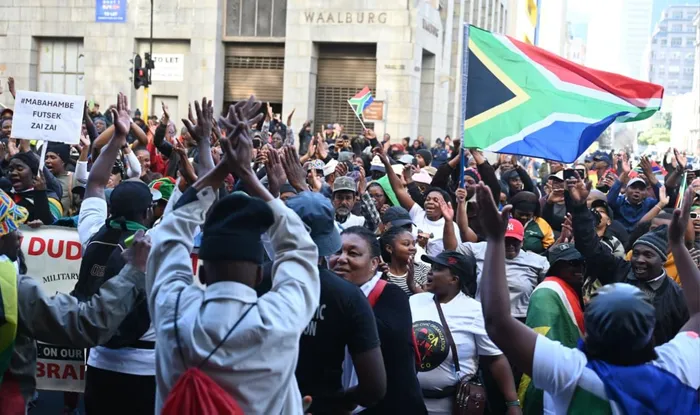
Supporters of LACO and other anti-undocumented migrant groups protest, accusing undocumented foreign nationals of occupying jobs that they say should be reserved for South Africans, particularly in sectors that do not require scarce skills.
Image: Ayanda Ndamane / ANAStudio
As South Africa grapples with the humanitarian fallout of recent anti-migrant violence and the mass processing of foreign nationals through the Musina Temporary Repatriation Processing Centre, questions have resurfaced about whether migrants are legally entitled to healthcare.
While some argue that public healthcare should be reserved for South African citizens, the country's Constitution, legislation and court rulings paint a bigger picture.
Section 27 of the Constitution states that "everyone has the right to have access to healthcare services", not only citizens.
It also guarantees that no one may be refused emergency medical treatment, regardless of nationality or immigration status.
It is widely understood that "everyone" means the constitutional protections extend to foreign nationals, including refugees, asylum seekers and, in special circumstances, undocumented migrants.
Regardless of a person's immigration status, public health facilities may not refuse emergency medical treatment.
This includes treatment for life-threatening illnesses or injuries requiring immediate medical attention.
Hospitals and clinics, therefore, cannot legally turn someone away simply because they lack South African identity documents or valid immigration papers.
The Healthcare Workers Against Xenophobia (HCWAX) weighed in, reiterating the law's stance on the matter.
"The Constitutional Court judgment of 5 July 2026 makes it clear that key provisions of the immigration legislation on which the government relies are unconstitutional," it said.
It said that South Africans fought against exclusionary and dehumanising practices such as these at great cost.
"The government's failure to uphold that legacy is an indictment of its commitment to the Constitution. Its willingness to rapidly process people through the immigration system while failing to protect their rights sits uneasily with its claims to uphold the Bill of Rights."
"Health workers will always provide care and humanitarian assistance to all who need it, without exception. But this cannot absolve the government of its constitutional responsibilities. Nor should it rely on non-governmental organisations and frontline health workers to fill gaps created by its own actions while it enables the continued demonisation of migrants as convenient scapegoats.
South Africa's public health policies also provide for the treatment of communicable diseases such as HIV and tuberculosis because interrupting treatment poses significant public health risks.
Government HIV and TB programmes are designed to ensure continuity of treatment, particularly for patients already receiving antiretroviral therapy (ART) or TB medication.
Pregnant women are also entitled to maternal healthcare services under national health policies, while children are protected under Section 28 of the Constitution, which guarantees every child access to basic healthcare services.
Recognised refugees generally have the same access to basic public healthcare services as South African citizens under the Refugees Act.
Asylum seekers whose applications are still being processed are also entitled to access healthcare while they remain lawfully in the country.
The position is more complex for undocumented migrants.
Although immigration laws regulate a person's legal status in South Africa, it's worth noting that they do not automatically remove constitutional rights.
The Department of Health has previously instructed public healthcare facilities not to deny essential healthcare solely because a patient lacks documentation.
However, advocacy organisations have repeatedly reported instances where migrants have allegedly been refused treatment or asked to produce documents before receiving care.
The issue has come under renewed scrutiny after public health organisations warned that people displaced during recent anti-migrant operations risk having their HIV, TB and chronic medication interrupted.
HCWAX argued that disruptions to treatment could have long-term consequences for both individual patients and public health, particularly where infectious diseases such as tuberculosis are involved.
Humanitarian organisations, including Médecins Sans Frontières (MSF), have also raised concerns about continuity of care for patients with HIV, TB, diabetes and hypertension during the recent displacement of migrants.
The Department of Home Affairs has maintained that repatriation operations are being conducted within the law and that humanitarian obligations are being observed.
At the same time, healthcare organisations argue that immigration enforcement should not interfere with constitutional rights or essential medical treatment.
As government continues processing migrants through repatriation centres, access to healthcare is likely to remain a key legal and public health issue, particularly as South Africa's Constitution continues to guarantee healthcare rights to "everyone", while also prohibiting the refusal of emergency medical treatment.
IOL