

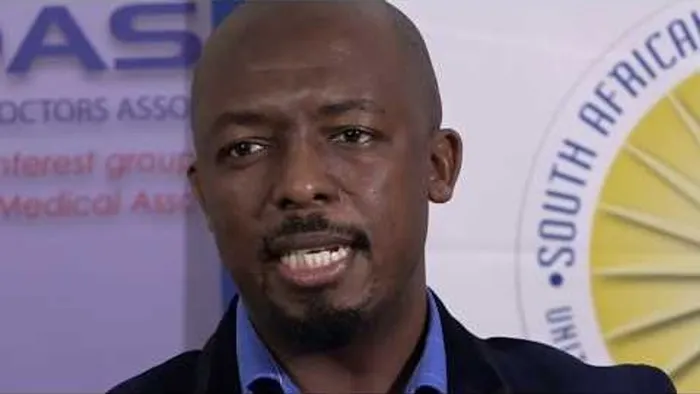
Dr Mvuyisi Mzukwa, chairperson of the SA Medical Association
Image: FILE
The SA Medical Association (SAMA) said the health ombud's investigation into the deaths of six healthcare professionals in KwaZulu-Natal should serve as a wake-up call for the country's public health system.
The ombud found no direct link between the deaths and workplace bullying, victimisation or poor working conditions.
However, the association on Thursday said the report exposed a healthcare system under immense strain.
The five doctors and a radiographer died between 2024 and 2025.
Claims circulating on social media suggested bullying and brutal working conditions at the province's public hospitals were to blame.
They were intern doctor Alulutho Mazwi, 25, of Prince Mshiyeni Memorial Hospital, Dr Tumelo Kgaladi, 31, of Addington Hospital and radiographer Mvelo Cele of Port Shepstone Hospital.
The others were Dr Siyabonga Zulu of Ngwelezane Hospital, Dr SI Ngidi of Benedictine Hospital and Dr Francis Idika of Vryheid Hospital.
It was the death of Mazwi in May 2024 that ignited the outcry, after claims he had collapsed on duty after a supervisor forced him to work while ill.
The ombud found those claims were fabricated.
Mazwi became critically ill at the doctors' residence with complications of uncontrolled diabetes.
Health ombud professor Taole Mokoena released the report on Wednesday.
This followed a joint investigation with the Public Service Commission.
The probe was launched after complaints by health minister Aaron Motsoaledi and former parliamentary health committee chair Sibongiseni Dhlomo.
"It is confusing us that a series of deaths can happen in one province, one after the other," Motsoaledi said at the release of the report.
SAMA said while the hospitals had been cleared, the system remained shambolic.
"The tragedy is that, though these doctors did not die because of their working conditions, thousands of healthcare professionals continue to work in conditions that are simply not sustainable," SAMA chair Dr Mvuyisi Mzukwa said.
He said the investigation laid bare the realities facing healthcare workers every day.
These included chronic staff shortages, frozen vacant posts, escalating workloads and shortages of essential medical equipment.
Deteriorating infrastructure, inadequate employee wellness programmes, security concerns and severe budget constraints added to the strain.
"These are not isolated problems... they are systemic failures that threaten both the wellbeing of healthcare workers and the quality of care patients receive," the association said.
SAMA said it was particularly alarmed by the report's finding that many intern doctors felt pressured not to take sick leave.
This was because they feared extending their training rotations or placing additional strain on already overstretched colleagues.
"No doctor should ever feel that looking after their own health comes at the expense of their patients or fellow colleagues," Mzukwa said.
"A healthcare system that leaves its doctors feeling unable to become patients themselves is a system under serious pressure."
On the individual cases, the ombud found Mazwi was never referred to an employee assistance programme despite the hospital being aware of his chronic illness.
Kgaladi died at his residence while off duty, with the cause of his death still subject to a SAPS forensic inquiry and inquest.
The ombud found he had a history of depression that was not disclosed when he began his rotation.
He also did not undergo the required entry medical assessment, meaning his mental health needs were never identified.
Cele died of cardiac arrest while on duty, while Zulu died in a car accident while off duty.
Idika died of natural causes after suffering a ruptured aortic aneurysm, disproving claims that workplace bullying had driven him to take his own life.
Ngidi, a community service doctor, died by suicide while off duty.
Mokoena said the findings did not mean the health system was free of serious challenges.
"The system cannot effectively care for patients if it fails to adequately support those who provide the healthcare," he said.
The report's recommendations include strengthening employee wellness programmes, improving staff support systems and addressing security concerns.
These will be referred to the Office of Health Standards Compliance for monitoring.
SAMA said the findings validated concerns it had consistently raised about the deteriorating conditions under which doctors were expected to work.
It called on national and provincial health authorities to move beyond acknowledging the challenges and urgently implement the recommendations.
"This report cannot become another document that gathers dust. Every recommendation must be backed by clear implementation plans, measurable timelines and accountability," Mzukwa said.
"SA cannot afford to normalise a healthcare system where doctors are expected to carry an ever-increasing burden with ever-decreasing support."
The association further called for the urgent filling of critical vacant posts, strengthened workforce planning and properly resourced wellness programmes.
It also demanded improved workplace security and sustained investment in the public healthcare workforce.
IOL