


Minister of Public Works and Infrastructure Dean Macpherson, during a media briefing at the GCIS Imbizo Centre in Parliament, Cape Town, on Tuesday afternoon.
Image: Bheki Radebe / ANAStudio
Minister of Public Works and Infrastructure, Dean Macpherson, said there have been more than 770 cases of construction-related extortion and intimidation reported across the country, while briefing the media on Cabinet’s approval last week of the Integrated Social Facilitation Framework (ISFF).
“Today, we announce Cabinet’s approval last week of the Integrated Social Facilitation Framework as a binding national policy instrument - a major step in moving from policy development to formal government implementation.
“Since the Durban Declaration, our work has shifted from establishing coordination mechanisms to making sure those mechanisms are used effectively across the sector. It is the next phase in our fight against the construction mafia,” Macpherson said.
The intent of the declaration, signed in 2024, was to outline a collective commitment to eradicate extortion and violence on construction sites and to initiate mechanisms to urgently and immediately give effect to that commitment.
He explained that more than 180 infrastructure projects, worth approximately R63 billion, were disrupted by the construction mafia across the country.
He explained that those figures represent “roads not built, schools delayed, water projects disrupted, public buildings stalled, private investment lost, workers sent home, and communities left waiting”.
He said that in 2024, the construction mafia problem had begun in KwaZulu-Natal, but had spread across the country.
“Contractors, developers, public entities, and investors were raising the same concern: projects were being stopped, workers were being intimidated, equipment was being damaged, and companies were being forced to pay money or surrender work to people who had no lawful claim to it. These syndicates were not only delaying projects, but they were also increasing costs to the state. They were scaring away investment. They were threatening the lives of workers,” Macpherson said.
“Since the signing of the Durban Declaration, there has been measurable progress. More than 770 cases of construction-related extortion and intimidation have been reported across the country. Of those, 241 arrests have been made. Most importantly, 176 individuals have been convicted.
“In KwaZulu-Natal, which was historically regarded as the hotspot of construction mafia activity, monthly site disruptions have dropped from more than 60 incidents per month to fewer than 10 incidents per month. That is a significant improvement. It shows what can happen when the government, law enforcement, public entities, and the private sector act together.
“But let me be very clear: we are not declaring victory today. This fight is far from over. Recent disruptions in Gauteng, including in Randfontein and the Vaal Region, show that risks remain. But they also show that the response system is now working differently.
“In those cases, incidents were escalated through the Provincial Priority Crimes Committee; SAPS and stakeholders responded, affected groups were engaged, and sites were stabilised without allowing the disruptions to spiral into prolonged stoppages. The construction mafia is still active. These networks are still looking for ways to infiltrate projects,” he said.
He explained that the Cabinet’s approval of the ISFF creates a binding national policy instrument to standardise and institutionalise community engagement in infrastructure delivery across all spheres of government, state-owned entities, and infrastructure development stakeholders.
“This framework is designed to address community protests, project disruptions, vandalism, delays, and security risks by promoting structured community participation throughout the infrastructure project lifecycle. It introduces a professionalised and coordinated approach to social facilitation, including the accreditation of social facilitators, clearer governance arrangements, stronger monitoring and evaluation, and a risk-based approach to managing community-related risks. In plain language, this means that communities must no longer be engaged only after conflict begins. They must be engaged before a project starts,” he said.
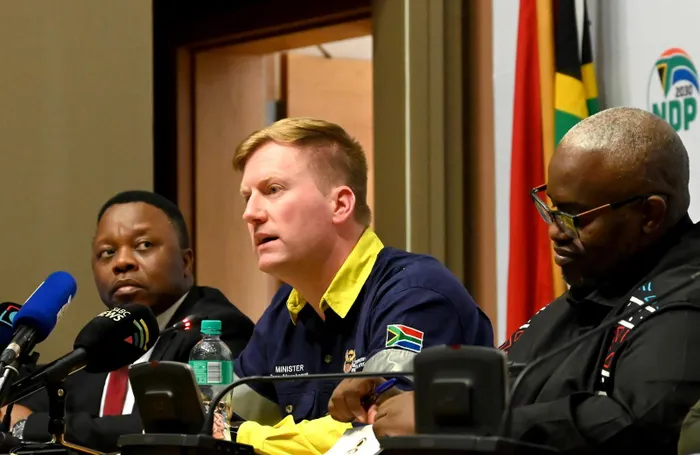
Minister of Public Works and Infrastructure Dean Macpherson was joined by the Acting Deputy Director-General for Real Estate Management Services in the Department of Public Works and Infrastructure, Molatelo Mohwasa, and the CEO of the Council for the Built Environment, Dr Msizi Myeza.
Image: Bheki Radebe / ANAStudio
He said the ISFF embeds social facilitation throughout the entire project lifecycle, from pre-initiation to project close-out, provides for proper stakeholder mapping and community profiling, establishes Project Liaison Committees as formal communication and conflict-resolution platforms, and supports the creation of targeted enterprise databases and Contract Participation Goal Plans to maximise lawful local economic participation.
“It integrates training and skills-development programmes for local labour. It requires continuous monitoring and evaluation of social issues. It requires regular reporting so that risks can be identified early and managed before they become disruptions. This is a major shift. We are moving from ad hoc consultation to structured engagement. We are moving from informal gatekeeping to professional facilitation.”