

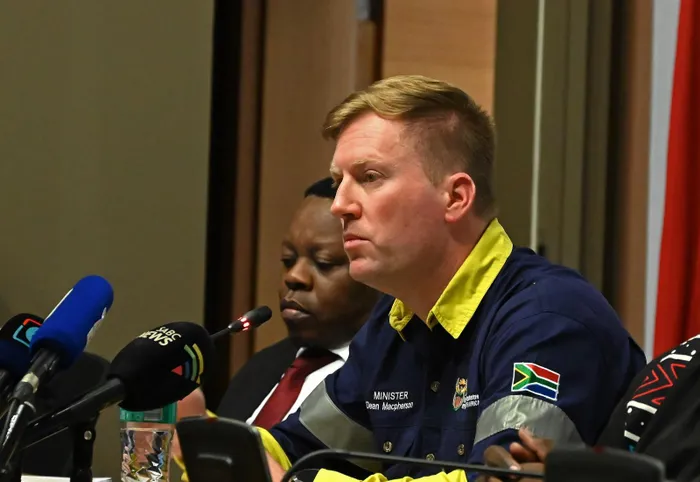
The Minister of Public Works and Infrastructure, Dean Macpherson, said ‘there is literally no border in some places’
Image: Bheki Radebe/ANA Studios
The Minister of Public Works and Infrastructure, Dean Macpherson, described his recent visit to the Limpopo border as shocking, describing how “there is literally no border in some places” and that “a crocodile sitting on a rock” was among the border security measures.
Macpherson, who briefed the media on Tuesday about Cabinet’s approval of the Integrated Social Facilitation Framework (ISFF), shared what he saw on a recent visit by the Inter-Ministerial Committee (IMC) to the Beitbridge border post in Limpopo.
The IMC is chaired by the Minister of Justice and Constitutional Development, Mmamoloko Kubayi. The inspection formed part of the government’s ongoing efforts to strengthen border management and assess the operational readiness of the temporary processing centre ahead of planned repatriation operations in Musina.
The department said Kubayi was accompanied by Deputy Minister Andries Nel; the Minister of Health, Dr Aaron Motsoaledi; Minister of Public Works, Dean Macpherson; Minister of Home Affairs, Leon Schreiber, Acting Minister of Police, Firoz Cachalia, and the Deputy Minister of Police, Polly Boshielo.
“If I get one message today, I get 100 messages of people online saying, 'When am I going to build the border fence?' I went up there last week with the IMC, and I'm going to be frank with everyone; it was shocking what I saw up there. There is literally no border in some places.
“I was told that there was a really highly developed electric fence, but that the electric fence had been turned off because when you touch that fence, it was designed to, to use a polite word, incapacitate you as an individual,” Macpherson said.
“It was then turned off because it was found to be in violation of people's human rights. So, you could cross the border illegally, but you couldn't be stopped, and I found that quite strange.
“I also saw the washing line, which has now been turned into just a ball of metal in a dump site, next to that,” he said.
The “washing line” is a colloquial descriptor for a section of the 46km of fence adjacent to the Beitbridge port of entry.
“Let me say, I mean I'm not a spokesperson for IMC, but I think that there is general support amongst political parties in the government, and amongst us in the IMC, that this issue has to be addressed and it has to be addressed urgently.
“Obviously, cost becomes an issue, but we have to deal with the trade-off. So we have to say, how do we find the money? How do we deal with the expenditure to at least secure those parts around Beitbridge?
“Now, Public Works is not the political champion of the border fence. That is the Department of Defence. So I'm not responsible for the border fence,” Macpherson said.
“We support the Ministry of Defence to do so, and when that plan comes to fruition, we will be there to get it done, but it is not our mandate per se. The minister of defence has been appointed as the political champion for this issue, and we will support that champion.
“We are ready to help wherever we can, and we are in full agreement that something has to be done urgently because when I stood there on the banks of the Limpopo River and saw people over the river waving at us, it was extraordinary,” Macpherson said.
“And when we left, they just continued with their job. The most proactive part of that border was a crocodile that was lying on the rock there, and that is literally it.”
Macpherson said that he understands the frustrations of South Africans with regard to the porous border, but he commended the DPWI for the temporary repatriation centre in Musina as “something quite extraordinary”.
“We have created a humane, dignifying facility for people who want to leave the country.
“I was in Durban (on Monday). I was at the Durban drive-in site. It is emotional and heartbreaking to see the difficulties of people who have been trying to leave a country - children, women - putting their bags together.
“Of course, no person should be in this country unlawfully or illegally, but we also need to facilitate that exit in a dignified way. And what DPWI has done in Musina is to do that, and I really want to thank the team for the work that they have done.”