

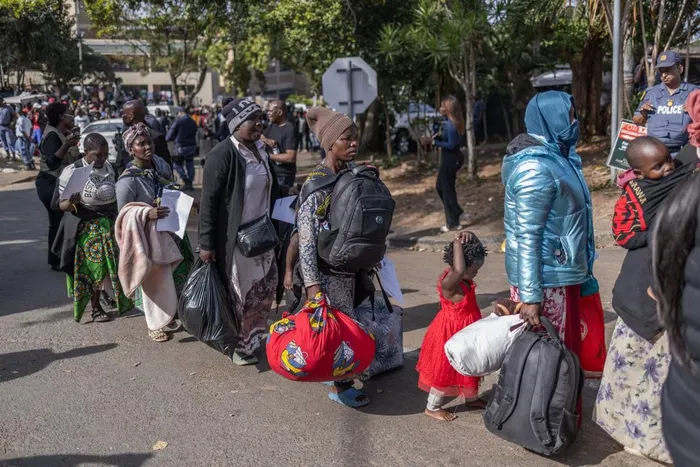
The government says it is not spending money on food for foreign nationals awaiting repatriation at the Musina Temporary Repatriation Centre, with NGOs stepping in to provide assistance.
Image: RAJESH JANTILAL / AFP
The government is not spending money to feed foreign nationals awaiting repatriation at the Temporary Repatriation Centre in Musina, Limpopo, but is only funding officials working on the process.
This was confirmed by Limpopo Home Affairs manager Albert Matsaung.
Thousands of migrants remain at the centre as authorities continue with repatriations and deportations through the Beitbridge Port of Entry, following the closure of the Durban Repatriation Centre.
The move comes as anti-migrant organisations continue to call for undocumented immigrants to leave South Africa.
Some foreign nationals have been deported or voluntarily repatriated amid rising tensions and protests.
Speaking at the centre on Sunday, Matsaung said the government is working with multiple stakeholders to manage food provision at the site.
“The good thing is that this is an integrated approach. We've got all stakeholders on board. And when it comes to food, we're not having any problems as a government because we've got NGOs that have been with us throughout.”
He said non-governmental organisations, including Gift of the Givers, are assisting with food distribution.
“From KZN, throughout all the provinces, those NGOs have been instrumental. You can see here, we've got the Gift of the Givers, they're here with us. They are assisting us in terms of the provision of food.”
Matsaung said community members in Musina are also contributing to relief efforts.
“That is why food is not a problem. So we're getting support from other relevant stakeholders because they are joining the government and they are supporting the government in terms of making sure that we deal with this issue of illegal migration.”
Asked whether the government is funding food supplies, Matsaung said it is not.
“The government is not spending money on food. We've got NGOs that are a support. No money is spent by the government on food. Except spending money on our own officials that are doing the work.”
On Saturday, the Department of Home Affairs says at least 50 buses are expected to arrive at the Musina repatriation centre to help clear a growing backlog as thousands of Zimbabwean and Malawian nationals wait to return home.
KZN Home Affairs official Cyril Mncwabe said the Musina site had been established as the country's official repatriation centre.
“We are currently here at the Musina repatriation site. This is a formal structure that has been put in place by the government of South Africa to ensure that we do the repatriation.”
He said the facility was created after large numbers of people had been gathering at the Durban Showgrounds.
“As you would know, everybody was arriving at the showgrounds. We have now put structures in place here to facilitate the process. We are busy processing people as they arrive, and most of them come from different provinces to this official repatriation centre,” he told eNCA.
Mncwabe said officials are currently processing Mozambican, Zimbabwean and Malawian nationals.
“Those are the predominant countries that we are trying to assist here.”
He said 2,068 people were processed on Friday.
“We hope that today the numbers will increase because the challenge has been the availability of buses to take people out of the country.”
Home Affairs expects at least 50 buses to arrive at the site to reduce the growing backlog.
“We are expecting not less than 50 buses to be on site today while processing continues.”
Mncwabe acknowledged that the growing number of arrivals was placing pressure on officials.
“Now that this is the official repatriation centre, all the provinces are sending people here.”
He said about 100 Home Affairs officials had been deployed to process arrivals and estimated operations could continue for another month, depending on the number of people still expected.
“People continue to arrive because they fear for their lives or because of developments taking place in the communities where they have been living.”
IOL News