

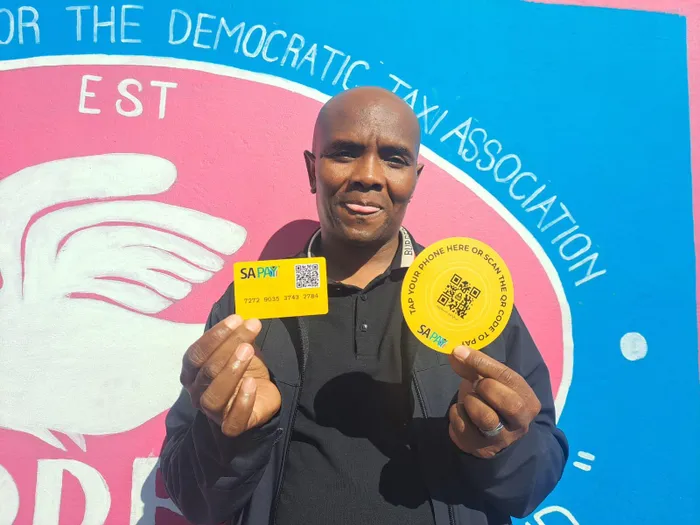
Mzwabantu Fayindlala, Codeta Secretary General, says SAPay has an offline mode enabling payment collection even when the driver’s phone is not connected to the internet.
Image: Siyavuya Khaya
Digital records generated through a cashless payment system don’t automatically prove historic tax evasion; instead, they create an auditable trail that SARS can use, together with banking records, lifestyle indicators and other third-party data, to assess whether declared income is consistent with actual economic activity, a taxation expert says.
Nqobani Mzizi, a professional accountant and academic, was weighing in on the cashless payment and in-camera system being piloted in the Western Cape by the Cape Organisation for the Democratic Taxi Association (Codeta) that could revolutionise the taxi industry by creating reliable financial records.
The reliable financial records would, according to the South African National Taxi Council (Santaco), improve access to vehicle finance, insurance products, business funding, and housing opportunities for operators and drivers.
Codeta is one of the largest and most influential minibus taxi associations in the Western Cape province, operating about 52 routes. Their project launched in June 2026, with the initial route in Khayelitsha, Killarney and Mfuleni.
Codeta’s SAPay system is one of several projects being piloted by the taxi industry across the country to enable commuters to pay fares using free reloadable smart cards or the SAPay app. Various structures, including Santaco, the Western Cape Department of Mobility, and academics, have welcomed the project.
Codeta also introduced cheaper fares for scholars, pensioners, and residents travelling to hospitals or clinics. These groups get a R10 discount to make travel more affordable for those who use public transport often or need it most.
Mzizi stated that the introduction of a cashless payment system in the minibus taxi industry should be welcomed as an important step towards transparency, accountability, and modernisation.
He stated that if the taxi industry becomes more transparent, government must also be fair and begin treating compliant taxi operators like other recognised public transport providers.
“Reliable data on routes, passenger volumes, and revenue could support a stronger case for properly designed subsidies, but this is provided that there are proper controls, licences, governance arrangements and audit mechanisms,” Mzizi stated.
He said the principle is that every person or business that generates income must contribute fairly to the fiscus. He highlighted that for many years, parts of the taxi industry have operated largely as cash businesses, making it difficult to verify passenger volumes, route income, and the true taxable position of operators.
“Around business organisation: Whether an operator trades as a sole proprietor, company or close corporation does not remove the obligation to declare income and comply with tax law. Smaller operators may qualify for simplified regimes such as turnover tax if they remain within the applicable threshold, but multi-vehicle fleet owners may quickly move beyond that level and be required to comply under the ordinary tax system,” he said.
He highlighted that one of the biggest spinoffs is that the payment system may also clarify labour arrangements between owners and drivers.
“It does not automatically create an employer-employee relationship, but where drivers are in substance employees, owners may have Pay-As-You-Earn (PAYE) and Unemployment Insurance Fund (UIF) obligations. That could create an administrative shock for some operators, but it could also extend labour protection to drivers who have historically operated in vulnerable conditions,” Mzizi stated.
To encourage adoption of systems being piloted, Mzizi said SARS should consider a dedicated public transport compliance unit, not only to enforce compliance but to educate, simplify adoption, and support a permanent shift away from cash-based opacity.
Explaining how the system works, Codeta secretary general, Mzwabantu Fayindlala, said SAPay has an offline mode enabling payment collection even when the driver’s phone is not connected to the internet.
He added that passengers using the app can self-scan QR codes, which expedites the process, while SAPay card and bank card transactions take seconds, making it more efficient than handling cash. Fayindlala stated that the system’s network operates nationally with major retailers for top-ups, including Shoprite, Boxer and others.
“It facilitates fuel payments from daily earnings and features a customisable payment structure designed for various business models to enhance collaboration between operators and drivers. It promotes transparency, benefiting both drivers and operators, and commits to not sharing operators’ private transactions with third parties without approval,” he said.
Asked to explain how the cameras installed in taxis operate and how law enforcement can access the recordings in case of a criminal incident, Fayindlala said the cameras in the taxis are not recording videos, but still images.
“These are only still images set at specific intervals and only for people counting purposes. There is no surveillance monitoring and not in breach of POPIA as no personal details are linked to cameras. The cameras only count the number of commuters in the taxi, which will be used as a revenue reconciliation instrument. Data is stored in the cloud,” Fayindlala stated.
Ashley October, secretary general of Santaco Western Cape, said the taxi council welcomes innovation and supports initiatives aimed at improving commuter safety, operational efficiency, financial inclusion, and the long-term sustainability of the industry.
October added that Santaco is closely monitoring developments and recognises the value of evidence-based decision-making. He also encouraged provincial structures and individual associations to pilot and test various systems that respond to their specific operational environments and commuter needs.
“The outcomes of pilots, including user adoption, affordability, system reliability, data security, commuter acceptance, and operational impact, will inform future discussions at provincial and national levels,” he said.
A realistic transition will depend on several factors, including infrastructure availability, digital literacy, network reliability, affordability, and universal access to payment technologies, he added.
“One of the key benefits of digitisation is the creation of reliable financial records, which can improve access to vehicle finance, insurance products, business funding, and housing opportunities for operators and drivers. As the industry evolves, Santaco will continue engaging with relevant government departments and regulatory authorities to ensure that any transition towards greater formalisation is fair, practical, and appropriately supported,” October said.
He added that the focus at this stage remains on creating sustainable business models and ensuring that operators understand both the opportunities and responsibilities associated with digital systems.
October stated that the taxi industry recognises that digitisation may create opportunities for improved employment practices and greater access to social protection mechanisms.
“However, matters relating to formal labour arrangements, UIF contributions, and broader employment structures remain under consideration and will be addressed as part of future policy discussions. Given that many digital initiatives are still in their calibration and testing phases, it would be premature to commit to specific implementation timelines or enforcement mechanisms,” he said.
Isaac Sileku, MEC for the Western Cape Department of Mobility, said they will closely monitor the pilot as part of efforts to modernise and improve the minibus taxi industry.
“This is a practical step towards a safer and more efficient public transport system. For too long, passengers have had to deal with cash in crowded taxis. This innovation will improve that experience,” he said.
Sileku stated that passengers and drivers may need time to adjust as the system is tested during busy travel periods, adding that his department will continue monitoring the system.