

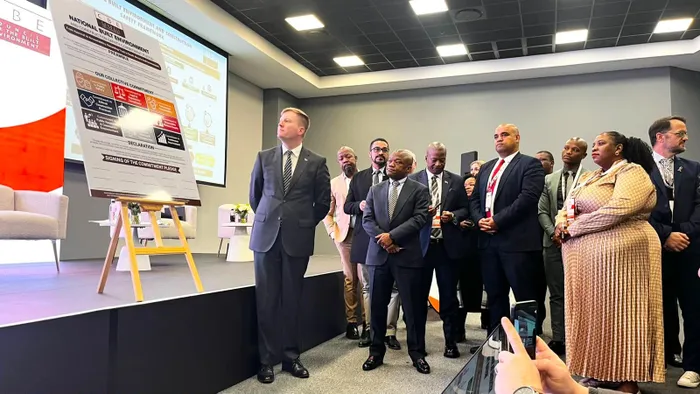
Public Works and Infrastructure Minister Dean Macpherson launches a national construction safety framework aimed at preventing building collapses and strengthening accountability across South Africa’s built environment sector.
Image: Supplied
Public Works and Infrastructure Minister Dean Macpherson has launched the National Built Environment and Construction Safety Framework, warning that South Africa must urgently strengthen building safety and accountability in response to repeated structural collapses.
Macpherson launched the framework at the second Public Works and Infrastructure Summit hosted by the Council for the Built Environment at The Focus Room in Modderfontein, Johannesburg, on Friday, saying it was aimed at preventing future building collapses and restoring confidence in the country’s infrastructure system.
He said recent tragedies had exposed serious weaknesses in construction oversight, regulatory enforcement and professional accountability.
“We meet today after a number of building collapses that have shaken South Africa and forced difficult questions about construction quality, regulatory oversight, professional accountability, enforcement and state capability,” Macpherson said.
He pointed to the George building collapse, which claimed 34 lives, as one of the most devastating incidents in recent years.
“The George building collapse remains one of the most painful construction disasters in South Africa’s recent history,” he said.
Macpherson said investigations into the Redcliffe and Ormonde building collapses had been completed, adding that their findings would soon be released and must lead to consequences.
“When they are released, they must not become reports without force and effect. They must become instruments of accountability and reform,” he said.
He stressed that accountability must extend across the construction value chain.
“No one should be above the law. Not an engineer. Not a developer. Not an official,” he said.
Macpherson said government was working to fix fragmented regulatory responsibilities across municipalities, national departments and professional bodies, which he said had created gaps in enforcement.
“We need stronger intergovernmental cooperation, clearer lines of accountability, better enforcement capacity, and professional sign-offs that are treated as solemn responsibilities, not box-ticking exercises,” he said.
As part of the reforms, Macpherson announced that the Ministry would gazette Council for the Built Environment Public Interest and Safety Regulations, aimed at strengthening compliance, improving building control and introducing clearer certification standards aligned with SANS 17024.
He also launched the Public Infrastructure Confidence Index, which will measure stakeholder confidence in the performance and credibility of South Africa’s infrastructure system.
Macpherson said the index would help government track progress and move infrastructure planning from perception to evidence.
He said the Department of Public Works and Infrastructure must shift towards becoming an economic delivery unit focused on turning plans into completed projects.
He also highlighted what he described as a rapid infrastructure intervention at the Beitbridge Border Post, where a repatriation centre was constructed within 96 hours.
“What we saw there was impressive. Within 96 hours, officials from the Department of Public Works and Infrastructure had built it,” he said.
Macpherson said the example demonstrated what was possible when urgency and capability were aligned within the state.
He added that partnerships between government, the private sector, regulators and professionals were essential to improving infrastructure delivery.
“Partnerships are not a courtesy in this work – they are central to whether we succeed,” he said.
Macpherson said the success of the summit would ultimately be measured by action, not discussion.
“It will be measured by what happens after we leave this room,” he said.
Macpherson called for a shift from crisis to delivery in the country’s infrastructure system.
“Let us use today to move from collapse to confidence, from disaster to excellence, from neglect to maintenance, and from plans to projects. Together, let us build South Africa,” he said.
IOL News