

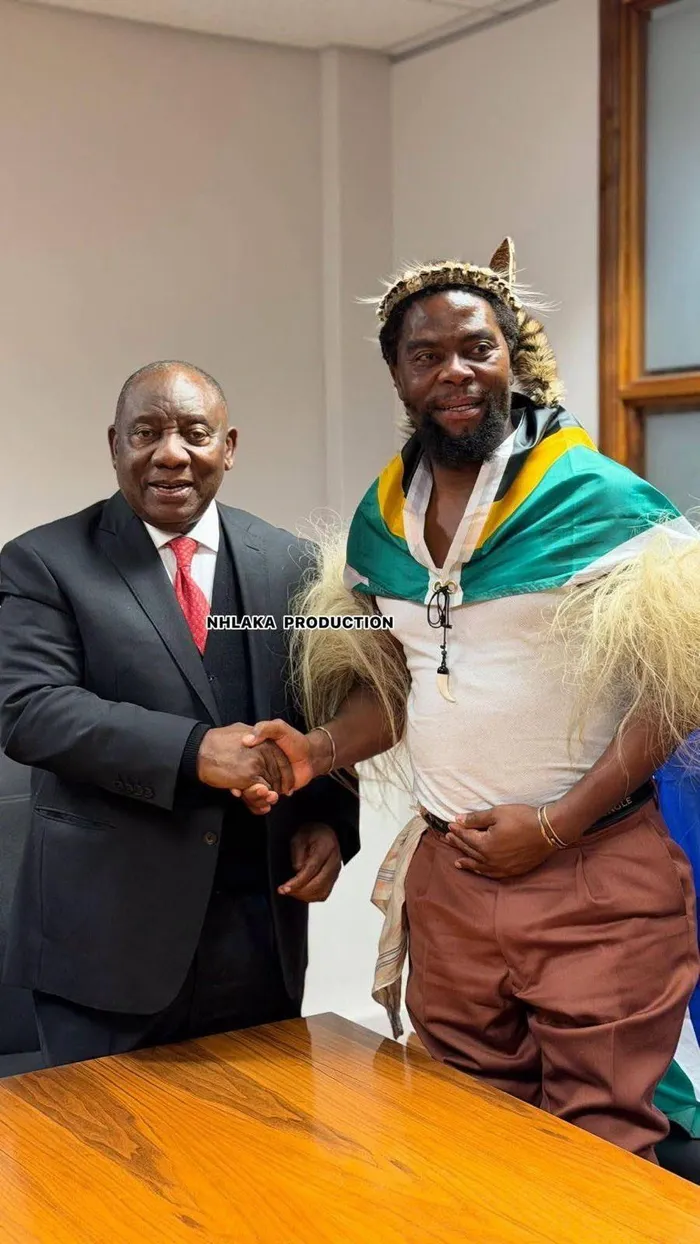
President Cyril Ramaphosa met with two of the country's most prominent anti-immigration activists, Nkosikhona Ndabandaba and Ngizwe Mchunu.
Image: Facebook
The Cabinet has reaffirmed the government's tougher stance on undocumented migration, announcing intensified border security, labour inspections, and deportation measures, while also approving a raft of policies aimed at strengthening energy security, environmental enforcement, and state-owned enterprise governance.
Briefing the media following Wednesday's Cabinet meeting, Minister in the Presidency Khumbudzo Ntshavheni said the Cabinet had received a progress report on the implementation of the government's five-pillar Comprehensive Approach to Managing Migration, which was announced by President Cyril Ramaphosa earlier this year.
On Friday, Ntshavheni said the Cabinet had welcomed the largely peaceful demonstrations and commended the National Joint Operational and Intelligence Structure (NATJOINTS) for maintaining law and order.
"Cabinet extended its appreciation to South Africans who participated in peaceful protests against unregulated migration and commended NATJOINTS for ensuring peaceful protests."
She said the government had expanded labour inspections at companies suspected of employing undocumented foreign nationals, reopened specialised immigration courts in Durban, at OR Tambo International Airport, and at the Lindela Repatriation Centre to speed up deportations, and continued intercepting undocumented migrants through the Border Management Authority.
The Cabinet also confirmed that the government is shifting its attention towards strengthening border infrastructure, with members of the Inter-Ministerial Committee inspecting the Beitbridge border with Zimbabwe on Thursday.
"We will use a combination of infrastructure upgrades and technology so that those who think they will leave our country and come back illegally again will not have the opportunity to do so," Ntshavheni said.
Responding to questions on the repatriation of Malawian nationals, Ntshavheni stressed that South Africa was assisting neighbouring countries that had requested support rather than initiating repatriations itself, adding that processing delays were largely due to the limited capacity of the Malawian High Commission to issue emergency travel documents.
She also warned communities against taking immigration enforcement into their own hands.
"You have no law enforcement responsibility. You cannot continue to go door to door asking for proof of identification of foreign nationals in the country... The government is firmly in charge of the process."
Beyond migration, the Cabinet approved the publication of a draft Strategic Petroleum Stocks Policy for public comment, proposing strategic fuel reserves equivalent to 60 days of South Africa's net petroleum imports, with plans to increase this to 90 days over time to improve energy security against global supply disruptions.
The Cabinet also approved the publication of the National Environmental Management Laws Amendment Bill, which seeks to strengthen environmental compliance by giving inspectors greater enforcement powers and introducing administrative penalties for less serious environmental offences.
Among other decisions, the Cabinet approved South Africa's submission of the Southern African Development Community Protocol on Industry and the United Nations High Seas Treaty to Parliament for ratification, saying both agreements would strengthen regional industrial development and international marine conservation.
Ntshavheni said the Cabinet had also received updates on state-owned enterprise reforms and the implementation of recommendations arising from the State Capture Commission.
According to the Cabinet, 62% of the commission's recommended actions have been completed or substantially completed, including the recovery of about R17.1 billion in assets linked to state capture and the successful prosecution of six criminal matters.
The Cabinet further reaffirmed government's commitment to inclusive education for children and young people with disabilities, endorsing recommendations to strengthen education support services and introduce compulsory inclusive education training for future teachers.