

Cabinet has approved key reforms including a strategic petroleum policy and migration crackdown measures, as South Africa also recorded gains in global competitiveness rankings and infrastructure investment initiatives
Image: GCIS
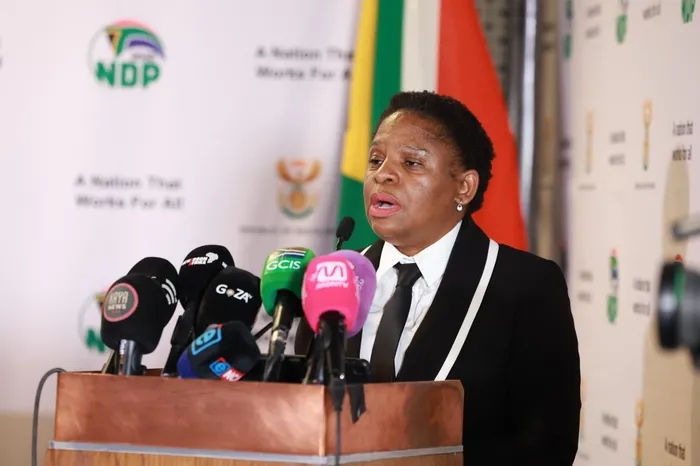
Minister in the Presidency Khumbudzo Ntshavheni says Cabinet has backed a tougher approach to managing migration following the June 30 anti-illegal immigration protests, while praising the peaceful conduct of demonstrations and security operations.
Briefing the media on Friday following Wednesday’s Cabinet meeting, Ntshavheni said government had taken note of the demonstrations and commended both participants and security agencies for ensuring stability during the protests.
“Cabinet extended its appreciation to South Africans who participated in peaceful protests against unregulated migration and commended the National Joint Operations and Intelligence Structures (NAtJOINTS) for enforcing peaceful protests on 30 June 2026,” she said.
Ntshavheni said Cabinet had also welcomed progress made by the Inter-Ministerial Committee on Migration, chaired by Justice and Constitutional Development Minister Mmamoloko Kubayi, which is implementing the comprehensive migration strategy announced by President Cyril Ramaphosa earlier this month.
She said the plan was already showing results across its five pillars, particularly in law enforcement and border management, where government has intensified inspections, deportations and surveillance operations targeting undocumented migration.
Under the law enforcement pillar, Ntshavheni said labour inspections had been stepped up at companies suspected of employing undocumented foreign nationals, coordinated by Deputy Minister of Employment and Labour Jomo Sibiya, Deputy Minister of Home Affairs Njabulo Nzuza and Deputy Minister of Police Polly Boshielo.
She said government had also strengthened deportation systems through the re-establishment of specialised immigration courts in Durban, OR Tambo International Airport and the Lindela Repatriation Centre in Krugersdorp, aimed at ensuring “orderly and lawful deportations”.
Cabinet also welcomed the establishment of a temporary repatriation centre in Musina to support coordinated returns by countries of origin, with Ntshavheni noting that humanitarian organisations were playing a key supporting role.
“In this regard, Cabinet extended its appreciation to non-profit organisations such as the Gift of the Givers, Ashraful Aid and the Mahlasela Foundation,” she said.
Ntshavheni said the Border Management Authority had, since June 7, intensified enforcement operations resulting in increased interceptions of undocumented migrants, while also turning away individuals with invalid or non-compliant documentation at ports of entry.
She added that NATJOINTS had briefed Cabinet on criminal cases linked to the June 30 protests, including arrests, investigations and matters now before the courts.
Government, she said, was also tightening border infrastructure, with members of the Inter-Ministerial Committee conducting an inspection-in-loco at the Limpopo–Zimbabwe border on Thursday to assess planned upgrades aimed at strengthening long-term border control.
Beyond migration, Ntshavheni said Cabinet had also reviewed South Africa’s economic performance, welcoming the country’s improvement in the 2026 World Competitiveness Yearbook, where it climbed from 64th to 54th place.
She said the improvement reflected gains in government efficiency, business confidence and infrastructure delivery.
“The improved ranking is boosted by progress in government efficiency, growing business confidence and enhanced infrastructure management, underscoring the impact of ongoing reforms to strengthen economic performance and governance,” she said.
Cabinet also welcomed the outcomes of the South Africa Infrastructure Summit held in Johannesburg earlier this month, which focused on accelerating infrastructure development through public-private partnerships and improved coordination across transport, water and digital infrastructure.
Ntshavheni said these efforts formed part of government’s broader infrastructure-led growth strategy, supported by more than R1 trillion in planned public investment over the medium term.
In the energy sector, she said Cabinet had approved the publication of the draft Strategic Petroleum Stocks Policy for public comment, describing it as a key step in strengthening national energy security.
Ntshavheni said the policy was informed by a 2024 study into South Africa’s fuel reserve vulnerabilities and proposes a mixed stockholding model to improve resilience against global supply disruptions.
She said the South African National Petroleum Company would be required to maintain strategic fuel reserves equivalent to 60 days of net imports of crude oil and refined products, with a phased increase to 90 days over the long term.
“The policy will contribute to safeguarding national energy security, improving resilience against global supply shocks and supporting sustainable economic growth,” she said.
Cabinet also noted developments in regional and international cooperation, including outcomes of the 9th Southern African Customs Union (SACU) Summit, where member states reaffirmed their commitment to deeper regional integration under the “Re-Imagined SACU” framework.
Ntshavheni said the bloc remained central to advancing industrialisation, trade expansion and economic diversification across Southern Africa.
She also highlighted Deputy President Paul Mashatile’s recent visit to China, where discussions with Vice-President Han Zheng and participation in the China International Supply Chain Expo strengthened economic ties and investment cooperation.
Ntshavheni said Cabinet had approved the publication of the National Environmental Management Laws Amendment Bill, which strengthens environmental enforcement powers, and the Electronic Deeds Registration and Recordal Systems Amendment Bill, aimed at modernising land administration and securing property rights.
Cabinet also approved the release of the Science, Technology and Innovation Funding Report, which calls for increased domestic funding of research to reduce reliance on foreign sources.
It further approved the submission of the SADC Protocol on Industry and the High Seas Treaty to Parliament for ratification, both aimed at strengthening regional industrialisation and global environmental governance.
Ntshavheni said Cabinet also received updates on state-owned enterprise reforms, including the proposed National State Enterprise Bill, which seeks to centralise and strengthen governance across public entities.
She said progress was also being made in implementing Truth and Reconciliation Commission recommendations, with more than 17,400 beneficiaries having received R30,000 in reparations.
Ntshavheni also said Cabinet noted updates on the National Intelligence Estimates and priorities, including strengthened labour inspections, regulation of informal trade, and focus on energy and food security.
She said government remained committed to ensuring stability, enforcement of the law and protection of national interests.
Cabinet also encouraged South Africans to participate in Mandela Month activities in July under the theme: “It’s still in our hands to combat poverty and inequity”, and marked National Science Month as part of efforts to promote science, technology and innovation.
IOL News