

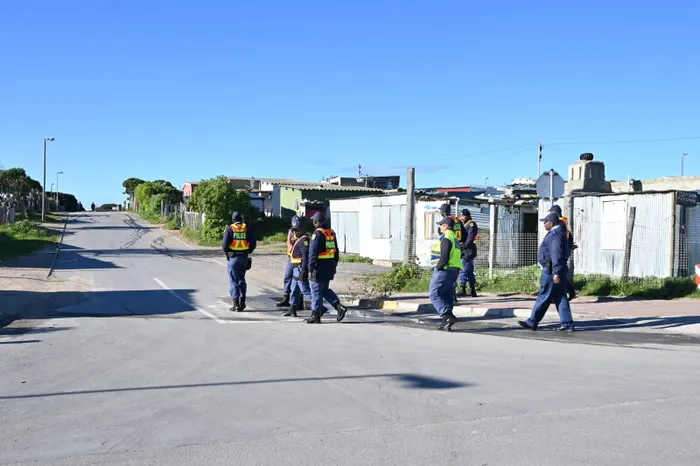
There was little sign of trouble in Gaansbaai on Tuesday morning as police conducted foot patrols.
Image: Bheki Radebe
There was little sign of trouble in Gansbaai on Tuesday as police conducted foot patrols through the town.
But the foreign nationals who had lived and traded in the township were no longer there.
Residents said they had driven them all out.
Barber shops and spaza shops once run by foreign nationals stood shuttered, and residents said none remained in the township.
Those still in Gansbaai, they said, were sheltering in the town's coloured neighbourhoods.
Gansbaai is a coastal fishing and tourism town in the Overberg region of the Western Cape.
It was officially flagged as a high-risk protest hotspot for the nationwide anti-immigration marches.
But it was business as usual.
At one house, music blared from a car parked in the driveway, where the residents said they were celebrating the removal of the foreign nationals.
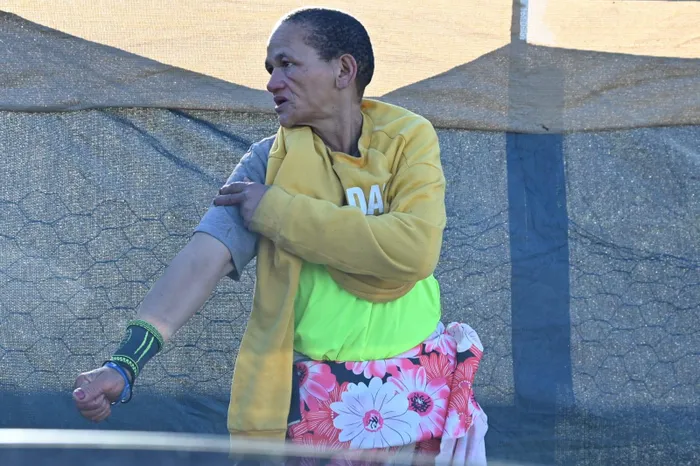
Sarah Plaatjies, 53, of the Masakhane township in Gansbaai, said she was attacked last month by a group of foreign nationals, who she said struck her with knobkieries and set their Jack Russell on her.
Image: BHEKI RADEBE
Among those glad to see them go was Sarah Plaatjies, a 53-year-old resident of the Masakhane township.
She said a group of foreign nationals had attacked her with knobkieries and set their dog, a Jack Russell, on her.
She said she had since taken to carrying a wrench to fight back.
"The dogs bit me — they set the dog loose on me," Plaatjies said, speaking in Afrikaans.
"I was almost torn apart by the dog.
"They bruised my arms black and blue and nearly tore me apart.
"They hurt me, very badly."I am so glad they are gone.
"Our police must take lessons from the police in Pretoria."
The calm belied the violence that had swept the Overberg in early June.
About 1,500 people from the Masakhane informal settlement marched on the community then, and more than 200 foreign nationals, mainly Malawians and Mozambicans, fled their homes.
Some sheltered in community halls, while others hid in the dunes and mountains overnight.
Hundreds more were displaced in nearby Kleinmond, and buses were laid on to take undocumented foreign nationals to the Lindela repatriation centre.
During IOL's visit to Kleinmond on Tuesday morning, it was also quiet.
About 150 people were moved from Gansbaai to the Stanford community hall, where authorities said most of those sheltering across the Overberg were undocumented.
In Hermanus, 38 displaced people were housed on a municipal farm, and a bus sent by the Mozambican embassy collected those who wanted to go home.
In Mossel Bay, along the Garden Route, the violence was worse, with about 55 shacks torched.
The Mozambican government said five of its citizens had been killed there.
The unrest formed part of a nationwide anti-immigration campaign led by the movement March and March, which set June 30 as the deadline for all undocumented foreigners to leave the country.
Overstrand mayor Archie Klaas said residents of Zwelihle, in Hermanus, would not take part in Tuesday's planned march.
The Western Cape government condemned the violence and intimidation directed at foreign nationals, and said the situation in the Overberg had stabilised.
Nationally, the National Joint Operational and Intelligence Structure said more than 25,000 foreign nationals had been repatriated, and that it had recorded at least 103 cases of anti-immigrant violence and made 195 arrests since March 1.
President Cyril Ramaphosa called for calm and said only state authorities could enforce immigration laws, and that vigilantism would not be tolerated.
IOL News