

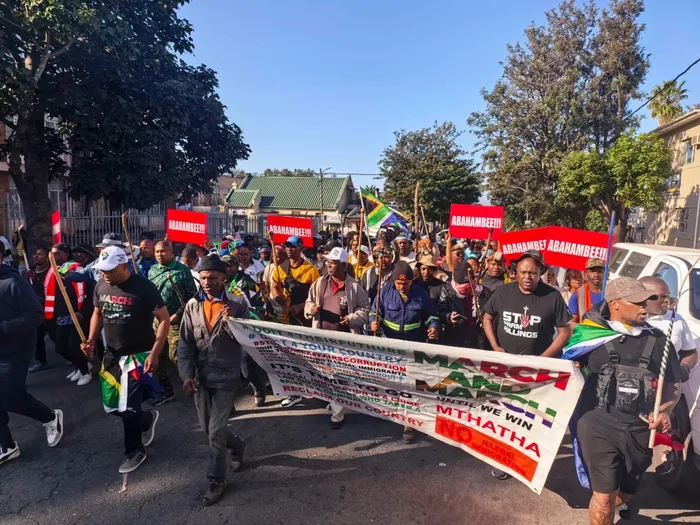
Security has been tightened ahead of planned June 30 demonstrations as government urges South Africans to respect the rule of law.
Image: Pedro Mapelo / I'solezwe lesiXhosa
As South Africa prepares for planned anti-illegal immigration protests on June 30, the government has stepped up security measures while appealing for calm and warning that the rule of law will be enforced.
The demonstrations, organised by anti-illegal immigration groups including March and March, follow weeks of mobilisation around a self-imposed deadline for undocumented foreign nationals to leave the country.
Although organisers have described the campaign as a demand for stricter immigration enforcement, government, political analysts and civil society organisations have warned that the rhetoric surrounding the protests has already heightened fear, intimidation and displacement among migrant communities, including refugees, asylum seekers and documented foreign nationals.
March and March leader Jacinta Ngobese-Zuma had not responded to questions by the time of publication regarding expected protest hotspots, security arrangements, the movement's stance against violence and whether demonstrations would continue beyond June 30.
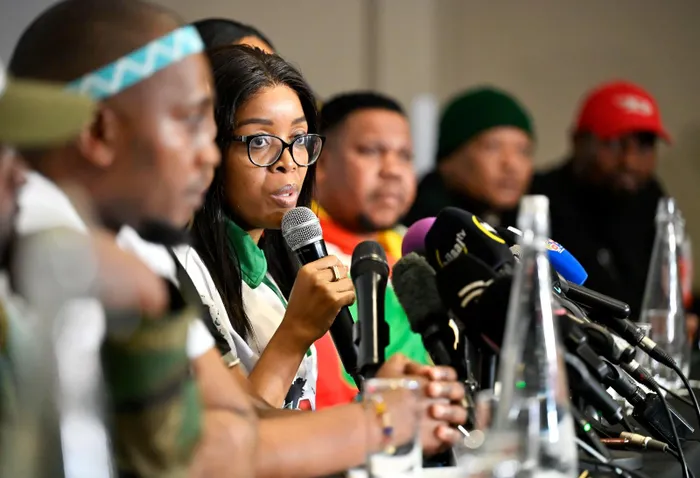
March and March leader Jacinta Ngobese-Zuma addresses the media recently during a briefing ahead of the planned June 30 demonstrations over illegal immigration.
Image: Itumeleng English / ANA Studio
However, speaking during a media briefing in Gauteng earlier this week, representatives of March and March and affiliated organisations reportedly maintained that Monday's demonstrations would remain peaceful.
Ngobese-Zuma was quoted in media reports as saying there would be no violence, killings or looting during the protests. The organisations also reiterated that their campaign was aimed at illegal immigration rather than foreign nationals generally.
The movement and its allies reportedly said they would proceed with the demonstrations while maintaining that responsibility for maintaining public order rests with the government. Media reports indicated that police and private security structures had identified Gauteng, KwaZulu-Natal, the Western Cape and the Eastern Cape as potential flashpoints.
Government has repeatedly stressed that June 30 is not a national shutdown and that normal business should continue. It has also warned that private individuals and groups have no authority to demand documentation from members of the public, block access to schools, clinics, hospitals or businesses, or determine who may live in particular communities.
Addressing a police parade before deployments, Acting Police Minister Firoz Cachalia said everyone in South Africa, whether citizens, refugees, asylum seekers, documented or undocumented foreign nationals, was entitled to constitutional protection.
"There will be no tolerance for vigilantism, no tolerance for xenophobic or any type of violence, no tolerance for intimidation, and no tolerance for anyone, no matter who they are, who thinks they can decide who may or may not live in our communities," Cachalia said.
He said police deployments were intended not only to respond to violence but also to prevent it through visible policing, intelligence-led operations, early intervention and action against those inciting violence or issuing threats online.
Cachalia also met representatives of the private security industry on June 24 to strengthen cooperation between public and private security structures. The discussions focused on information-sharing, coordinated planning and pooling resources to reduce risks ahead of the protests.
Government has also engaged organised business. According to an official statement, President Cyril Ramaphosa met business leaders on June 24, while Acting National Commissioner of Police Lieutenant-General Puleng Dimpane held discussions with SANTACO and leaders from the private security industry.
In KwaZulu-Natal, Premier Thami Ntuli cautioned community safety structures against allowing a repeat of the July 2021 unrest, saying many businesses had never recovered and thousands of jobs had been lost.
"If violence erupts and property is destroyed, it is us, our children, and our families who will suffer the consequences," Ntuli said.
Border Management Authority spokesperson Mmemme Mogotsi referred questions about repatriation figures and border preparedness to the government's latest migration management statement.
According to that statement, 15,162 Malawian nationals had been processed for deportation and repatriation by the close of business on June 25, while additional individuals were still undergoing verification at temporary repatriation centres across the country.
Government said Malawi, Ghana, Nigeria, Mozambique and Zimbabwe had offered to facilitate the voluntary repatriation of their nationals, with Kenya and the Democratic Republic of Congo the latest countries to submit requests.
It added that conditions involving Malawian nationals in Sherwood, Che Guevara, Durban Drive-In and eMsunduzi in KwaZulu-Natal had become untenable because of the large numbers involved and the resulting humanitarian emergency.
The jurisdiction of the Musina Refugee Reception Office in Limpopo has been expanded to assist with verification processes, while a temporary repatriation processing centre has been established outside Musina. Government said the facility would speed up processing, improve movement through the Beitbridge border post and reduce reliance on Lindela.
The BMA, working alongside the SAPS, SANDF and other law enforcement agencies, has maintained heightened security at land, air and sea ports of entry. Static checkpoints and roadblocks also remain in place along major routes leading to critical ports, including Beitbridge.
Government reported that by June 21, authorities had opened 89 criminal cases linked to public order incidents and incitement, up from 53 the previous week. A total of 164 people had been arrested on charges including incitement to violence, contravening the Regulation of Gatherings Act and related offences.
Political analyst Dr Ayabulela Dlakavu, a senior lecturer at the Wits School of Governance, said South Africa's current climate reflected a broader international rise in anti-immigration politics.
"There has been an anti-immigration movement worldwide since right-wing political parties and politicians gained popularity, some even winning power," he said.
Dlakavu said hostility towards migrants was often driven by economic insecurity, competition for limited resources and perceptions of scarcity.
"At the heart of anti-immigration and migration is the scarcity of resources and economic opportunities. Realists in political thought have coined a phrase: 'inhumanity is humanity under pressure'."
He said South Africa already had laws regulating work permits, study visas and travel, but weaknesses in implementation remained a significant challenge.
"Perhaps implementation is where the weaknesses are: porous borders caused by corrupt border control processes where undocumented migrants go in and out of the country, some including criminal syndicates responsible for drug and human trafficking, hijackings, etc," he said.
Civil society organisations have also criticised government's handling of the situation. The Siyafana Sonke Action Campaign, a coalition representing more than 160 civil society organisations, trade unions, civic groups and social justice activists, met government this week to raise concerns over what it described as escalating xenophobic violence, forced removals, displacement and intimidation.
Labour federations including Fedusa, Saftu and Cosatu also joined the "Defend Democracy. Reject the Shutdown" online rally on Saturday.
The rally was organised in response to concerns surrounding the planned demonstrations and called for constitutionalism, respect for the rule of law and practical solutions to unemployment, crime, corruption and service delivery failures.
IOL News