

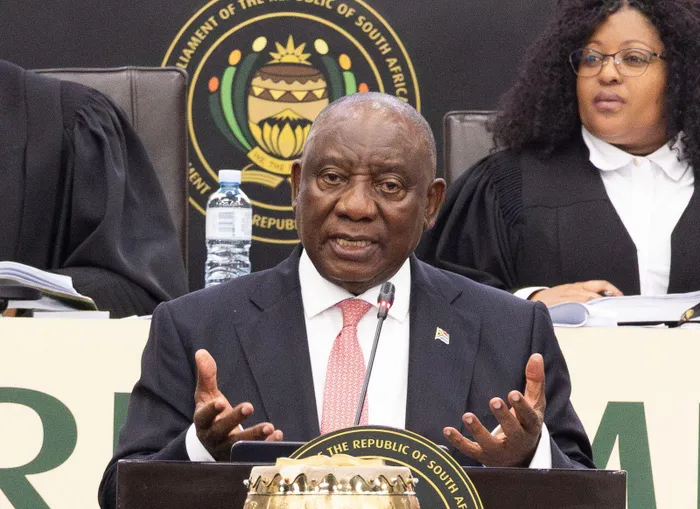
As President Cyril Ramaphosa heads to court to review the Independent Panel's report, Parliament is set to have its first Impeachment Committee meeting on Monday.
Image: GCIS
The uMkhonto weSizwe Party (MK Party), the United Africans Transformation (UAT) and the Economic Freedom Fighters (EFF) have argued that the urgency of President Cyril Ramaphosa’s interdict application is self-created and that his appeal will stand the test of scrutiny.
On Monday, Parliament’s Impeachment Committee filed their papers as the second respondent in the case opposing Ramaphosa’s interdict bid, stating that it could not only delay the committee for years.
Parties voiced their frustration after it emerged that National Assembly Speaker Thoko Didiza would not oppose Ramaphosa’s interdict.
Ramaphosa, who filed papers in the Western Cape High Court two weeks ago, is seeking to have the committee barred from commencing the impeachment inquiry pending the decision on his review application regarding the Independent Panel report.
Ramaphosa’s papers said a case management meeting was held on June 4, 2026, to establish a timeline for the review of the independent panel's report. He explained that he wants the committee’s proceedings to be delayed until after his review application is heard in September.
Several political parties, some of which are on the committee, are participating in the matter in their individual capacities after being cited by the president as respondents.
In their opposing court papers, EFF leader Julius Malema said that upon analysis of Ramaphosa’s interdict, it is clear that he was only ever concerned about the implications of the report, “rather than its alleged unlawfulness”.
Malema maintains that the interdict, being premised on Ramaphosa’s review application, violates three principles.
“Firstly, our courts do not readily halt an internal process of another Organ of State, certainly not for reputational purposes. Secondly, our courts generally do not engage internal investigation processes. Instead, that very process, in this case the impeachment enquiry, is the correct platform for a person to vindicate themselves. This is worse, considering that the report has been in the public domain for almost four years.
“Third, our courts do not engage cases premised on speculation. The president speculates that witnesses called by the committee will defame him,” Malema said. “Despite the speculation, his immediate problem is that some of them have already done so, as contained in the report.
“The only way to vindicate the president is the committee testing the veracity of the statements contained in the report and inviting him to respond.”
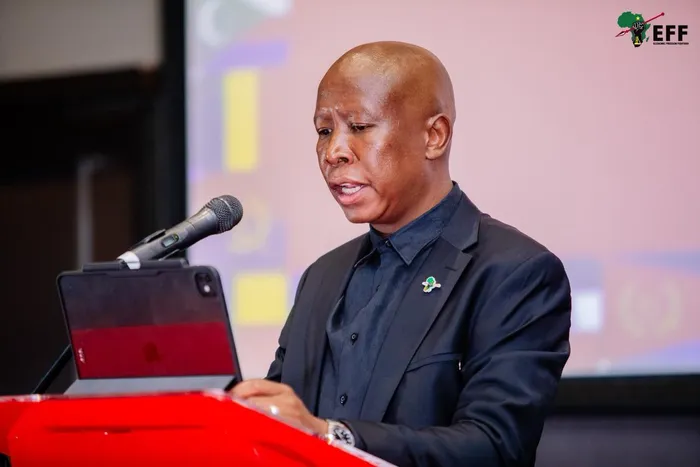
EFF president Julius Malema says criticism of foreign nationals owning spaza shops distracts from the real economic struggle over control of strategic sectors, including South Africa’s mining industry.
Image: EFF / X
Malema said that the panel’s role was a preliminary sifting function to decide whether sufficient evidence exists to disclose a prima facie case. He said that this undercuts the president’s argument that the panel misconstrued its mandate.
Malema contends “that the president has not made out a case for urgency” and that Ramaphosa has been “unreasonably delayed in bringing this application, which amounts to self-created urgency”.
“The president has not made out a proper case that he will not obtain substantial redress if this matter is not heard urgently, nor could he. Curiously, he affords urgency averments only three-quarters of a single page. That perhaps explains the inadequacy of setting out the requisite timeframes in justifying the time taken, so as to show the urgency is not self-created.
“The president is not concerned so much with defamatory material borne of the panel report and the impeachment process. He is rather concerned about being held accountable.
“Had he been concerned about defamatory statements about him relating to the Phala Phala scandal, he would not have abandoned the review application simply because the National Assembly voted against the adoption of that report,” Malema said.
“This application amounts to an abuse of process as this court does not have the power to halt a parliamentary process sanctioned by an order of the Constitutional Court.”
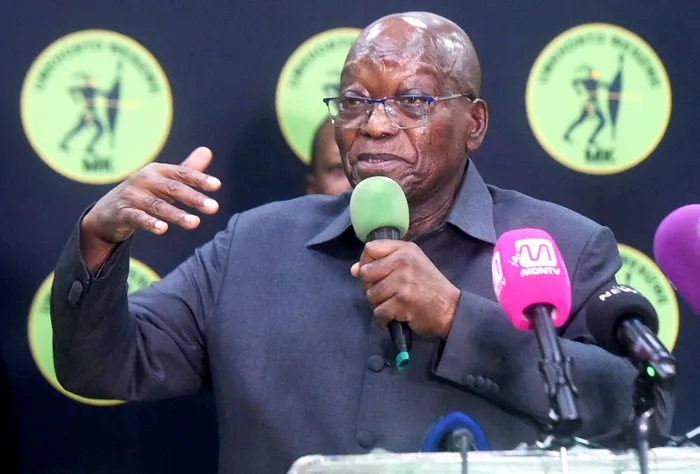
uMkhonto we Sizwe Party president Jacob Zuma
Image: Picture: Itumeleng English/ Independent Newspapers
MK Party president Jacob Zuma deposed his affidavit on behalf of the party, and the United Africans Transformation (UAT), in which they said that the “sole purpose of the litigation is therefore to annoy, harass, intimidate in bad faith”.
Zuma also said that Ramaphosa’s review application “stands to be rejected simply because it confuses review and appeal”.
“A mere error of law can sustain an appeal but not a review. For an error of law to be reviewable, it must first pass the threshold of materiality, which has not been alleged in the present application. Finally, it seems obvious that it is the applicant who is not misunderstanding but deliberately misrepresenting what the mandate of the panel was.
“The panel merely represents a preliminary step or sifting mechanism. It is not intended to produce an objective assessment of all the elements of the alleged offences and pronounce a verdict.”
The Impeachment Committee will meet on Wednesday to consider its draft terms of reference and the process of appointing evidence leaders.