

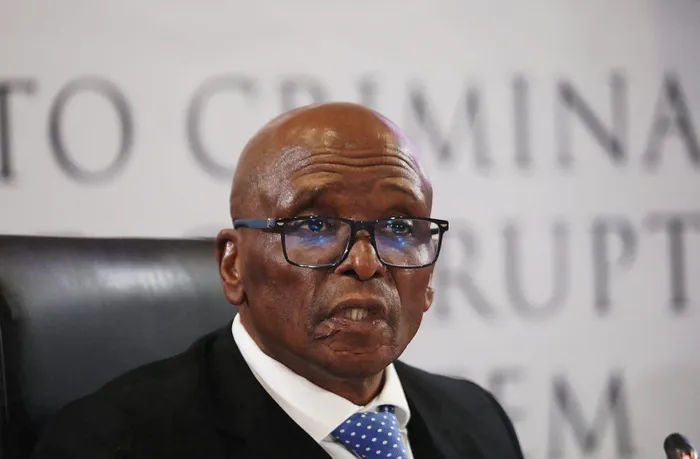
Brigadier Campbell Nyuswa, provincial commander of the Serious Organised Crime Investigation Unit in KwaZulu-Natal, this week apologised for the November 2021 theft of 541kg of suspected cocaine with a street value of R200 million at the Hawks’ Port Shepstone storage facility.
Image: Timothy Bernard / Independent Newspapers
The Madlanga Judicial Commission of Inquiry continued hearing evidence of the still unresolved theft of 541kg of suspected cocaine with a street value of about R200 million from a Hawks storage facility in Port Shepstone, KwaZulu-Natal.
The commission, chaired by retired Constitutional Court Justice Mbuyiseli Madlanga, publicly heard the testimony of three witnesses – Brigadier Campbell Nyuswa, the provincial commander of the Hawks’ Serious Organised Crime Investigation Unit in KwaZulu-Natal, his boss, suspended Hawks provincial head Major-General Lesetja, and an anonymous police officer, only identified as “Witness J”, who gave evidence on the seizure of 715kg of cocaine in Aeroton, Johannesburg in July 2021.
“Witness J”, a Hawks analyst, gave evidence in-camera due to its sensitivity, which the commission decided was likely to expose his life and his family’s lives to danger.
The commission made the ruling after the witness indicated that his testimony included that businessman Tumelo Nku played an active role in tipping off suspended Gauteng Traffic Police’s chief inspector Samuel Mashaba about the transportation of high-value cocaine with a street value of R300 million from the Durban Harbour to Aeroton.
According to “Witness J”, he also wanted an in-camera hearing to protect investigative leads, ongoing investigation concerns, and protect investigative methods.
Nku had also been scheduled to testify on Thursday, but his evidence was postponed to a date still to be agreed.
Justice Madlanga undertook to make the transcript of the in-camera proceedings by no later than Monday, June 22.
“The transcript must be redacted to protect the identity of ‘Witness J’ and the integrity of ongoing investigations,” the commission chairperson ruled.
In his evidence, Nyuswa told the commission that he apologised for the bungling that occurred during the June 2021 drug bust and senior police officers’ failures to ensure that the suspected cocaine was safely stored.
“I cannot change what has happened. The only thing I can say, I am sorry to you and the nation,” he responded to a question by Commissioner, Advocate Sandile Khumalo SC.
Khumalo had asked Nyuswa about the failure to enquire with the other police stations, especially in Durban, whether they had storage capacity, and his arrival with Senona in Port Shepstone, where they could see that police prescripts on handling suspected drugs were being violated.
“You allow this culture where people do not comply with the prescripts, and for five years, you do nothing about it, and people continue doing the same thing over and over again. And it creates this culture where prescripts are just there on paper. Nobody complies with them, and people do as they please,” Khumalo said.
Senona testified that he kept the keys to the storage facility because Nyuswa did not have a safe. “I kept the keys for the sake of safety,” he said, adding that the decisions he took were bona fide (in good faith) and not mala fide (in bad faith).
Senona also told the commission he informed Brigadier Naicker from head office in Tshwane that he was uncomfortable with the suspected cocaine being stored in his office, as the security in his office was not up to standard.
Meanwhile, President Cyril Ramaphosa also amended the commission’s terms of reference, providing not only for Justice Madlanga to direct any person to submit an affidavit or an affirmed declaration, to appear before the commission to give evidence, or to produce any document in that person’s possession or under that person’s control that bears on the matter under investigation, but also for that person to be examined by the chairperson or an evidence leader.
In terms of the amended terms of reference, any official of the commission duly authorised by the chairperson in writing may now direct any person to submit an affidavit or affirmed declaration or to appear to give evidence or produce any document in his or her possession or under his or her control which has a bearing on the matter being investigated, and such person may be examined by the chairperson or other members of the commission or an evidence leader.
Ramaphosa has also given the commission a 60-day period as a winding down phase after it has submitted its final report.
The commission has August 31 to submit its final report at the completion of the inquiry.
Its amended terms of reference now stipulate that the winding down phase will be to facilitate the referral of matters arising from its findings to the appropriate law enforcement agencies or relevant State institutions.
In addition, the winding down phase is to ensure the proper handing over of all records, evidence, and documentation to such authorities or institutions and undertake any other administrative tasks, as the commission may deem necessary for the effective and orderly closure of its operations.
Another development this week was Justice Madlanga providing his reasons for dismissing alleged ANC fixer Brown Mogotsi’s bid to have Chief Evidence Leader Advocate Matthew Chaskalson SC recuse himself from leading his evidence.
Justice Madlanga described last month’s unsuccessful attempt by Mogotsi to have a different evidence leader leading him in his testimony as a “hopeless case” and “deliberate presentation of a misleading record”.