

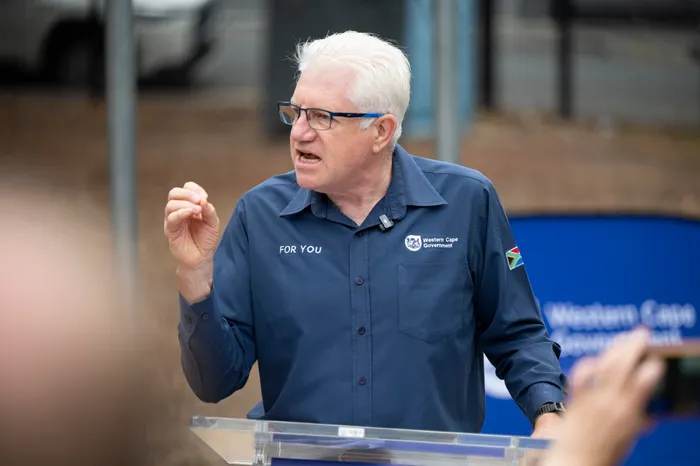
Western Cape Premier Alan Winde outlined the province's recovery strategy after storms caused over R9 billion in damage.
Image: Armand Hough/Independent Newspapers
The Western Cape Government says it is moving from emergency disaster response to long-term recovery efforts after the recent severe weather events that battered the province, leaving a damage bill of more than R9 billion and widespread destruction to roads, bridges, electricity networks and public infrastructure.
Addressing a media briefing on Thursday, Western Cape Premier Alan Winde said authorities had made progress in restoring access to affected communities, but warned that rebuilding efforts would take considerable time and funding.
"In an extreme weather event like this, our immediate reactions are always about saving lives. We have now turned our attention to the recovery efforts," Winde said.
He noted that coordinated interventions involving all spheres of government, municipalities, emergency services and other partners had resulted in about 70% of previously closed roads being reopened in some form.
"Through these coordinated interventions, about 70% of the roads that were closed have since been reopened in some form, restoring vital connectivity for residents, businesses and emergency services," he said.
Despite the progress, major challenges remain, particularly regarding damaged transport infrastructure.
Western Cape Infrastructure Minister Tertuis Simmers said many roads and bridges had suffered extensive damage.
"Many roads, bridges and related structures have sustained significant damage and will require major repairs or, in some cases, complete reconstruction. These are complex projects that require detailed assessments, engineering investigations and design work before construction can commence," Simmers said.
The provincial government has identified 19 emergency road repair projects across the province, with contractors already deployed and work underway at several priority sites.
To fund urgent repairs, Provincial Finance Minister Deidré Baartman announced that the provincial government plans to reserve R100 million from its Unforeseen and Unavoidable Reserve during the current financial year.
"The Western Cape Government made provisions for disasters in its 2026 Budget by allocating funding to its Unforeseen and Unavoidable Reserve," Baartman said.
She added that departments had been allowed to reprioritise spending and use emergency procurement mechanisms to speed up disaster response and infrastructure repairs.
Baartman also criticised the country's current disaster funding framework, saying the province would continue engaging national government on reforms.
"We will continue to engage national government to reform the disaster funding process, as the current system is lengthy and largely retrospective," she said.
Electricity restoration efforts have also shown significant progress. According to the provincial government, 97% of residents who lost power during the storms have now been reconnected, with Eskom continuing restoration work in the remaining affected areas.
Meanwhile, Western Cape Local Government, Environmental Affairs and Development Planning Minister Anton Bredell said the disaster highlighted the growing impact of climate change on the province.
"We cannot ignore the impact of climate change in our province. To recover properly from and avoid disasters in the future, a business-as-usual approach will not work and indeed is likely to erode our development progress," Bredell said.
He stressed the need for adaptive strategies that reduce risks while protecting communities and the economy from future climate-related disasters.
While welcoming the progress made since the storms struck, Winde cautioned that the scale of destruction means recovery will be a lengthy process.
"We are focused on restoring infrastructure as quickly and safely as possible, but the scale of the damage means that recovery will take time," he said.
"Our approach is to prioritise the most critical routes and infrastructure while ensuring that all work is properly planned and executed to build greater resilience against future disasters."
The Premier said the provincial government would continue working closely with municipalities, Eskom and national government to support affected communities.
"While considerable progress has been made, we recognise that many residents continue to face hardship, and we will continue driving recovery efforts with urgency," Winde said.
IOL News