

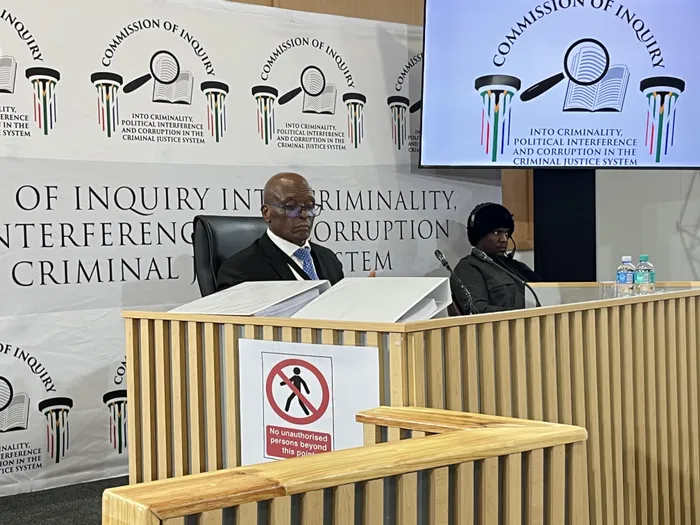
Hawks commander in KZN, Brigadier Campbell Nyuswa, testifies at the Madlanga Commission of Inquiry on Wednesday about the mishandling of 541kg of cocaine bricks worth R200 million.
Image: Kamogelo Moichela / IOL News
Hawks KwaZulu-Natal head Major-General Lesetja Senona knew about security lapses at the Hawks’ Port Shepstone premises where 541kg of cocaine bricks worth R200 million were stolen in November 2021.
This was according to the testimony of KwaZulu-Natal Hawks head for Serious Organised Crime Brigadier Campbell Nyuswa before the Madlanga Commission of Inquiry in Pretoria on Wednesday.
Nyuswa took the stand following recent testimonies indicating he consulted with Senona about moving the drugs seized from Durban Harbour in June 2021 to Port Shepstone, 100km away, allegedly due to storage capacity issues. Senona agreed to the relocation.
This was despite other police stations within a 20km radius, where the exhibits could have been kept.
The drug exhibits were initially booked into the Isipingo police station's SAP13 register and then booked out the same day by Warrant Officer Livingstone Mpangase, who cited the need for further investigation.
The commission heard that burglars gained entry using a grinder and stole the drugs from the Hawks' Port Shepstone strongroom.
Nyuswa told the commission that Senona visited all provincial offices after arriving in KZN in August 2020, and was, therefore, fully aware of the security issues at the Port Shepstone offices.
The commission previously heard that the Port Shepstone offices lacked CCTV cameras and that the alarm failed after load shedding.
Retired Hawks member Lieutenant-Colonel Jakobus Prinsloo recently testified that Senona and Nyuswa were aware of the 2017 order prohibiting the storing of exhibits at the Hawks offices.
Nyuswa conceded failing to secure a police station in Isipingo as a safer alternative for storing the drugs.
He told the commission that Senona knew about the security issues because the Hawks’ supply chain management was procuring upgraded security for Port Shepstone.
He said he was also involved in procuring and enhancing security, and would report the process to Senona.
According to him, Captain Van Niekerk from supply chain management also reported the same to Senona.
He said that before he assumed the position of brigadier in 2020, there were already problems with the security at the premises.
Nyuswa said he could not understand why Senona would claim ignorance of the security situation at the Port Shepstone office.
He dismissed the perception that he was “General Senona’s guy”, saying it was incorrect.
“I suspect it is because we were appointed at the same time to the province. However, I have no dealings with Senona before August 2020. When he was appointed as the provincial head, our relationship was that of senior and junior colleagues. I have never been to his home, and he has never been to mine.”
He testified that while on a week’s leave in late October 2021, he received a call from Lieutenant Colonel Prinsloo informing him of an attempted break-in at the Port Shepstone Hawks premises.
He told the commission that Prinsloo voiced safety concerns about the cocaine exhibits in the strongroom for the first time after the break-in.
He said after the drugs were kept at Port Shepstone offices, the strongroom was locked, and Senona asked that both sets of keys be handed to him.
Nyuswa said, although he was concerned, he thought the drugs would be safe because Senona had the keys and the safe could not be breached without detection.
“At the time, it made sense to me that the provincial head should take the keys because this was a big drug bust, and who better to have ownership and responsibility of the keys than the provincial head, especially if the safe could not be accessed without the keys.”
Nyuswa's testimony continues.