

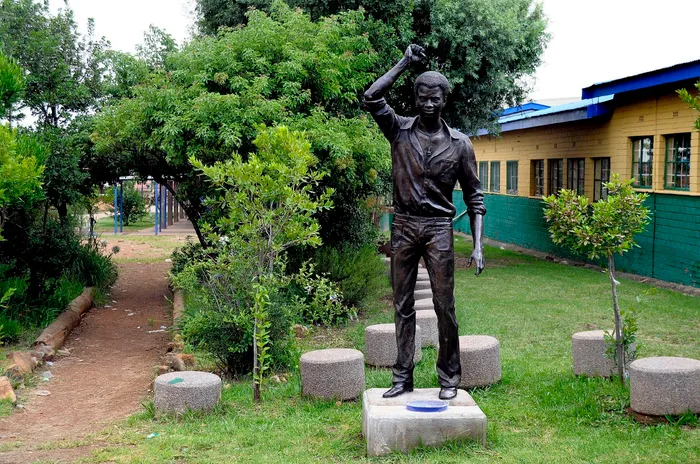
The legacy of Morris Isaacson High School is characterised by its historical contributions to education and leadership. The school remains a true testament to the courage of some of its former students, including Tsietsi Mashinini, who has been immortalised with a statue on the school premises.
Image: Dumisani Dube
Morris Isaacson High School, a cornerstone of education in Central Western Jabavu (CWJ) in Soweto, is not merely an academic institution.
The school, formerly known as Mohloding Secondary School, nurtured some of the most fervent leaders of the June 16 Soweto uprisings in 1976.
The school was named after Morris Isaacson, an Israeli, who donated money to build 10 classrooms.
According to media reports, Isaacson, an immigrant from Lithuania who arrived in South Africa in 1896, after setting up a fund for black students to complete their education to university level, donated enough money for 10 classrooms in the 1950s.
The school, now remembered as the nurturing ground for student leaders such as Tsietsi Mashinini, Murphy Morobe, and Dr Irvin Khoza, among others, also boasted an influential connection to the Black Consciousness Movement (BCM) shortly before the Soweto uprising led by Mashinini and others in 1976.
Born in the same neighbourhood, Mashinini's early life was steeped in community and faith, having been raised as the son of a Methodist preacher. His educational journey began at Morris Isaacson in 1971, where he was inspired by the politically courageous teachings of Abram Onkgopotse Tiro — an educator who had been expelled from university for his activism.
As an English and History teacher, it goes without saying that Tiro’s influence was instrumental in inspiring Mashinini to become a prominent voice against the apartheid regime’s policy of Afrikaans as a medium of instruction. In a crucial gathering on Sunday, June 13, just days before the protests, over 500 Soweto students convened at Orlando Donaldson Community Hall.
United in their resolve, the students engaged in what they believed would be a peaceful protest march to challenge the government's directive that public schools adopt Afrikaans as the medium of instruction, despite the language posing a fundamental challenge for both teachers and students.
Mashinini served as the chairperson of the Action Committee, which was later renamed the Soweto Students Representative Council (SSRC).
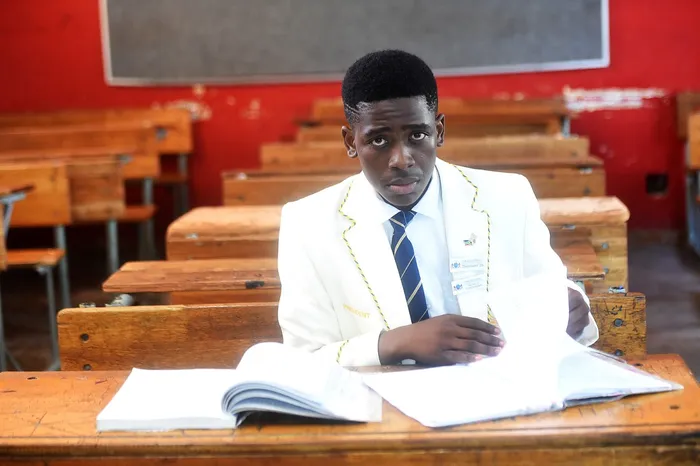
Sibusiso Tsoaeli, a matric learner at Morris Isaacson High School in Soweto, shared his views of Soweto 50 years after the uprising.
Image: Itumeleng English / Independent Newspapers
Active in politics, sports, and the arts, Mashinini acted as the SSRC's first president (until he was succeeded by Khotso Seatlholo from Naledi High School), with Mashinini and Morobe becoming the only two representatives from Morris Isaacson High School serving in the SSRC.
Reflecting on the 1976 generation of students and their contribution to the Struggle for freedom, current Principal Sikhetho Hlabangwane, who was 11 years old at the time of the student-led protest action, stated: "I do not want to compare current students against those from 1976. What I can say is that those students were brave, and they were passionate. Most people are shocked to learn the truth about June 16. They only see what’s portrayed in textbooks or films."
Hlabangwane, like Mashinini's former mentor, Tiro, who is a former History teacher at the school, recalls how even the tragic story of a dog killed during the protests continues to resonate with young people today.
Due to the widespread effects of this new policy, the uprising soon ignited countrywide anti-apartheid sentiment that resonated far beyond Soweto, with students as young as 12, tragically losing their lives to the brutality of the apartheid security forces.
Yet, for the current principal, the history of Morris Isaacson High extends beyond that fateful day, as its first principal, Mr Derek Masipa Kobe, was instrumental in shaping the school to be the institution that it has since become.
"As you can see, we still have the picture of Mr Kobe on the wall. He is credited with having sought assistance to transform the institution into a high school. His vision saw the construction of additional facilities that would provide a foundation for academic and activist excellence," pointed Hlabangwane.
As South Africa gears up for the 50th anniversary of the Soweto uprising, Morriss Isaacson High stands out as one of the schools at the forefront of the student-led protest of June 16, 1976.
Image: IOL
Further, reflecting on the school’s lineage, Hlabangwane acknowledged the contributions of past leaders such as Principal Lekgau Mathabathe and Dr Nthato Motlana, adding that their strategic leadership and commitment provided essential support to both students and the community during tumultuous times.
"Together with Dr Motlana, Principal Mathabathe led the school tremendously well, fostering vital connections that empowered the students of 1976. In recent times, we have had the pleasure of calling Dr Irvin Khoza, one of our esteemed alumni. He has been a big benefactor to the school as well," Hlabangwane recounted proudly.
As Morris Isaacson High School continues to evolve, it does so with a focus on academic achievement and extracurricular excellence.
The principal envisions a future where learners not only excel academically but also make their mark in sports, particularly basketball, drawing from a strong community partnership to nurture potential NBA stars.
Pointing to a cabinet filled with silverware in his spacious office, Hlabangwane is equally optimistic about the robust participation in debates and competitions, marking the school’s commitment to all-rounded educational development.
"We are doing well with our basketball team due to the community partnership we have established. We might have a big basketball name in our books soon enough as well. However, like many other public schools, challenges remain, particularly the need for greater parental engagement as well as the improvement in the school's matric pass rate, which remains another concern for the school leader," he added.
Despite all these challenges, Hlabangwane said they will be turning the corner to achieve an above 90% pass rate to celebrate the 50th anniversary of the Soweto uprising.
"The structure and processes are in place for us to do it for the Class of 1976 this year. We are also endeavouring to educate parents about the importance of being active citizens in the daily lives of their children. We want to teach them the importance of involvement," he said.