

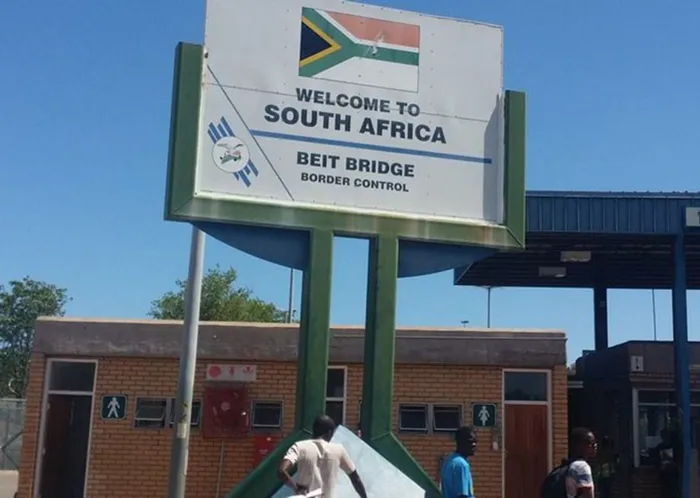
MPs heard that two minibus taxis left for Zimbabwe empty and returned to South Africa again without passengers, only to be intercepted in Musina with illegal foreigners.
Image: Independent Newspapers Archives
The Border Management Authority (BMA) on Friday told parliamentarians that the two minibus taxis that were intercepted in Polokwane, Limpopo, earlier this month with more than 50 illegal foreigners had left Beitbridge for Zimbabwe and entered South Africa without passengers.
Briefing the joint meeting of the Transport and Home Affairs Portfolio Committees, BMA Assistant Commissioner Balene Mkhabela said the interviews with the undocumented foreigners had revealed that they were facilitated in the country by means of a make-shift boat at a cost of R100 each.
“The buses passed through Beitbridge twice. The one bus (minibus taxi) exited South Africa for Zimbabwe. The second bus also left for Zimbabwe. The same buses came back following each other in the evening, still no one was in the buses,” Mkhabela said.
The BMA, the Cross-Border Road Transport Agency, and Home Affairs were appearing before the committee to brief on the intercepted minibus taxis, as well as action taken against the companies found transporting illegal foreigners into the country.
The department made a presentation on traffic register numbers, which are issued by the Transport Department to foreign nationals, apparently acquired using fraudulent documents.
Mkhabela explained that BMA was informed that traffic authorities intercepted two minibus taxis travelling from Musina, driven by South African nationals, on May 22.
The taxis transported a total of 55 passengers, comprising 54 Zimbabweans and one Malawian.
One minibus was found carrying 27 passengers, and another 26.
Mkhabela said a total of 54 passengers were identified as undocumented.
“Based on interviews conducted with these individuals, all reported that they had been facilitated into the Republic of South Africa by means of a boat, with such illegal facilitation occurring during nighttime hours.”
According to Mkhabela, it seems the passengers were dropped off on one side of the border and then came through the border line and paid R100 each by crossing the river using a makeshift boat.
“That confirms the responses were correct.”
Mkhabela also said the buses intercepted in the Free State on April 2 were processed at Beitbridge, and all ports of entry procedures and regulatory requirements were followed and satisfactorily complied with.
“The presence of 43 duly documented passengers and the absence of any irregularities during inspection further confirm full compliance with immigration and border management protocols.”
He stated that there was no evidence of non-compliance or procedural irregularities.
Regarding another bus intercepted in Polokwane on May 18, Mkhabela said it was subjected to primary verification processes to ensure compliance with screening requirements and verify all passengers were in possession of valid passports.
“The bus was found to be carrying 25 passengers, all of whom were properly documented. The bus was then allowed to proceed into the port for immigration processing, luggage scanning, and physical inspections, after which it exited the border at 2.50, having been found fully compliant with all port of entry processes,” he said.
Mkhabela said subsequent verification at the weighbridge, where the vehicle was confirmed to be legally loaded, provided additional assurance of adherence to transport regulations.
BMA Commissioner Michael Masiapato said they had, since the incidents, met with a multiplicity of stakeholders to ensure they dealt with the illegal migration issue.
“We agreed we are going to do a 24/7 roadblock between the border and Baobab Plaza area to facilitate the monitoring and inspection of passenger-carrying vehicles,” he said.
Mkhabela told the MPs that factors contributing to illegal migration included the non-existence of a border fence, farms, and trucks on the border used as transit areas, and capacity constraints to maintain deployment along the vulnerable segments of the border line.
There was also corruption by some border officials, a lack of sufficient resources to allow aerial surveillance and deterrence, and a lack of CCTV coverage at strategic points.
Mkhabela named as a solution the need for the BMA to procure and install dedicated surveillance cameras at all immigration service points to ensure proper documentation and recording of activities, among other things.
DA MP Adrian Roos said the incidents showed that there was a need to improve law enforcement on the transport routes.
“It is important when we deal with illegal migration that we consider internal enforcement,” he said.
He called for the capturing of the biometric details of the foreigners and that the data be linked to the Home Affairs Department.
While some MPs criticised the BMA and raised broadly issues related to illegal migration and porous borders, Transport Portfolio Committee Chairperson Donald Selamolela cautioned those who termed the meeting as useless amid growing disorder, violence, and undermining of the sovereignty of South Africa by undocumented foreigners.