

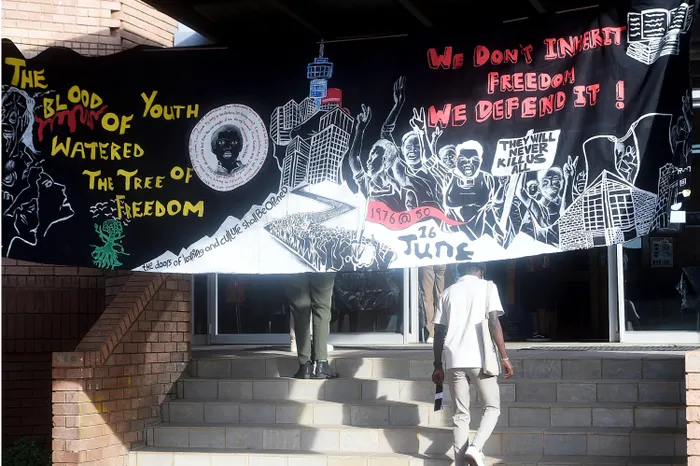
Activists and scholars gathered at the University of Johannesburg, Soweto campus on Thursday as part of the 50th anniversary of the Soweto Uprising.
Image: Itumeleng English/Independent Newspapers
Former Salt River High School student activist and detainee of the Women's Prison, Miriam Gaffoo, has issued a heartfelt call to action for South Africans to demand accountability from their political leaders.
Gaffoo on Thursday highlighted the long-standing neglect of the conditions faced by black South Africans during her address to an audience gathered at the University of Johannesburg (UJ) in Soweto as part of the 50th anniversary of the Soweto Uprising.
Gaffoo said that petty party politics have killed the spirit of activism, which characterised the student-led protests of June 16, 1976.
"Each one of you here must stand up and apologise for allowing this country to be where it is today. We have allowed party politics to divide us, and that needs to stop as we remain anguished and betrayed by our leaders," she stated.
Gaffoo was speaking during a discussion, facilitated by Dr Ali Hlongwane, alongisde prominent figure Mmagautha Molefe, and the veteran journalist Oupa Ngwenya. Together, they reflected on the significant challenges faced during the apartheid era, using personal experiences to motivate and galvanise the younger generation.
Echoing Gaffoor's sentiments, Mokoena also called for scholarship to return to politics, stating: "I remind people that Seth Mazibuko was just 15 years old, and Hector Pieterson a mere 13 when the uprising first ignited.
"Now, we're at a point where we must ask if we are making progress, a challenging inquiry indeed. However, we must never tire of telling the story."
The University of Johannesburg (UJ) Soweto campus hosted a wide-ranging colloquium on the legacy of the Soweto Uprising as part of the 50th anniversary of the student led protest of June 16, 1976.
Image: IOL
Ngwenya further lamented the current state of activism, asserting that many who endured the horrors of the Bantu Education System and other oppressive policies often shy away from recounting their tales.
"If we grapple with the narrative surrounding the last 50 years, while biblical stories are shared with clarity, we must comprehend that our battle is to prevent forgetting, lest we repeat the appalling events of our past," he asserted.
Molefe underlined the impact of the Black Consciousness Movement (BCM) on the student protests of 1976. She praised the late Steve Biko for inspiring a generation of students, including herself and notable figures such as Abram Ongkopotse Tiro.
"We were young people mixed with Biko's Black Consciousness Movement. However, many things happened, and as black people, we were living under the brutal force of apartheid, and education and Afrikaans were just one aspect."
Even though she was in hiding on the day, Molefe reflected on the pain of the disposal of dead children, buried in shallow graves, as the apartheid police force went on a killing spree.
"There are untold stories of bodies being carried in bakkies and buried in shallow graves. This is something no one is talking about, where our children who wanted to deliver a memorandum were killed when the system reacted the way it did," she recalled.