

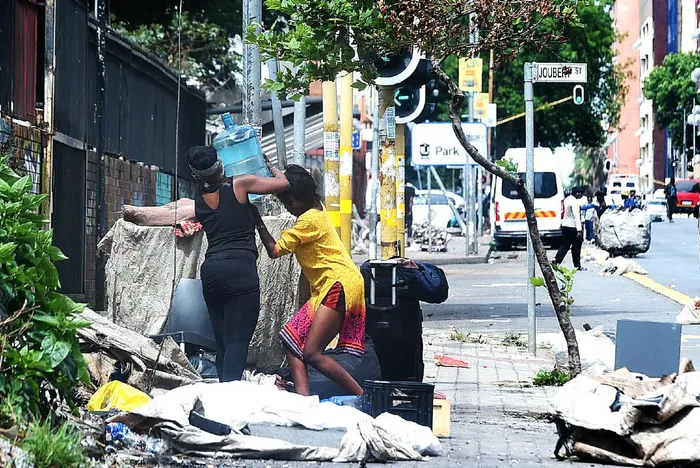
According to the City of Joburg, 190 homeless persons have been reunited with their families in Johannesburg in the past 12 months.
Image: Itumeleng English / Independent Newspapers
Building shelters for the homeless, asking families to accommodate their relatives, strengthening data management systems, upskilling those in shelters, and helping them become self-sustaining are among the strategies used by the country’s major cities to reduce homelessness.
The 2022 Census shows that at least 55,719 individuals are homeless; however, organisations such as the National Homeless Network dispute this figure, arguing that it could be much higher.
In the eThekwini Metropolitan Municipality and the City of Joburg, there have been calls for families to accept their homeless relatives. The City of Cape Town is also making efforts to reunite homeless people with their families.
Nthatisi Modingoane, spokesperson for the City of Joburg, said the StatsSA census of 2022 showed that there are a total of 8,800 homeless persons living in the city, and they are targeting at least 7,000 street homeless persons.
“The City of Johannesburg Social Development Department is currently at 6,245 as of the end of February 2026. Progress is reported on quarterly reports, which are accessible to the public,” Modingoane said.
He added that they have three city-owned shelters with a bed capacity of 450 beds, and the department is working with NPO-owned shelters to assist in providing additional bed spaces.
He highlighted that there is no waiting list at any of the city-owned shelters, “which indicates that there were no individuals who did not find shelter when they required it”.
He stated that the Social Development Department provides services to homeless individuals voluntarily.
Modingoane stated that several interventions aim to restore dignity and hope for displaced persons and assist in their reintegration into society, including family reunification.
He stated that in some instances, homeless beneficiaries have been successful in being independent and living on their own. However, some do not follow their individual development plans, including programmes recommended for their development and breaking the rules of the shelter, which often leads to their dismissal.
He added that 190 street homeless persons were reunited with their families in the past 12 months.
Modingoane stated that the reunification can be lengthy for social workers, especially if there is no cooperation from the receiving family or if the beneficiary has been disowned by their family.
Social workers conduct follow-ups with beneficiaries and their families, and identify resources within their communities to provide continuous support to the beneficiaries and their families, he said.
“From the interventions, the department has success cases of previously street homeless persons who are now permanent city employees who started as EPWP learners and proved that they only needed an opportunity to turn around their lives, and they did. During the current financial year, three former beneficiaries are EPWP learners within the Displaced Persons Sub-Unit since July 2025 until June 30, 2026,” Modingoane said.
He stated that the department has put systems in place for beneficiaries who require shelter but have lost their documentation due to the hostile environment of living on the street.
The City of Cape Town, after opening the 300-bed Ebenezer Safe Space in Green Point and expanding the Culemborg Safe Space, now has over 1,000 beds. However, recent data suggests that ‘repeat engagements’ with the same 36,500 individuals are driving the homelessness crisis.
City of Cape Town spokesperson, Luthando Tyhalibongo, said the figure of 36,500 refers to the number of engagements, and not the number of individuals.
He added that in many instances, the same individual is engaged several times, and highlighted that transitioning from rough sleeping to coordinated interventions is not a simple task.
“It takes time to establish a rapport and assess the particular needs of an individual. Therefore, in many instances, multiple engagements are required before they are open to accepting assistance, such as shelter space, medical, or social services, etc,” Tyhalibongo said.
He stated that shelters and safe spaces operate with reasonable rules to ensure safety, fairness, and the well-being of all residents, and there is no “lockout rule”.
While movement off the street is not always linear, each engagement creates an opportunity to support individuals towards more sustainable, long-term transitions, he said.
“Clients are encouraged to leave the facility during the day to seek employment, access services, or participate in meaningful developmental activities, which form part of the reintegration approach. No person can be forced to accept social assistance. However, where eviction orders have been granted, individuals who refuse available alternative accommodation are required to comply with the terms of the order and may not unlawfully reoccupy public spaces,” Tyhalibongo said.
On the total bed capacity compared to the estimated homeless population, he said, the number of bed spaces is never meant to equate the number of people on the street, as shelter beds are a renewable resource used only for a period of time until a person can stand on their own feet, or reunite with their family or friends in a supportive environment.
Regarding the city’s recent allocation of R6 million for a new Street People Data Management System, he said it will comply with the Protection of Personal Information Act (POPIA), and the only difference now is that the system will be digital rather than manual and will be solely for social services assistance.
In eThekwini, the council has approved an increased capacity of 1,200 beds for the Sakhithemba Homeless Shelter, which had initially been a 400-bed project. This, the city said, was to strengthen its homelessness intervention efforts.
eThekwini Mayor Cyril Xaba said the city has intensified its multi-sectoral plan to address homelessness, which is centred on prevention, compassion, reintegration, and long-term support.
He urged the people of eThekwini to join hands with the municipality to address the homelessness challenge in a lawful, humane, and sustainable manner.
eThekwini Deputy Mayor Zandile Myeni said: “Council recognised that with thousands of people experiencing homelessness across the city, expanding capacity from 400 to 1,200 beds was necessary to provide safe accommodation and support pathways out of homelessness. The expanded scope significantly increased project complexity, requiring a phased implementation approach.”
Myeni encouraged continuous and frequent engagement with the community of Illovu (where the shelter is being built), non-profit organisations, and people experiencing homelessness, as the project nears completion.
Dr Raymond Perrier, director of the Denis Hurley Centre (DHC), and former chairperson of the National Homeless Network, said most homeless people are not addicted to whoonga and are homeless simply because they cannot find work.
Perrier said that the central driver of homelessness is unemployment and the failure of the government at the national and local levels to create an economy that produces jobs, focusing instead on vanity projects, such as the R22 million spent on statues, which did not produce a single job in Durban.
“Any task force to address poverty and drugs needs to bring together all players – not to be led by one group or another, but for all groups to listen to each other and learn from their different experiences. We have tried and failed to work with the (eThekwini) municipality to identify homeless people who could be candidates for EPWP. Sadly, the demand for these places is over-subscribed, and local councillors usually have their own candidates already lined up,” he stated.
On the DHC’s Street Lit project, which trains homeless individuals to run their own second-hand book businesses, he said they rely on private property, such as malls, venue owners, schools, and churches, for places to sell.
Perrier highlighted that when homeless people are being removed from streets through clean-up operations, the social cost is immense, as people lose their belongings, which include IDs, certificates, and medication, a blanket, or clean clothes; things they have to try and replace.