

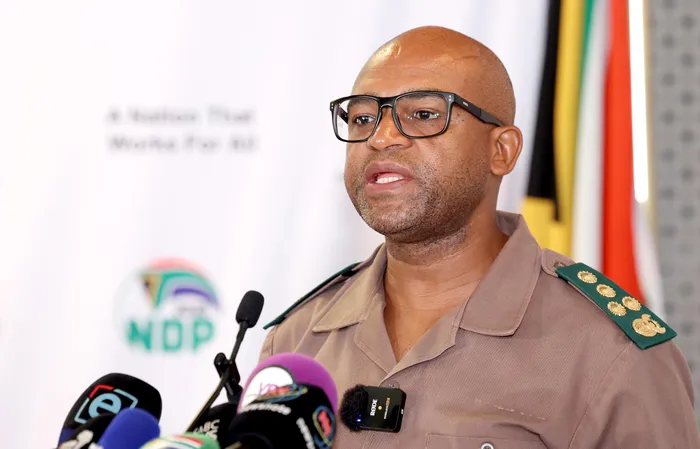
The Department of Correctional Services is the latest to face a backlash over inflated tender prices following the revelation that it was charged R726.57 per litre for cooking oil, which costs between R26 and R29. Pictured is DCS National Commissioner Makgothi Thobakgale, who has said that the figure was a data entry mistake.
Image: GCIS / Kopano Tlape
Government institutions and departments have, over the past few years, paid exorbitant prices for goods and services due to inflated tender pricing, often termed as procurement inflation or procurement leakage.
These have been described as a heavy drain on the national purse. The Auditor-General of South Africa has continually flagged that a staggering percentage of material financial losses in the government is driven by the purchase of goods and services at prices far exceeding open-market value.
The high-profile examples of tender inflation that the state has legally bound itself to pay or has already paid out have caused public outcry, as the country faces insufficient budget for service delivery to citizens.
Five times, the government institutions overpaid for goods and services through tenders.
Department of Correctional Services
A recent meeting of the Portfolio Committee on Correctional Services revealed that the Department of Correctional Services paid R726.57 per litre for cooking oil, with prices varying between R672 and R726 in some regions. The market value of a litre of cooking oil is between R26 and R29. The department also paid R3,735.32 for gravy powder that should cost around R920. Following widespread outrage from political parties and Parliament over what appeared to be gross procurement inflation, the department stated that the figure was a data-capturing error. It claims that the R726 price tag was meant to be for a 25-litre drum of cooking oil, as when calculated correctly, the actual price per litre comes to roughly R29.06.
The Independent Development Trust (IDT)
The IDT Pressure Swing Adsorption (PSA) oxygen plant tender has been a hot topic after it emerged from the Department of Public Works’ probe that the project initially budgeted for R216 million ballooned to R836 million. The National Department of Health and the IDT had signed off on an infrastructure plan, setting the baseline budget at R216 million (averaging roughly R3.6 million per hospital). IDT, the state’s implementing agent, has since been officially stripped of this status in the oxygen plant project, and the project has been handed over to another entity.
Tembisa Hospital
Tembisa Hospital processed two separate purchase orders for 12.5-litre heavy-duty plastic buckets, two in red and two in blue. The hospital paid R19,600 per bucket, when the retail price was less than R100. Tembisa Hospital also spent R2,500 per pair of children’s skinny jeans. In total, R498,000 was splurged on a single order of 200 pairs of skinny jeans meant for girls aged 6 to 7. The tender was awarded to a shell company a month before the contract. The late hospital CEO, Ashley Mthunzi, claimed the invoice was a ‘typing/capturing error’ and that the hospital had actually ordered surgical sutures. However, investigators revealed that the contract was awarded to a network of 45 interconnected shell companies that had siphoned over R110 million from the hospital in just two months. The hospital also paid for medical supplies that never arrived.
Transnet
Transnet, in an unadvertised tender, was charged R151 per spring accessory, which normally sells between R3.95 and R4.00 each. The service provider who had supplied the springs to Transnet for 40 years blew the whistle about the tender inflation scam to the Minister of Enterprises, and a probe was instituted. However, according to testimony heard from the Madlanga Commission, this resulted in the murder of Vereeniging engineer Armand Swart, whom the hitmen mistook for his colleague who had blown the whistle.
Eskom
The State-owned company paid R238,000 for one wooden-handled basic floor mop. Eskom also paid R934,950 for kneepads that cost R150 at local hardware stores. For a black refuse bag that retailed for R2.99, Eskom paid R51. A single-ply roll of toilet paper, which retailed at R3, cost Eskom R26. Fixing 12 grass trimmers costs Eskom R600,000, whereas buying brand new ones would have cost R114,000. These were revealed by the previous management, namely former CEO André de Ruyter, during investigations into procurement fraud.
Professor Zwelinzima Ndevu, an expert from the School of Public Leadership at Stellenbosch University, said the tender system is unsustainable in its current format.
“The biggest challenge is the issue of abuse of the tendering system. The system has checks and balances, but we are seeing more abuse by those in authority. It would then mean that the system, as we currently have it, might not necessarily be serving its purpose because of the abuse,” he said.
Ndevu stated that many of the procurement inflation issues could easily be resolved, but that is not happening, despite the country having very good legislation, such as the Public Finance Management Act, which is also being abused.
“It is either we get the right people, who are ethical, to manage the tendering system, or we will have to revamp the entire system by automating it to limit human involvement.”
He added that the vetting system for people who work with the money must be very good to ensure a credible system is in place.