

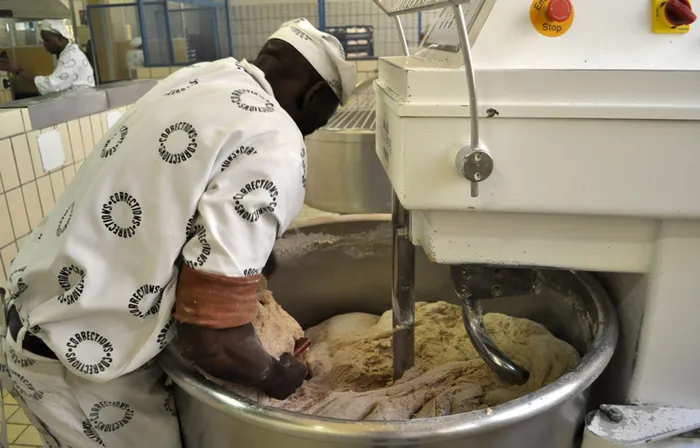
The Department of Correctional Services is under fire after MPs uncovered food items billed at vastly inflated prices, including gravy powder costing more than R3,700.
Image: Timothy Bernard / Independent Newspapers
The Department of Correctional Services (DCS) has defended paying R726.57 for cooking oil, despite it costing just R29, saying the amount referred to a 25-litre container rather than a single litre, and that the discrepancy resulted from a capturing error.
This comes after Parliament uncovered staggering food price inflation within the DCS, revealing that the state was paying inflated prices on cooking items.
It found that the department was paying R3,700 for gravy powder that ordinarily costs under R1,000, while cooking oil was billed at more than R700 despite a market price of just R29.
The committee said that under the newly negotiated prices, the department will pay between R26 and R29 for the same quantity.
The committee said DCS will also save between R2,815 and R2,538 on gravy powder procured under the new contract. The old price was R3,735 compared with the new price of R920 in the Gauteng region, it said.
The figures emerged during a recent meeting of Parliament’s Portfolio Committee on Correctional Services, where department officials were called to account over a controversial five-year food supply contract.
According to the committee, the department paid R3,735.32 for gravy powder that costs approximately R920 in bulk, while cooking oil was procured at R726.57 per litre despite a retail value of about R29.06.
Following the uproar over the prices of the food items, the department said it was important to provide clarity and ensure that the facts surrounding the department’s procurement reforms and ongoing cost-containment measures were accurately reflected.
DCS spokesperson Singabakho Nxumalo said at the centre of the matter was Contract H04/2023, concluded with 115 service providers for the supply, delivery and off-loading of 66 perishable and non-perishable commodity items across all six regions of the department.
The contract, he said, is valid for five years, from April 1, 2025, to March 31, 2030.
“It provides for a negotiated pricing model under which prices remain fixed for the first six months from the date of signature and are thereafter subject to review at six-month intervals.”
“Prior to its implementation, food procurement was fragmented across regions, with some operating without long-term contracts and others relying heavily on the Request for Quotation (RFQ) process.”
Nxumalo said this resulted in recurring awards to the same suppliers and identical items being procured at varying prices across regions, creating inefficiencies, undermining standardisation and reducing value for public funds.
“It also exposed systemic weaknesses that contributed to irregular expenditure of R36.9 million in 2022/23 and R194.7 million in 2023/24, as identified by the Auditor-General of South Africa, mainly due to non-compliance with Treasury Regulation 16A6.1.”
He said in response, the department introduced a single national bid framework to standardise procurement, comply with food handling regulations, enhance transparency, ensure fairness and promote pricing consistency.
“The current price review process commenced in May 2025 following the identification of pricing variances through routine internal monitoring, and predates the Department's appearance before the Portfolio Committee on Correctional Services in July 2025, reflecting proactive financial oversight and accountability.”
According to him, to ensure seamless operationalisation and responsiveness to enquiries on the contract, National Commissioner of DCS Makgothi Thobakgale instituted continuous oversight from the outset.
He said that on April 30, 2025, Thobakgale received a detailed progress report confirming that implementation was delivering as intended.
“The contract was also discussed at the weekly National Operations Committee meetings, held every Monday.”
“In addition, following receipt of enquiries, the Minister of Correctional Services convened briefing meetings in May and June 2025 to be updated on the contract's implementation.”
According to Nxumalo, these interventions led to the early identification of pricing concerns and the issuance of a directive on May 13, 2025, instructing all regions to suspend transactions on affected higher-priced items pending review.
“Regardless of the negotiated pricing model, which provides that prices submitted by successful bidders remain fixed for the first six months from the date of contract signature and are subject to review only every six months thereafter, the department proactively initiated a pricing review in June 2025.”

The Department of Correctional Services insists pricing irregularities were identified and corrected internally, but MPs say the inflated costs should never have passed procurement controls.
Image: Bheki Radebe
“This was preceded by the identification of variances, and as previously explained, a directive was immediately issued to suspend acceptance of orders for the affected items pending completion of the price review process.”
He said the review covered all 66 commodity items, of which only seven reflected higher pricing, with expenditure incurred on only four items: curry powder, white flour, gravy and spices.
“The Department further clarifies that the cooking oil prices reflected as R726.57 and R697.51 relate to 25-litre containers, not single litres as incorrectly interpreted due to a capturing error.”
“These prices were, in fact, the result of successful downward negotiations and represent justifiable market-related pricing for the specified quantity,” he said.
He said that, in line with contractual provisions and established procurement governance mechanisms, the department initiated engagements with all affected suppliers to review and renegotiate prices downward.
“These engagements were conducted strictly within the framework of the Department's Standard Operating Procedures (SOPs) and the Special Conditions of Contract (SCC), ensuring full transparency, fairness and consistency across all six regions. Importantly, the renegotiation process was not based on Consumer Price Index (CPI) or Producer Price Index (PPI) adjustment formulas.”
Instead, he said, the department applied direct market-price benchmarking to assess whether quoted prices were reasonable, fair and justifiable.
“The above mechanism has been consistently applied since the inception of the contract and forms part of the Department's contractual safeguards to ensure continued price fairness and responsiveness to market conditions.”
“Through this process, the Department successfully secured substantial price reductions.”
“The revised prices were then applied uniformly across suppliers within each region, consistent with the Department's pricing equality principle.”
He said the presentation made before the Portfolio Committee on Correctional Services on May 12, 2026, demonstrated how prices were laid bare.
“The next round of price reviews and renegotiations has already commenced in line with contractual obligations.”
“It must be affirmed that all engagements with suppliers have been conducted transparently, lawfully, and in strict compliance with the contractual prescripts, and the Department will continue to subject itself to appropriate oversight,” he added.
The committee expressed serious concern that highly inflated prices were initially allowed to pass through procurement processes.
Committee chairperson Kgomotso Anthea Ramolobeng said the DCS presented the renegotiated prices as savings, but the real issue was that the original prices were irrational and should never have passed internal procurement controls in the first place.
“The concern is not necessarily the reductions achieved afterwards, but how such inflated figures were initially accepted.”
“We should be cautious not to celebrate the correction of failures as achievements. If one litre of oil was initially quoted at an amount far above the ordinary market value, reducing that price later cannot be framed as prudent financial management.”
“Instead, it exposes weaknesses in supply chain management systems and processes,” she said.
IOL News