

A MultiChoice logo is displayed outside the company's building in Cape Town, South Africa.
Image: File photo: Reuters
Regulators have lifted the lid on how French media giant Canal+ pulled off its takeover of MultiChoice — revealing a complex deal structure designed to sidestep broadcasting control laws while securing full ownership of the pay-TV group.
While appearing before the Portfolio Committee on Communications and Digital Technologies on Tuesday morning, the Independent Communications Authority of South Africa (ICASA) and the Competition Commission explained how Canal+ came to acquire MultiChoice.
The two organisations briefed the committee on the regulatory conditions, public interest commitments, and compliance requirements linked to the final approval of the Canal+ acquisition of MultiChoice.
The briefing came after the news that the committee is scheduling a special oversight visit to the broadcasting sector, after Canal+ said it would discontinue its loss-making streaming service Showmax.
Over the years, Canal+ already had a minor stake in the company before it made the move to acquire over 90% of the shares in the pay-TV operator.
While the ICASA chairperson was on hand, it was ICASA’s executive in charge of the Licensing and Compliance Division, Fikile Hlongwane, who explained the timeline to the committee.
Hlongwane explained that LicenceCo is a separate entity that holds the broadcasting service licence granted by ICASA and is presently not controlled by the MultiChoice Group or Canal+.
Before the deal, the MultiChoice Group (MCG) was the former majority shareholder in LicenceCo and was listed on the JSE prior to the transaction. It was the MCG that was acquired by Canal+, which does not have a broadcasting licence in South Africa.
After the acquisition, LicenceCo would have five shareholders, namely: MCG 20%, Phuthuma Nathi Investments (RF) Limited 42.4%, Identity Partners Itai Consortium (IPIC), Afrifund Consortium 30% and an employee-focused, broad-based ownership trust (the Workers’ Trust) 8%.
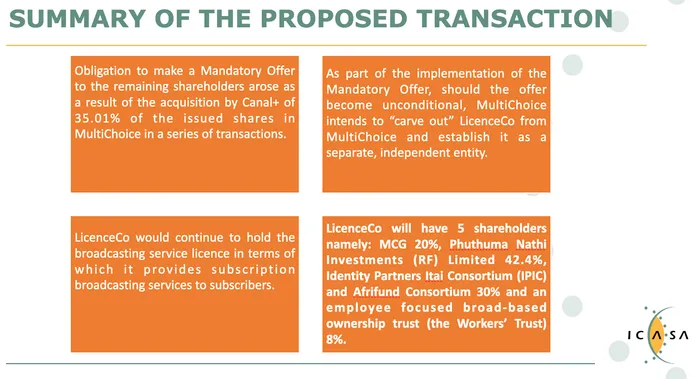
ICASA’s executive in charge of the Licensing and Compliance Division, Fikile Hlongwane, explained the timeline to the committee.
Image: Screenshot
On 30 September 2024, ICASA received correspondence from LicenceCo that, following the directive from the Takeover Regulation Panel (“TRP”), Canal+ made an offer on 8 April 2024 to acquire the remaining shares in MultiChoice.
ICASA was informed that after the transaction, no entity would control LicenceCo; therefore, there would be no transfer of control as required under Section 13 of the Electronic Communications Act (ECA) and the Licensing Regulations.
On 29 October 2024, ICASA replied to LicenceCo’s letter, stating that it did not share LicenceCo’s view but needed formal documentation regarding the proposed transaction before determining the applicability of section 13 of the ECA.
On 20 February 2025, ICASA and MultiChoice met, where MultiChoice presented the proposed transaction. Thereafter, MultiChoice sent a letter to ICASA on 14 March 2025, with supporting documentation.
ICASA then examined whether the deal triggered Section 13 and/or 31(2A) of the ECA, and Section 64 of the ECA, but ultimately found that “based on information from MultiChoice, the proposed transaction does not require regulatory approval since no single shareholder will control LicenceCo after implementation”.
“There is no transfer of control as outlined in Sections 13 and 31(2A) of the ECA. Therefore, MultiChoice is not obliged to apply under Section 13 or 31(2A) for the transfer of control of an individual licence.
“In ICASA’s assessment, Canal+ would not have an interest in voting shares or paid-up capital, granting it control exceeding 20%, subsequent to the implementation of the proposed transaction. This is so because it would (factually) Canal+ would only hold 20% shareholding in LicenceCo,” Hlongwane said.
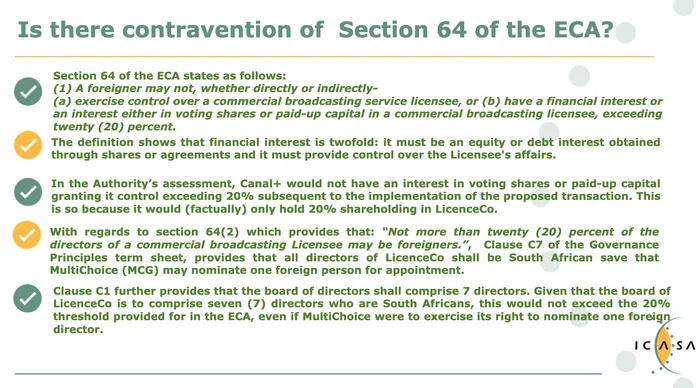
Section 64 of the ECA
Image: Screenshot
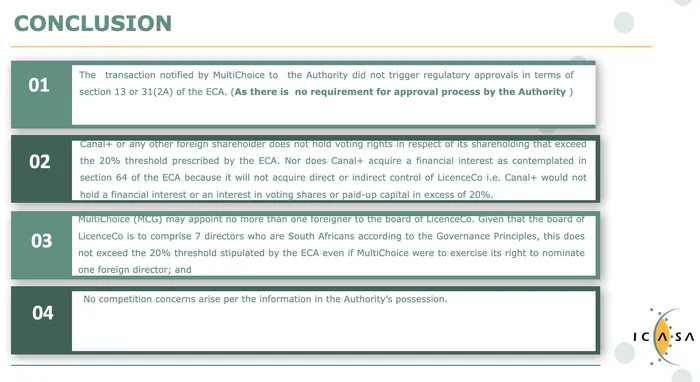
Hlongwane explained that ICASA’s task team was satisfied that the merger does not negatively affect the competitive landscape in South Africa
Image: Screenshot
Hlongwane explained that ICASA’s task team was satisfied that the merger does not negatively affect the competitive landscape in South Africa, “particularly since Canal+ was not previously active in the local market”.
“The merger is expected to generate content acquisition efficiencies and synergies, while the combined entity will continue to face strong competition from other large, global players such as Netflix and others.”
The Competition Commission explained to the committee that in May 2025, the commission recommended to the Competition Tribunal to approve with conditions the merger for these reasons:
In July 2025, the Tribunal published a decision to approve the merger between Canal+ and MultiChoice with conditions. The conditions are primarily related to public interest, including employment, promotion of ownership by HDPs and workers, supplier development and corporate social investment initiatives.
The conditions include providing access to an international sporting event where South African national teams or individuals are participating. The merged entity will identify opportunities to increase the availability of locally produced South African general entertainment content internationally.
The conditions also included listing of Canal+ on the JSE, subject to obtaining all regulatory approvals.