


Rushna Minnaar Lipsey with her husband, Sean Lipsey, and their two daughters, Melody Story and Jazzy Luna.
Image: Supplied
South African expatriates living in the Middle East have spoken about the fear and uncertainty following a wave of Iranian airstrikes targeting United States military bases across the Gulf Cooperation Council (GCC) region since the weekend, POST has reported.
The GCC includes Bahrain, Kuwait, Oman, Qatar, Saudi Arabia and the United Arab Emirates. Although defence systems intercepted many of the missiles, the attacks triggered emergency alerts and safety warnings for residents across several countries.
Despite the tense atmosphere, South Africans living in the region say they are staying vigilant while trying to maintain a sense of calm.
In Dubai, some well-known landmarks — including areas near Dubai International Airport — were affected when falling debris from intercepted missiles damaged parts of buildings and infrastructure. Authorities also reported injuries linked to the incidents.
Rushna Minnaar Lipsey, 36, who lives roughly 15 minutes from Dubai International Airport, described the situation as deeply unsettling. Originally from Cape Town, she moved to Dubai 12 years ago to work as a hotel singer and now works as a freelance make-up artist.
Lipsey said the sudden escalation shattered her sense of security in the city.
She explained that the noise of fighter jets and explosions created an overwhelming atmosphere, particularly as she tried to comfort her young children while remaining calm herself.
Authorities urged residents to stay indoors following the attacks because falling debris from intercepted missiles could pose serious risks.
According to Lipsey, the UAE military managed to intercept many of the hundreds of missiles reportedly launched from Iran. Even so, residents were advised to avoid going outside until the immediate danger had passed.
Although the situation has since eased somewhat, she said she has chosen to remain indoors until officials confirm that conditions have fully stabilised.
Lipsey has taken several precautionary measures to protect her family. She reinforced her bedroom windows, placed a fire extinguisher beside her bed and prepared emergency bags containing shoes, medication, first-aid supplies, canned food and water.
Her main concern, she said, is the safety of her daughters, Jazzy Luna, 7, and Melody Story, 3, as well as her husband Sean, 40.
Sean is currently stranded in Australia after flights were cancelled over the weekend, leaving him unable to return home immediately.
Lipsey said the separation has been emotionally difficult, particularly during such a tense period. However, her husband has rebooked a flight scheduled for March 9, giving the family hope they will soon be reunited.
She also praised the UAE authorities for their response, saying the government had worked tirelessly to protect residents. A 24-hour trauma hotline has also been made available to provide emotional support during the crisis.
Elsewhere in the UAE, Miksha Ramlall, 31, said she is trying to remain optimistic despite the occasional tension.
Ramlall moved from Durban to Abu Dhabi seven months ago with her two sons, Ethan Govender, 11, and Akario Govender, 4. She currently works as a teacher at a private school.
Living in a more remote area roughly two hours from the city centre, she said her experience has been less intense than that reported in central urban areas.
However, she confirmed seeing missile interceptions in the sky and hearing loud blasts as defence systems engaged incoming projectiles.
Ramlall added that fighter jets have occasionally been heard overhead. Even so, she described her area as relatively calm compared with the main city.
Residents regularly receive emergency alerts advising them to stay indoors and avoid standing near windows or doors during periods of heightened risk.
According to Ramlall, government communication has played a key role in reassuring residents.
She said authorities have repeatedly emphasised that strong safety and defence systems are in place, which has helped ease fears within the community.
Nevertheless, uncertainty can still be stressful, particularly when alerts arrive late at night or early in the morning.
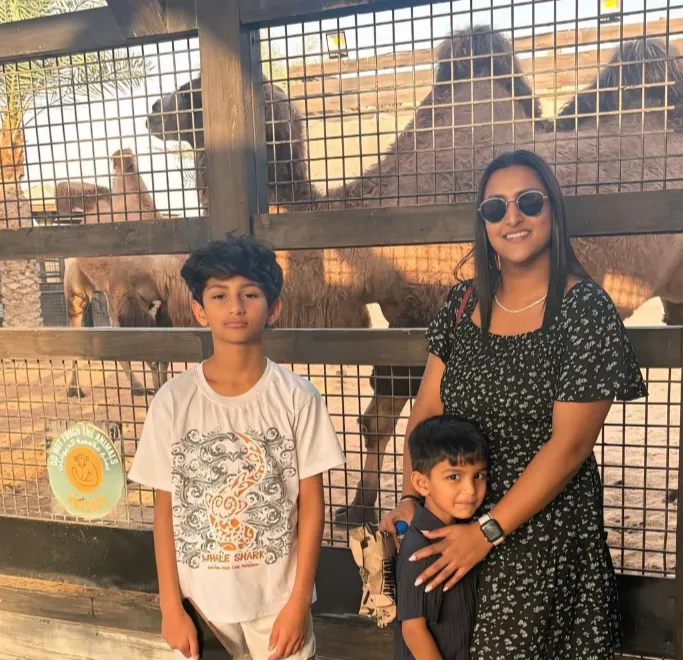
Miksha Ramlall, with sons Ethan Govender, left, and Akario Govender.
Image: Supplied
Ramlall said she focuses on maintaining a sense of normality for her children while closely following official guidance.
For now, she does not plan to return to South Africa, saying she still feels safe despite the tense regional climate.
Meanwhile, a South African resident in Doha, Qatar, who asked not to be identified, described similar experiences amid the escalating tensions.
She said authorities in Qatar began issuing regular emergency notifications after reports emerged that Iranian forces had targeted US bases across the GCC region.
On Saturday, residents across the country received a nationwide emergency alert on their mobile phones.
Shortly afterwards, she and others heard several loud explosions, which officials later confirmed were missiles intercepted by Qatar’s air defence systems.
At the time, she and her family were attending a church gathering.
She said attendees remained calm and left the venue once it was considered safe.
Although the situation caused anxiety for many residents, she expressed confidence in the Qatari government’s ability to maintain public safety.
As a precaution, schools in Doha have temporarily shifted to online learning, while many businesses have instructed employees to work from home.
Her husband is currently working remotely as the family monitors developments through official updates.
While conditions in their neighbourhood remain calm, she said they have chosen to remain indoors and follow government guidance.
Like many expatriates across the region, she said the family remains hopeful that stability will soon return as authorities continue to prioritise public safety.
IOL News