

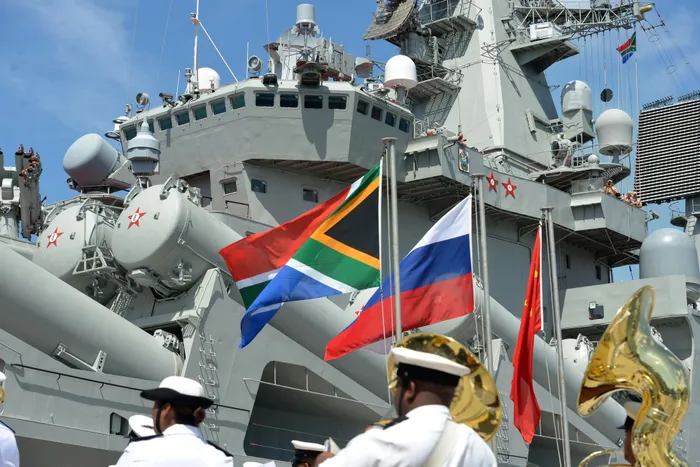
President Cyril Ramaphosa said the panel that is probing Iran’s involvement in the Exercise Will for Peace 2026 is expected to finish work within six months of its establishment.
Image: SANDF
President Cyril Ramaphosa has confirmed that he has not yet received a report from the board of inquiry that is probing the involvement of Iran in the Exercise Will for Peace 2026, despite a report promised within a month of its establishment six months ago.
Ramaphosa revealed this in reply to parliamentary questions from DA MP Chris Hattingh on Wednesday.
In February, he removed the probe that was announced in January by Defence Minister Angie Motshekga from the Department of Defence and placed it under the direct authority of the Presidency.
The probe was sparked by allegations that the South African Navy allegedly ignored Ramaphosa’s directive to limit Iran to observer status during the exercise that involved South Africa, China, Russia, and Iran.
The Presidency said at the time of the announcement of the investigation that the panel, led by Justice Bernard Ngoepe, would finish its work and report to Ramaphosa within one month of its establishment.
In parliamentary questions to Ramaphosa, Hattingh asked about the current status of the investigation and by what date the panel was expected to submit its report.
He also enquired whether the panel found that any instruction issued by him regarding the participation of Iran in Exercise Will for Peace 2026 was not complied with, and whether the Department of Defence, the ministry, or any other organ of state was found to have acted improperly in relation to the naval exercise, or whether any action has been recommended or initiated.
In response, Ramaphosa said he has not received the report.
“The panel is expected to finish its work within six months of its establishment. The president may, on compelling cause shown, extend the period of the panel’s proceedings,” he said.
Hattingh expressed shock that the panel has not produced a report into its investigation.
He said the Constitution vested supreme command of the SANDF in the president.
“If his instruction was ignored, South Africans deserve to know. If it was not, the president should say so unequivocally.”
Hattingh said the matter was no longer merely about a naval exercise.
“It is about the constitutional principle of civilian control over the military.”
He also said the basic command-and-control facts should have been established within days, not months.
“Instead, Parliament still does not know who authorised Iran's participation, why the president's instruction was allegedly not implemented, or who is accountable.”
Hattingh added that his party will pursue the matter until South Africans know what happened, who was responsible, and what corrective action has been taken.
“The authority of the Commander-in-Chief is not negotiable, civilian control of the military is not optional, and accountability cannot be delayed indefinitely,” he said.
In a separate set of questions, ActionSA MP Lerato Ngobeni wanted to know the consequence management steps Ramaphosa has taken against Motshekga for failing to enforce his directive that South Africa should not participate in the naval exercise if it included Iran, yet participation proceeded.
The president said matters related to the naval exercise were being probed by the panel chaired by Justice Ngoepe.
“The panel will investigate and make recommendations in relation to the circumstances surrounding the exercise, the factors that may have contributed to the failure to observe the president’s order, the person or persons responsible, and the consequences to follow.
“The panel will have the power to summon any member of the defence force and/or public service it needs, and to request all documents, including classified documents, to fulfil its mandate.”
Ramaphosa also said he may, on the recommendation of the panel and Motshekga, decide to publicise or not to publicise all or any portion of the outcomes of the panel’s investigation.