

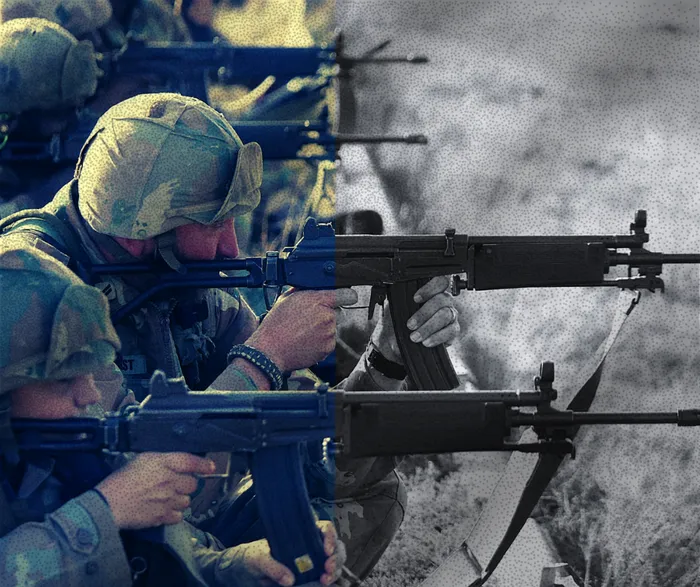
South Africa's defence crisis has deepened as politicians clash over whether the South African National Defence Force needs more funding or sweeping reform before receiving additional taxpayer money. While military leaders warn of an operational collapse caused by years of budget cuts, opposition MPs argue that wasteful spending, procurement failures and poor governance have hollowed out the SANDF from within.
Image: SANDF Social Media / IOL Graphics
South Africa's defence crisis has erupted into an extraordinary public showdown, with military leaders accusing National Treasury of crippling the country's security while MPs warn that corruption, waste and luxury spending have hollowed out the SANDF from within.
As calls grow for billions more in defence funding, Parliament has revealed a stark contrast between the conditions endured by ordinary soldiers and the lifestyles enjoyed by senior military commanders.
As the stand-off intensifies, explosive disclosures from parliamentary oversight members have laid bare a stark contrast: ordinary soldiers deployed to high-risk zones are enduring degrading, squalid living conditions, while senior generals maintain elite lifestyles characterised by luxury vehicles and taxpayer-subsidised golf days.
The battle lines have escalated into an unprecedented public slanging match between the Ministry of Defence and the National Treasury. The military argues that its ongoing decline is a direct result of chronic underfunding.
Despite President Cyril Ramaphosa’s public commitments to allocate at least 1.5% of GDP to defence, the 2026/27 defence budget was slashed in real terms to R57.6 billion, down from R59 billion the previous year, and representing a mere 0.7% of GDP.
Economic Freedom Fighters (EFF) MP Carl Niehaus, a permanent representative on the Joint Standing Committee on Defence (JSCD), has strongly criticised the cuts, accusing National Treasury of conducting "sovereign sabotage".
"I view National Treasury’s 'neoliberal austerity' as a deliberate strangulation of a critical state organ. It is the slow-motion destruction of our sovereign defense capability,” Niehaus said.
This financial starvation has directly compromised active operations. During the recent deployment of Operation Prosper to combat gang violence and social instability, promised emergency funds from the presidency were not released expeditiously. Consequently, the cash-strapped SANDF was forced to cannibalise its own depleted operational budget to keep boots on the ground.
Deputy Minister of Defence Bantu Holomisa launched a scathing public assault on Treasury, accusing officials of "gambling with the country's sovereign safety" by refusing to unlock emergency funds.
However, the narrative of a victimised military starved by heartless bean-counters has faced significant resistance. Critics argue that throwing money at the problem is no longer a viable option because internal mismanagement has hollowed out the force from within.
Even defense advocates concede that Treasury's reluctance to release funds is rooted in systemic administrative issues.
"National Treasury has legitimate concerns about how limited resources are managed," Niehaus admitted.
He acknowledged that compensation of employees (CoE) devours 65% to 70% of the entire budget.
"Simply pouring more money into the current structure would be like pouring water into a cracked bucket,” he said.
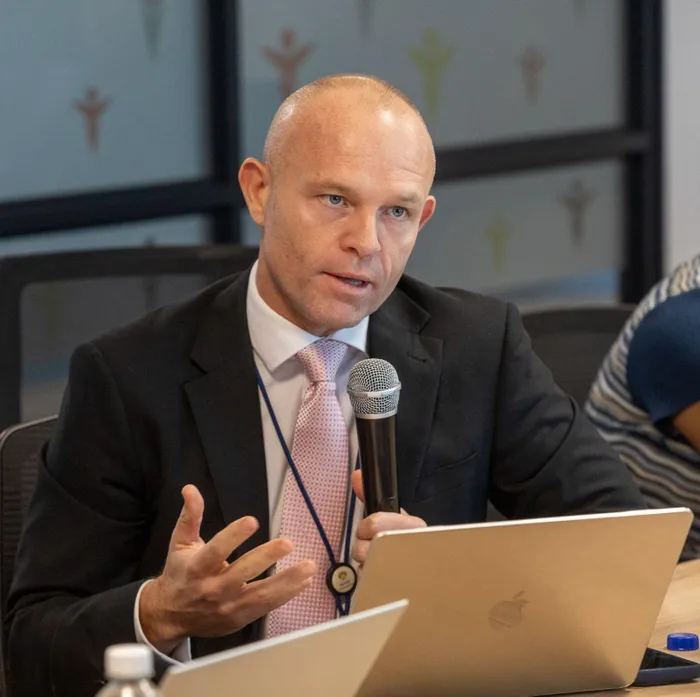
Democratic Alliance (DA) MP Nicholas Gotsell.
Image: File
Democratic Alliance (DA) MP Nicholas Gotsell has roundly rejected what he calls a "blank cheque" approach to military funding, arguing that the primary driver of the SANDF's decline is the jaw-dropping waste of the budget it already receives.
"South Africans cannot reasonably be asked to pour more money into a Department that continues to prioritise senior management over operational capability," Gotsell said.
Gotsell pointed to a stark moral and operational disconnect within the military’s command, revealing that money is consistently found to fund executive comforts. According to Gotsell, the department regularly purchases luxury vehicles for top military brass, with some generals allocated up to two Audi Q7s each, complete with blue lights.
Furthermore, the Minister of Defence and her deputies racked up a massive R14 million international travel bill in just seven months, while routinely soliciting sponsorship from the defence industry to host bi-monthly golf days at exclusive courses like Richards Bay and Pinnacle Point, all while taxpayers foot the bill for senior management's travel, accommodation, and catering overheads.
The real-world consequences of this fiscal and administrative deadlock are now visible on the tarmac and at sea.
In early June, shocking reports emerged that the military had, quite literally, run out of aviation fuel. Up to 80% of the South African Air Force (SAAF) fleet is currently grounded due to budget cuts, lack of spare parts, and maintenance backlogs. At times, only a single Oryx helicopter has been operational for the entire country. Pilots are reportedly being sent home because the force cannot afford fuel, leaving them unable to fly enough hours to maintain their licenses.
Alarmingly, Gotsell and Niehaus both revealed that parliamentary oversight committees were never formally briefed by military command before these grounding decisions were made. Gotsell slammed the ANC-led committee leadership for reducing parliamentary oversight to "retrospective box-ticking," where crises are only made public after a total operational collapse has occurred.
The maritime sector faces a similar paralysis, with Navy vessels forced to remain docked alongside harbours for prolonged periods due to maintenance backlogs, leaving South Africa's vast coastlines entirely undefended.
According to defense experts, the cumulative impact of these crises has transformed the SANDF into a "hollow force" with virtually no conventional deterrence left. Niehaus warned that if a minor, landlocked neighbour like Lesotho were to launch a hostile cross-border incursion, the SANDF would struggle to mount a swift or effective conventional defense.
While top commanders enjoy luxury vehicles and high-end golf days, ordinary soldiers and military veterans are being treated with "contempt".
Over 140 soldiers deployed in Cape Town under Operation Prosper were housed in a freezing, leaking hangar at Fort iKapa with no reliable hot water and substandard sanitation. Rather than immediately fixing the issue, the DoD spent its energy disputing the soldiers' accounts.
The ANC’s lone Co-Chairperson on the Joint Standing Committee on Defence (JSCD), Phiroane Phala, was dispatched to conduct an oversight visit, after which he released a statement declaring the leaking hangar "adequate" and dismissing reports of neglect as "fabricated". The political cover-up fell apart just days later when the Gauteng High Court intervened, ordering the urgent relocation of the troops to AFB Ysterplaat and slapping the SANDF with a punitive legal costs order.
Similar conditions were documented at De Brug near Bloemfontein, where troops returning from peacekeeping missions in the Democratic Republic of the Congo (Operation Mistral and Operation Thiba) were placed under a mandatory 21-day Ebola quarantine. Niehaus revealed they were housed in leaking tents in the bitter Free State winter, sleeping on thin mattresses placed directly on the frozen ground.
Additionally, the Department of Military Veterans has failed to comply with a High Court ruling ordering the finalisation of the military veterans' database and the rollout of long-overdue pensions and healthcare benefits guaranteed under the Military Veterans Act of 2011.
Beneath the operational collapse lies a deep-seated culture of procurement corruption, with over R2.5 billion in suspected fraud across the defense portfolio currently under active investigation by the SIU and the Hawks.
Gotsell pointed to the DoD's failed "Military Veterans Pothole Repair Project" as a prime example of administrative dysfunction. The DoD spent nearly R28 million to procure 90 road-rolling machines with absolutely no implementation plan, and not a single pothole has been repaired. The Auditor-General has since flagged the expenditure as a Material Irregularity.
Other notable scandals include:
Despite these clear cases of abuse, senior officials continue to be shielded from accountability. Gotsell revealed that Tsepe Motumi, the former acting Director-General of the Department of Military Veterans, who was found by the Supreme Court of Appeal (SCA) to have unlawfully committed the department to an unappropriated R60 million liability, continues to draw a massive salary as a Special Advisor to the Minister of Defence, Angie Motshekga.
Both the EFF and the DA are demanding a complete overhaul of the state's defense apparatus, though they differ slightly on the immediate sequence of funding.
The EFF is demanding an immediate presentation of the fully costed "Journey to Greatness" defense plan, a radical reduction of the bloated senior officer corps, the full implementation of the Military Veterans Act, and an increase in the defense budget to 1.5% of GDP once restructuring is underway.
"History will judge harshly those who allowed our national defence capability to collapse while the world around us grows more dangerous," Niehaus warned.
The DA has gone a step further, lodging formal ethics complaints against JSCD Co-Chairperson Phala for acting as a "public relations shield" for the executive. The party is calling for a DA member to lead the committee to ensure impartial scrutiny, alongside legislative reforms to prevent corrupt officials from escaping disciplinary action by resigning with full benefits.
"South Africa cannot repair its Defence Force by pouring more money into the same broken system. Funding, structural reform, and accountability must occur together,” Gotsell said.
IOL reached out to Minister Motshekga’s office and the SANDF for comment but did not receive a response by time of publication.
IOL