

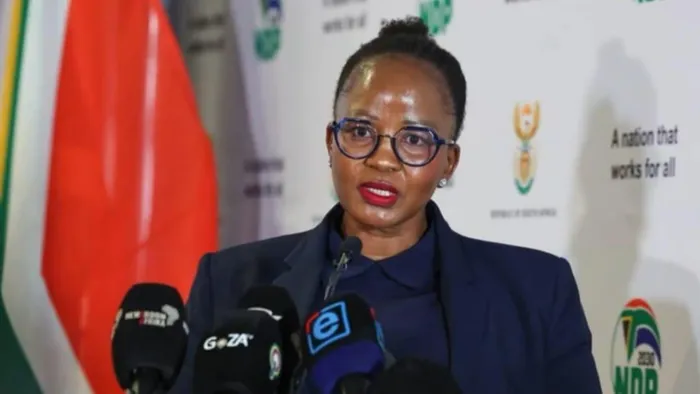
National Treasury Deputy Director-General Ogalaletseng Gaarekwe addressing the media after the department announced the withholding of equitable share transfers to 69 municipalities in an effort to instill fiscal discipline.
Image: Screengrab
The National Treasury on Wednesday revealed that it withheld only R13.5 billion in equitable share transfers from 69 defaulting municipalities that failed to comply with financial regulations and other financial management prescriptions.
It said the withheld funds could be released to the affected municipalities within a week, or within a month if the defaulting councils were compliant.
“The overall equitable share of municipalities for this new financial year is R110 billion. It is only R13.5bn that has been withheld,” Deputy Director-General Ogalaletseng Gaarekwe said.
Gaarekwe made the comment when she briefed the media after the department announced on Monday that it withheld the transfers to instill fiscal discipline and ensure that public money is properly managed, that unauthorised, irregular, fruitless, and wasteful expenditure (UIFWE) is addressed, and that municipal officials and office-bearers are held accountable where required by law.
Gaarekwe also said the withheld funds would be released once municipalities provided proof of the conditions being met.
“Once they give us that, we release a portion of that, probably a third, for them to pay those accounts as agreed with those creditors.”
Gaarekwe further said the time it would take for the funds to be released depended on the responsiveness of the affected municipalities.
“It could be a week, it could be two weeks or a month, depending on the responsiveness of a municipality," she added.
Gaarekwe stated that the first set of letters was sent to 99 councils on June 22 and 23.
“So 30 responded in a way we did not withhold their monies. Those 30 submitted what was required,” she said.
Jan Hattingh, chief director for Local Government Budget Analysis, said the councils were given seven days to respond, and only 69 did not provide the required documents.
Hattingh said the legislation allowed a maximum of 120 days to release the withheld funds.
“In all the time, we never exceeded 30 days,” he said.
The National Treasury has been issuing the notices to the municipalities as far back as 2015.
Gaarekwe said there have been fewer municipalities that have had their transfers withheld over the past years, but the number jumped to 75 last year around August 2025.
She was hopeful that the number of affected municipalities would decline in the near future.
Gaarekwe indicated that the constitutional provision used to withhold the transfers to municipalities was used as a last resort.
“We don't want to do it all the time. We expect behaviour will change and we don't have to do it again.”
Gaarekwe said the municipalities had been expected to make commitments on unfunded budgets, payment plans signed by their creditors, and plans to reduce unauthorised, irregular, fruitless, and wasteful expenditure.
Meanwhile, departments that fail to pay municipalities will soon have their own taste of medicine in the matter.
Finance Minister Enoch Godongwana notified Parliament last month of his intention to withhold equitable share to departments that owe municipalities a whopping R15 billion in unpaid rates and services for water and electricity.
Gaarekwe said national departments were sent letters in February, warning them of the withholding of their transfers, while the provincial departments were notified in April.
They were given until May 29 to respond.
Gaarekwe said there were a lot of disputed amounts claimed by municipalities.
“We say to them on the accounts not in dispute, give us the payment plan,” she said, adding the monies must be paid with the current year, not over several years.
“The minister has made it clear that the disputed amounts need to be dealt with within three months. It can't be disputed forever,” she said.
Gaarekwe stated that they wanted to correct the behaviour in all spheres of government.
“We need to get into the habit of paying our creditors.”
Gaarekwe said the National Treasury was really serious about compliance to legislation.
“It is important that all three spheres of government comply with the legislation we have.”
Gaarekwe was adamant that withholding the funds would not affect community service delivery.
The municipalities' budget was about R750 billion, and the National Treasury transferred them below R200bn a year.
“It just shows they got more revenue-raising power from the Constitution, unlike provinces, which raise less than R30bn a year. Municipalities raise almost R500bn from their revenue,” she said.
Hattingh mentioned that a similar exercise regarding defaulting councils' non-payment of debts owed to water boards has yielded positive results.
“As a result of actions we have done jointly with the Department of Water and Sanitation, two water boards that were on the brink of being closed were helped and are still operational.
“If the water board can't proceed to provide services, the impact of that is much more negative because that means communities won't get water.”
He added that their actions were linked to findings by the Auditor-General that some councils adopt unfunded budgets.
“Part of the work and support municipalities we help them table funded budgets and deal with planning problems upfront. If you don't plan well and overspend, that is regarded as unauthorised expenditure,” Hattingh added.
The National Treasury officials detailed the support given to municipalities to execute their mandate insofar as finances are concerned.
“We work with the Provincial Treasuries and our counterparts, including SALGA, to equip municipalities to improve their planning and budgeting system so that they use the money properly and citizens benefit from the resources allocated by Parliament,” said Hattingh.