

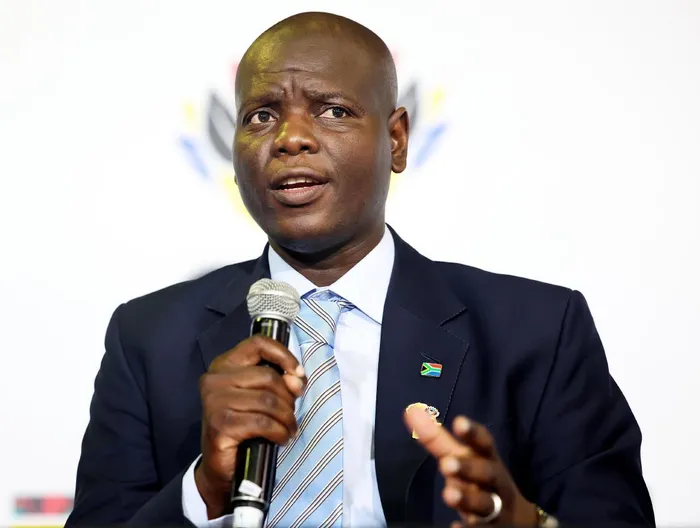
International Relations and Cooperation Minister Ronald Lamola says former President Jacob Zuma's visit to India reflects negatively on South Africa, warning that former heads of state cannot conduct a parallel foreign policy.
Image: GCIS
International Relations and Cooperation Minister Ronald Lamola says former President Jacob Zuma's visit to India, where he met Ajay Gupta, reflects negatively on South Africa, warning that the former head of state appears to be running a "parallel foreign policy" despite having no mandate to represent the government.
Lamola said the Department of International Relations and Cooperation was awaiting an internal report and was inquiring into Zuma's visit to determine how it was facilitated, its purpose and whether it had any implications under the Foreign Service Act.
The remarks follow Zuma's visit to the northern Indian state of Uttarakhand in late June, where he was photographed at the Siddhpeeth Shri Dakshin Kali Mandir in Haridwar alongside Ajay Gupta, one of the Gupta brothers accused of playing a central role in South Africa's state capture scandal.
During the visit, Zuma also made political remarks, telling reporters he believed he would return to power.
"It does impact us negatively that the former head of state will be running a parallel foreign policy to the South African government,'' Lamola said.
He stressed that only the sitting President and government representatives authorised through official state processes could represent South Africa abroad.
"When the President of South Africa goes anywhere, he's mandated through internal procedure of the state and of government. There are processes that are followed. There is a mandate," he said.
Lamola said the same applied to him as minister.
"I myself follow a certain procedure, this mandate, these processes. I'm mandated. I report to the Cabinet and to government. I also account to Parliament. So a former president does not have all those processes. So really, he can't be representing the South African government anyway."
Lamola said the department was awaiting an internal report into Zuma's India visit.
"We are waiting for a report internally to see how it happened and what was the purpose, what are the implications in terms of our Foreign Services Act."
He said the department would also establish the nature of the visit and the involvement of South Africa's High Commissioner to India.
"We need to explain that, as you are aware, former presidents are entitled to privileges, and some of their privileges include facilitation through our diplomatic protocols.
''So we will have to inquire, and that's what we're inquiring, to find out how did this happen, what informs it, what was the nature of the visit, and what was the nature of the involvement of our High Commissioner in India."
Lamola said although legislation afforded former presidents certain benefits and diplomatic protocol assistance, those privileges did not extend to conducting foreign policy on behalf of the country.
"We must state that while the Presidential Act does allow privileges to flow to former presidents, it does not allow them to run a parallel foreign policy, which seems to be the case now with former President Zuma."
He said Zuma's recent international engagements had raised concerns within government.
"You will have seen his visit to Uganda, to Morocco, which he proposed to represent the South African government. In India, from what I've seen, the speeches was a bit different because it was about him reclaiming leadership of the country."
Lamola said Zuma's continued involvement in active politics complicated the issue of former presidential privileges.
"It was a bit easier in the past when former presidents were no longer active in politics. But it's clear now, former President Zuma is active, is in active politics. What does it mean for our foreign policy? His party has got a different perspective on foreign policy."
Lamola said the department was considering how to balance the privileges afforded to former presidents with ensuring they did not represent the South African government.
IOL Politics