

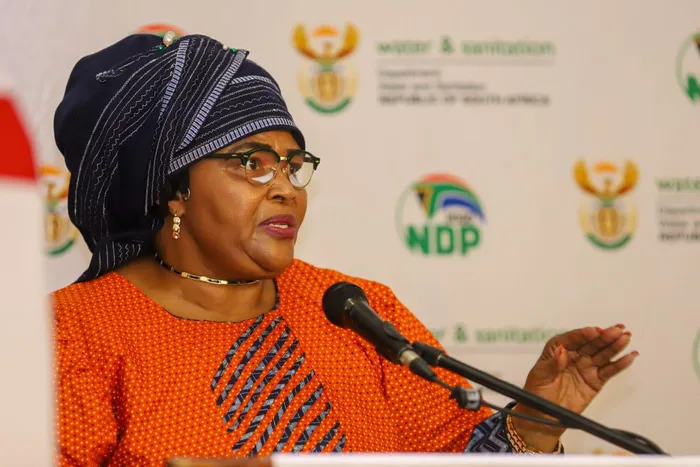
Water and Sanitation Minister Pemmy Majodina briefed the National Assembly on the debt owed to water boards by municipalities.
Image: Supplied
The total debt owed by struggling municipalities to water boards has ballooned by almost R4 billion to R28 billion over the past 10 months.
At least 16 municipalities are not making any payments while those that have had their Equitable Share allocations withheld due to non-payment, start making payments but abscond once the funds are released.
This was disclosed by Water and Sanitation Minister Pemmy Majodina, when she fielded questions during the question-and-answer session in the National Assembly on Wednesday.
Majodina said the amount owed by municipalities to water board boards was R24 billion a year ago.
“We are now standing at R28 billion that is owed by municipalities,” she said.
According to Majodina, some municipalities blame the non-payment of their consumers for not servicing the debt.
“So currently, we are engaging with those municipalities to pay what they can afford because the water boards, unfortunately, are not subsidised by the government. They are self-financed,” she said.
The minister told MPs that they have engaged all the municipalities that are owing the water boards across the country.
“Some municipalities have already started to pay the water boards, but they are not consistent in paying. They only do that when we talk to the National Treasury to withhold the Equitable Share.”
In an effort to make the defaulting municipalities cough up, the Department of Water and Sanitation requests the National Treasury to withhold Equitable Share allocations to defaulting municipalities.
The department previously said it used the withholding of the allocations as a last resort to force the councils to honour their obligations by paying their current invoices prior to their allocations being released by the National Treasury.
In terms of this initiative, the councils enter into payment arrangements with the water boards to settle their debt.
However, Majodina said the defaulting municipalities generally pay upon entering into agreements and two months down the line abscond, a move that forces the department to approach the National Treasury to withhold the Equitable Share.
“We have already made a submission regarding close to 16 municipalities that are just not paying the water boards."
Majodina observed that a closer look at the situation shows that the municipalities are owed for rates and services by government departments, both at provincial and national levels as well as state-owned enterprises.
“We have said municipalities must also apply what we are doing because we want them to pay us. They must ensure that the departments that owe them...that their budgets are withheld by the National Treasury, because if they do that, we know we are going to benefit and our water boards are going to be paid,” she said.
Despite the non-payment by the defaulting municipalities, Majodina said the water boards were rationing water to the affected councils.
“At some points, you lower the pressure at night but that is not assisting because the debt is growing,” she added.
Majodina said the water boards were at risk of collapse if they were not paid the amounts due to them by councils.
“That is why our intervention will rescue all water boards that must not collapse because when they collapse, it will be a disaster for all of us."
She said the municipalities were supposed to be paying R62 million monthly, but they only afford R30 million.
“It means the water boards are, in a way, subsidising municipalities, and if that is the case, they cannot be sustainable forever.”