

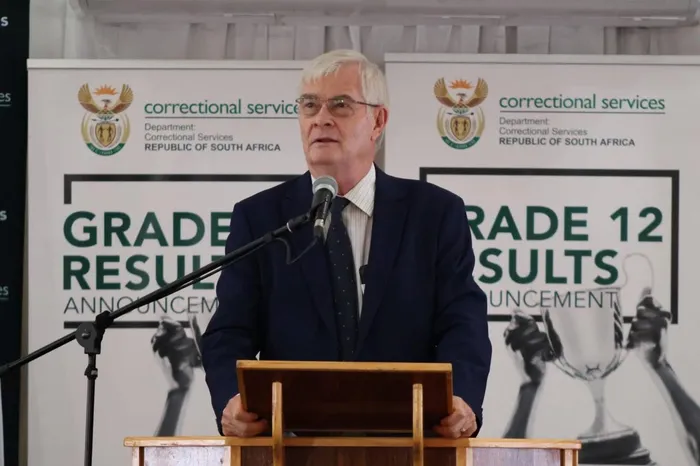
Minister of Correctional Services Pieter Groenewald on Tuesday led a department team to brief the Correctional Services Portfolio Committee on issues surrounding parolees.
Image: Social Media
The Department of Correctional Services on Tuesday said it was in the process to resuscitate the procurement of electronic monitoring devices for parolees, while still engaged in litigation with a service provider.
National Commissioner Makgothi Thobakgale said they have submitted a document to the State Information Technology Agency (SITA) to continue with the procurement of the devices.
“We have tentatively received positive consideration from Integrated Justice System (IJS) funding for electronic monitoring. What is left now is for SITA to process as much as they can as we are in arbitration with the service provider,” he said.
The department has allocated R15 million to kickstart the procurement for the electronic monitoring devices.
Thobakgale said the contract was cancelled because the procurement did not go through SITA.
“We will continue to push for the procurement so that we can have the system put in place,” he added.
Correctional Services Minister Piet Groenewald confirmed that they were dealing with the issue of electronic monitoring devices for parolees.
“There is a process of litigation when it comes to that, but there is progress,” he said.
However, Groenewald said if things were to go his way, anyone wanting parole, must pay for the devices themselves.
“I respect human rights but that is if I could have my way,” he said.
Groenewald said electronic monitoring devices will play a major role in proper control and monitoring of parolees.
“We should not be held at ransom on the electronic bands,” he said, adding that the devices could assist to detect if a parolee used drugs or alcohol.
Groenewald and Thobakgale made the comments when the department briefed the committee following reports that the department cannot account for 27,797 high risk parolees who have absconded.
It also reported that more than half of those who cannot be traced were 15,860 “archived absconders”, parolees who were released between 1991 and 2004, and that the cases were listed as “non-active” and remain separate from the current case loads of absconders.
Thobakgale said they continued to trace parolees released prior to 1994 and that they no longer define absconders as active, inactive or archived.
“The number that we have of 29,320 is the recent total as of 29 May 2026, and it includes all. When we track and trace, we track and trace all.”
Thobakgale said community corrections officials, the Emergency Support Team security officials and SAPS track down the absconders.
“The impression created is that there is no attention given to parolees and around parole. This is factually incorrect,” he said.
Deputy Commissioner for Community Corrections Gustav Wilson said parolees were not supervised from 1991 until 1994 and their number absconders stood at 24,221 during that period.
“Tracing of parolees by the specialised track and tracing teams was established in 2021,” Wilson said.
Wilson told the committee that there were a total of 8,303 absconders between 2021 and 2026 and that 6,060 had been traced during the same period.
However, a presentation to the committee painted a picture of the department’s community corrections unit as being under-capacitated in terms of personnel and other resources.
While there were 234 offices, with 62 satellite offices and 861 service points, the department had 491 vehicles for use by 1,764 officials, and 933 of them were the monitoring officials.
The department has a case load totaling 52,773, and each official handled an average of 87 cases instead of 30. A total of 14,265 parolees re-offended over the past six years in serious crimes such as theft, assault, rape, robbery, assault with intention to do grievous bodily harm and house-breaking.
Thobakgale said the department has set aside a quota of 1,500 from the 6,000 new recruits to serve on the community corrections unit.