

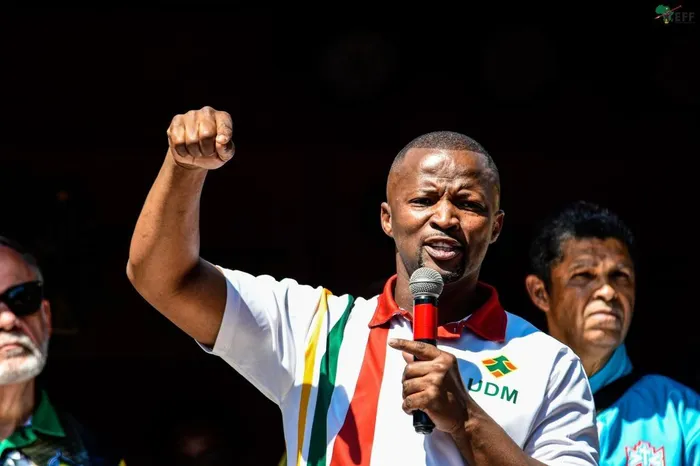
UDM Deputy President Nqabayomzi Kwankwa says South Africa must enforce immigration laws while rejecting violence against foreign nationals, addressing economic migration, unemployment and race-based claims during the budget vote debate.
Image: X
The United Democratic Movement (UDM) has backed stricter enforcement of South Africa’s immigration laws while rejecting violence and intimidation against foreign nationals.
UDM Deputy President Nqabayomzi Kwankwa was speaking during the Presidency Budget Vote debate in Parliament, where he said the party supports South Africa’s response to worsening socio-economic conditions, including high unemployment, deep poverty, inequality and sluggish economic growth.
This comes against the backdrop of heightened public tension around immigration enforcement and undocumented migration, which in recent weeks has fuelled political and social debate over law enforcement, labour competition and regional migration pressures.
He said that despite these challenges, South Africa remains one of the most developed and diversified economies on the continent, adding that this reality has made the country a destination for migrants seeking economic opportunities, including those who enter or remain in the country illegally.
Kwankwa said the UDM stands with South Africans calling for the lawful enforcement of immigration laws.
“No country in the world is expected to simply look the other way when faced with illegal and undocumented migration. No country is told that enforcing its laws is somewhat immoral,” he said.
He said that in South Africa, whenever the issue of illegal immigration is raised, it is met with “lectures, labels and moral grandstanding”.
Kwankwa said South Africans are often told they must not complain, must not ask questions, must not expect their laws to be enforced, and must simply absorb the consequences and remain silent.
He said the issue is frequently reduced to race, which he rejected.
“We are constantly told by those who are intellectually lazy that white undocumented foreigners are not targeted.”
“Well, if they were competing for jobs in Gugulethu, Mdantsane, Khayelitsha, KwaMashu and Soweto, if they were concentrated in township economies, petrol stations, restaurants and informal businesses, if they were directly competing for some opportunities and limited resources that millions of poor South Africans rely on, they too would be part of this debate,” Kwankwa said.
He said the issue is not primarily about race, but about economics, opportunity, unemployment and competition for scarce resources, adding that ignoring this reality does not address the concerns of poor communities.
Kwankwa said the UDM is Pan-Africanist, but not naive, rejecting what he called a “Temu version of Pan-Africanism” that only appears when South Africa is expected to make sacrifices.
He said South Africans are often told they must carry the burden of poor leadership and governance failures elsewhere on the continent, while being discouraged from raising concerns.
Kwankwa questioned where Pan-Africanism is when African leaders are allegedly influenced by the West and Morocco to vote against African interests in international forums such as the IPU, and when South Africa came under sustained verbal attacks during its G20 presidency.
He also referred to the deaths of 14 South African soldiers deployed in peacekeeping operations in the Democratic Republic of Congo, saying their lives were lost in pursuit of peace and stability on the continent.
Kwankwa said subsequent agreements between the DRC and the United States gave American companies priority access to mineral wealth, while South Africa bore the human cost of peacekeeping.
He said too often solidarity is demanded from South Africa but not reciprocated.
“Solidarity without reciprocity is exploitation. Partnership without mutual benefit is dependency. And Pan-Africanism without accountability is a scam and merely a slogan and we reject it with the contempt it deserves,” he said.
Kwankwa said the UDM supports the enforcement of South Africa’s immigration laws, while at the same time rejecting violence, intimidation and attacks against foreign nationals. He said the rule of law must prevail.
IOL Politics