

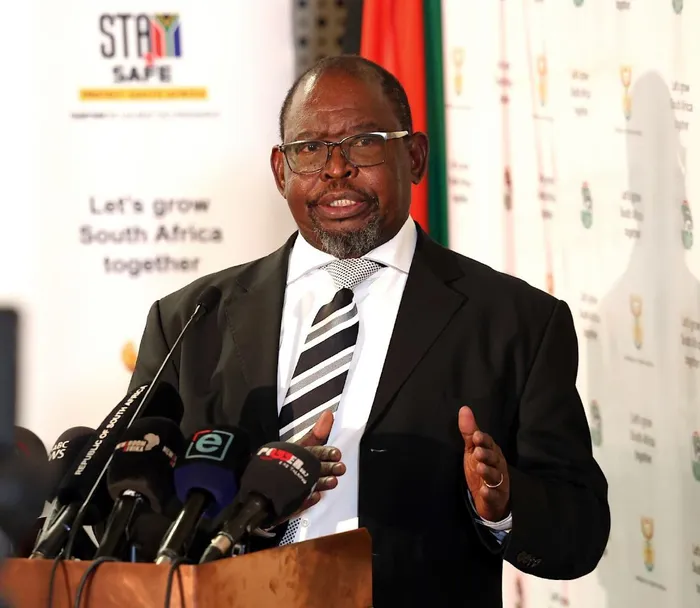
Finance Minister Enoch Godongwana says the government does not have the financial resources to inject into a new state bank.
Image: Supplied
Finance Minister Enoch Godongwana has ruled out the establishment of yet another state-owned bank, saying South Africa not only has quite a number but the government does not have the financial resources to inject into a new one.
“The government currently does not have plans to establish a new state-owned commercial bank. South Africa currently has several state banks, including the Land Bank, the Postbank, the Development Bank of Southern Africa, the Small Enterprise Development and Finance Agency, and other national and provincial Development Finance Institutions,” Godongwana said.
The Postbank, which falls under the Department of Communications and Digital Technologies, is still in the process of finalising its application for a banking licence with the South African Reserve Bank’s Prudential Authority.
He was responding to parliamentary questions from MK Party MP Zwelakhe Mthethwa on Tuesday, who observed that there are stringent requirements set by the banking industry to qualify for funding.
Mthethwa asked whether the government intended to establish a state commercial bank, which would also be able to invest in communal land and assist ordinary citizens and communities in accessing funding to acquire assets such as land
In response, Godongwana stated that the Land Bank is the one that has a mandate that relates to supporting and transforming South Africa’s agricultural sector by delivering specially designed financial services to commercial, emerging, and development farmers.
“The Land Bank is charged with assisting in addressing historical inequities by facilitating access to agricultural land ownership for historically disadvantaged persons.
“However, it is also important to note that each state bank needs to determine its own business model and whether it can also service a market that may not be adequately serviced by existing banks.”
The minister also stated that there needed to be a clear balance between providing access to finance to underserved markets and pricing of risk to ensure sustainability.
“Even for a bank that is mandated to support land and agricultural development like the Land Bank, the government as the shareholder is not able to dictate its day-to-day operations,” he said.
“What is also important before the government can make considerations on the establishment of new state-owned banks is to determine the market failure that the government will be attempting to address, and whether such identified market failures cannot be adequately addressed within the framework of currently existing public and private sector financial institutions.”
Godongwana reminded him about the constrained fiscal environment he had outlined in the 2026 Budget speech in February.
“It is also vital to note that the government does not have the financial resources to inject into a new state bank, especially since the country already faces challenges with the financial position of existing state banks.
“Ultimately, it is imperative that no state bank be a burden on the fiscus and that all state banks must be able to generate sufficient revenue to fund their operations.”
He added that it was paramount that all banks were managed prudently at all stages, with the highest regard for sound corporate governance practices and ethical conduct.
“If any bank lends recklessly or is managed poorly and/or fraudulently by its board of directors or management, such bank will fail and face the prospect of closure.”