

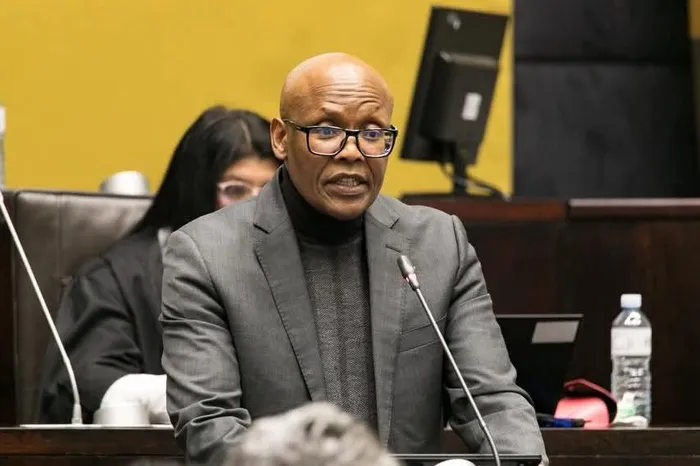
MK Party MP Mzwanele Manyi made a presentation to the Justice and Constitutional Development Portfolio Committee on the Private Member's Bill that proposes a constitutional amendment to allow expropriation of land without compensation.
Image: Parliament / RSA
The MK Party’s Private Member’s Bill, aimed to amend the Constitution to allow for expropriation of land without compensation, as far back as 1652, drew mixed reactions from parties in Parliament on Tuesday.
Some members in the Justice and Constitutional Development Portfolio Committee described the bill as “food for thought”, while others felt it has far-reaching implications.
This was after the party’s MP, Mzwanele Manyi, made a presentation on the bill to fellow committee members during a virtual session.
Manyi said the bill sought to restore land justice, advance economic freedom, and complete decolonisation.
“We thought that by moving away from apartheid, we were getting closer to equality, but as we sit here and now, there is empirical evidence that we are the most unequal society in the world. In fact, the inequality we have now is worse than even the apartheid days,” said Manyi.
According to Manyi, land remained highly concentrated to a few and millions were landless.
“The democratic breakthrough of 1994 did not fully resolve the land question. This bill seeks to complete the unfinished work.”
Parliament previously rejected calls to amend the Constitution on the matter.
In his presentation, Manyi said the bill sought to align the Constitution with social justice, as well as restore the dignity, economic participation, and historical redress.
The bill asserts that “land and natural resources in the Republic belong to the people of South Africa collectively”.
It also says the custodianship of land and natural resources vests in the democratic state on behalf of the people, and may be exercised, in partnership with recognised traditional and Khoi-San leadership structures.
“Property may be expropriated without payment of compensation for a public purpose or in the public interest; and only in terms of a law of general application.”
The bill proposes that restitution start on April 6, 1652, as opposed to the 1913 cut-off date contained in the Constitution.
“This restores historical honesty to the Constitution,” Manyi said, adding that the 1913 cut-off date legalised land invasions in order to forget the past.
Manyi said the MK Party’s model of expropriation of land has no agenda to chase anybody to the sea.
“We say let's come to Parliament. Let's have a lawful, democratic route,” he said as he assured the MPs that there would be no Zimbabwean-style of land grabs.
Newly-appointed DA chief whip Glynnis Breytenbach said: “It's certainly food for thought. However, the presentation is complex and covers a range of issues.”
Breytenbach said there were aspects she agreed with and would like to discuss further.
“I would like an opportunity to engage with a document a little more in-depth and revisit it,” she said.
Her colleague Damien Klopper said there were concerning things in the proposed bill.
“I don't understand why anybody would want to invest in a country that does not guarantee land rights. This bill, at a glance, has far-reaching implications not for land owners but for all South African people,” Klopper said.
He expressed his doubts about the assurance by Manyi that the bill did not threaten food security, among other things.
ACDP MP Steve Swart said he fully appreciated that land was an emotive issue in the country.
“We all want a peaceful country. We understand the need for restoration for the past wrongdoings, and we have maintained our position for compensation.
“We are aware, at glance, that it has far-reaching implications for this country, the economy, its people, but understand it's an emotive issue. We would like to study the document further,” said Swart.
EFF MP Rebecca Mohlala said her party would thoroughly study the bill, as land was one of the cardinal pillars of the Red Berets.
“We welcome the tabling of this bill. It confirms what we also say that the land question remains a central unfinished task of the liberation,” Mohlala said.
“Our support for land justice does not mean we support a weak bill or unambiguous bill.
“This bill must clearly state that land belongs to the state as the custodian so that it can be redistributed in the public interest. The bill must also insist on expropriation without compensation,” she said.
Committee chairperson and ANC MP Xola Nqola echoed Breytenbach’s sentiments that the bill was “a food for thought”.
“It is something we must apply our minds on so that whatever decision we take at a later stage is informed by the best interest for the people of South Africa,” he said.
The bill will be deliberated at a meeting to be scheduled with two other Private Member’s Bills that were introduced by the DA.