

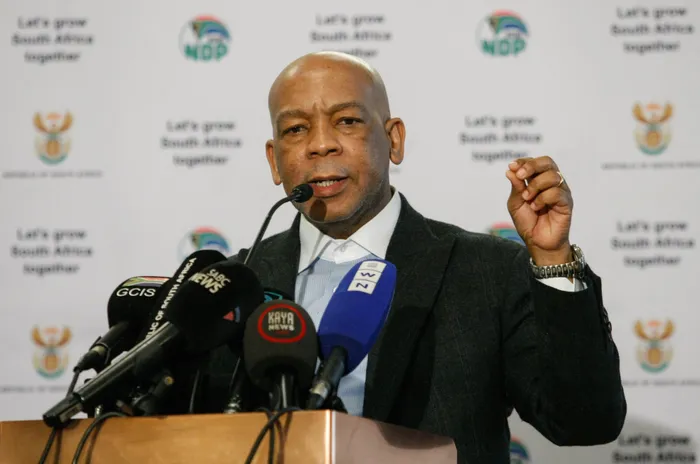
Electricity and Energy Minister Kgosientsho Ramokgopa told Parliament that the free basic electricity allocation for indigent households will be increased after public participation process.
Image: Jacques Naude / Independent Newspapers
Electricity and Energy Minister Kgosientsho Ramokgopa said the current free basic electricity allocation for indigent households will be reviewed.
Ramokgopa said the review of the 50 kilowatt per hour per household free basic electricity will form part of the electricity pricing policy that will soon be released for public comment.
Speaking during a question-and-answer session in the National Assembly on Wednesday, he said the free basic electricity was introduced in 2003 after the realisation that although electricity was available to many of the households, it remained expensive.
He stated that the free basic electricity allocation was determined based on the consumption profile.
“Twenty-three years later, that number is no more relevant because the profile of consumption has changed, and the average poor household now has a television. Some of them have bought electric kettles, they have got refrigerators, so the consumption has changed,” he said.
“So, as part of our intervention, we are revising that number, but in revising that allocation, we will not place a burden on the fiscus, as it is under constraint.”
Ramokgopa also said the policy on electricity pricing will be released first and then increase the allocation of the free basic electricity after public consultation process.
“We have a number of what it should look like. We will announce it when we come (with electricity pricing policy). So, it will increase.”
He said the quantum of free basic electricity will also answer the question of universal access to electricity, as there are about 1.69 million households that still don't have access to electricity.
Ramokgopa also said the government was designing instruments on how to support the cost of primary energy.
“In that policy framework, we say something about how we deal with that primary energy, and once the public has given their comments, we'll then answer when it's going to start. Yes, it will increase. It will not place a burden on the fiscus,” he said.
“We are going to use a multiplicity of primary energy sources, and in that way, the ideal of universal access to electricity that is affordable will be achieved.”
Asked about cross-subsidisation of the free basic electricity allocation by non-indigent consumers, Ramokgopa said they are not going to place a burden on the fiscus.
“We are going to use other alternative sources of energy… This indigent intervention on electricity costs will not significantly impact other consumer classes.”
Pressed on measures to standardise and enforce the implementation of the free basic electricity across municipalities amid exclusion of many qualifying indigent and poor households, Ramokgopa said they will determine a policy at a national level.
“The only lever we have in how that policy is exercised is how the Minister of Finance ensures that the allocation filters through to the end-consumer.”
Ramokgopa noted that there were about 2.1 million eligible households, but only about 400,000 currently receive free basic electricity.
He also said smart metres will be introduced and allow free basic electricity to be allocated directly to qualifying poor and indigent households.
“It means that from the National Treasury, once that allocation comes, we are able to directly subsidise the end-consumer without having to go through the conduit of the municipality, and we find that that money has to be redirected to other spending pressures of municipalities and undermining the efficacy of this instrument (free basic electricity),” said Ramokgopa.
“We will work out with the National Treasury so that this programme is not undermined.”