

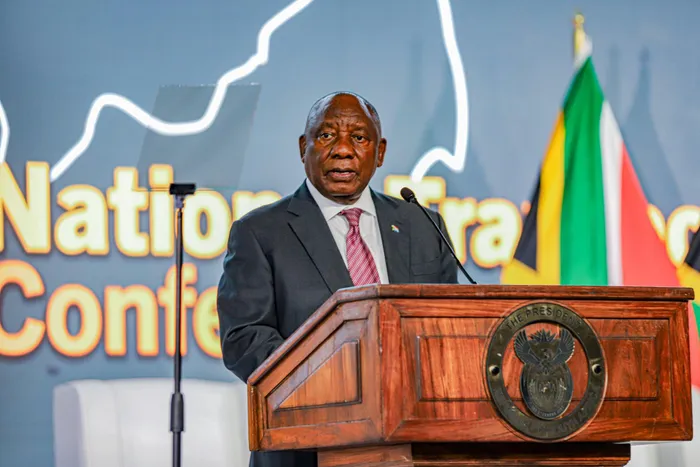
President Cyril Ramaphosa calls for urgent reforms in South Africa's transport system to unlock economic growth, reduce inequality, and create an inclusive, sustainable future for all South Africans.
Image: Department of Transport / X
President Cyril Ramaphosa has called for an inclusive and sustainable transport system that can drive economic growth and development, saying that the state of South Africa's transport infrastructure is critical for the nation's future prosperity.
Speaking at the inaugural National Transport Conference at Gallagher Estate in Midrand on Monday, the president highlighted key challenges and opportunities facing the sector, emphasising the need for modernisation, collaboration, and greater accessibility.
The conference takes place under the theme: “Transport: The Driver for Growth, Job Creation, Inclusivity and Sustainability.”
The gathering brings together decision-makers, investors, and innovators to engage on how to build a sustainable transport system that works for the economy and job creation.
"Given the role of transport as a facilitator of economic growth and an enabler of social development, the conference will tackle the sector’s most pressing issues. These include modernising failing passenger rail systems and resolving port and freight bottlenecks," the presidency said.
"Transport is vital to our economy and our people," Ramaphosa said in his opening address.
He noted that when transport networks are inefficient or congested, it directly hampers economic growth, increases costs, and reduces opportunities for businesses and individuals alike.
"When our transport arteries are blocked or inefficient, growth stalls, costs rise, and opportunity diminishes. But when the flow is free, the country thrives," he added.
The president pointed out that an effective transport and logistics system goes beyond simply moving goods and people.
It plays a pivotal role in unlocking opportunity, reducing inequality, and fostering inclusive economic growth.
He stressed that the sector is essential for ensuring that goods produced in South Africa, including minerals and agricultural products, can reach both local and international markets.
Ramaphosa also drew attention to the ongoing shifts in global trade routes and the rapidly evolving geopolitical environment.
"Other countries on our continent are investing aggressively in their own rail and port infrastructure, creating both competition and opportunity," he said, noting that these developments could open up new trade and investment opportunities for South Africa.
Ramaphosa acknowledged that extreme weather events, such as floods, have caused significant damage to the country’s rail, road, and port infrastructure in recent years.
"We need infrastructure that is resilient and sustainable," he stressed, calling for operational capabilities that are flexible and able to adapt to a changing environment.
Addressing the state of the country's freight transport system, Ramaphosa revealed that 69 percent of all freight in South Africa is still moved by road, placing considerable strain on the road network.
He noted that inefficiencies in logistics are costing the economy an estimated R1 billion a day. "That is a cost we should not – and need not – bear," he said.
As part of the government's reform agenda, the president highlighted the National Rail Policy of 2022 and the National Freight Logistics Roadmap of 2023, both of which aim to reposition rail as the backbone of the country’s logistics network.
"The cornerstone of our reform programme is the National Rail Policy," Ramaphosa said.
He explained that through the establishment of the Transnet Rail Infrastructure Manager, private operators will now have access to the rail network, with 24 million tonnes of freight slots already awarded to 11 private companies, with operations set to begin in April 2027.
In addition to freight transport, Ramaphosa stressed the importance of an efficient passenger rail system for ensuring inclusive growth.
He pointed to the Passenger Rail Agency of South Africa (PRASA), which has revived 37 of its 40 priority passenger rail corridors and introduced more than 300 locally manufactured train sets.
"We are targeting 116 million passenger journeys this financial year, on our way to 600 million trips by 2029," he said.
Ramaphosa also touched on road transport, which remains indispensable to South Africa’s logistics ecosystem.
He also expressed support for the taxi industry, which provides transport for 80 percent of South Africans who rely on public transport.
"The taxi industry is one of the largest black-owned sectors in our economy," he noted, adding that the government is working with financial institutions to de-risk the sector and provide accessible finance to taxi owners and drivers.
He outlined measures to make the country's transport system more inclusive.
He referred to the government's Action Plan for Universally Accessible Transport, which was launched in November 2024, and emphasised the importance of ensuring that people with disabilities have access to public transport.
"The new PRASA trains have dedicated areas in their carriages for those who are wheelchair-bound," he said.
Despite the progress made, road safety remains a significant concern, with over 12,000 people dying on South African roads each year.
However, Ramaphosa pointed to recent successes in reducing road accident fatalities, including the lowest number of crashes during the 2024 festive season in five years.
"We aim to at least halve road deaths by 2030," he said.
Ramaphosa proposed the establishment of a permanent Transport Council, which would bring together government, the private sector, and all transport service providers.
"Just as collaboration transformed our energy response, cross-sector collaboration of this kind will enable further stabilisation and inclusive growth in transport," he said.
“Let us place transport at the center of our country’s growth path,” Ramaphosa said.
IOL Politics