

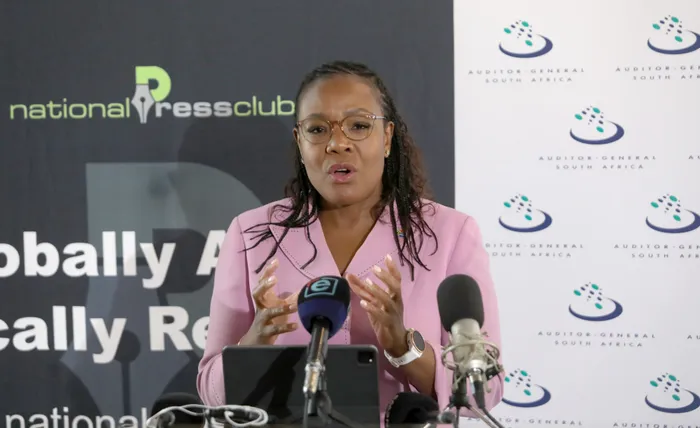
Auditor-General Tsakani Maluleke said the process of recruiting the next Deputy Auditor-General following the resignation of Vonani Chauke has already begun.
Image: Oupa Mokoena / Independent Newspapers
The search for South Africa's next Deputy Auditor-General is officially afoot, following the resignation of Vonani Chauke last month.
Auditor-General (A-G) Tsakani Maluleke provided an update on the recruitment process during a briefing to the Standing Committee on Auditor-General (SCoAG) on Friday, confirming that candidates have been shortlisted and that the selection process is nearing the crucial interview stage.
Chauke, who was due to complete his five-year term in June, had previously communicated his intention to return to the private sector.
“From the time he started working at the A-G's office, he indicated that he would want to serve only five years. We agreed that I would start the recruitment process, and I communicated that internally at the beginning of January,” Maluleke said.
Chauke, who was appointed as the head of administration at the state’s audit office on a five-year term, called it quits last month before his term expired.
The head of audit, Bongi Ngoma, is now the Acting Deputy Auditor-General.
Meanwhile, the collaboration between the Office of the A-G and the National Treasury to engage with state organs for the payment of audit fees is yielding positive results.
It was reported last year that the A-G was grappling with an alarming R1 billion owed by various government entities, with municipalities and state-owned enterprises accounting for the bulk of the debt.
The debt prompted the National Treasury to write to the defaulting municipalities, warning that it would withhold their Equitable Share for the delivery of services if they did not pay up.
Maluleke told the standing committee that the initiative was gaining some momentum in collections.
“We were able to get an additional R18 million out of a R55 million that was particularly problematic at the time. It's still small relative to the total, but it is encouraging to see how the deliberate collaboration between the Office of the A-G and the National Treasury can bear fruit.”
She said they will continue with the engagement so that they can bring down the level of local government debt and improve the quality of that debt because there were very old long outstanding audit fees.
“We still have R1.4 billion of debt owed to the office. The majority, approximately R900 million, is owed by local government,” she said.
“What I do want to point out is that local government continues to be the highest contributor to our debt book and also a very high contributor to the quality of the debt book, as you see much of it is for long outstanding 120 days plus.”
Maluleke named the “problematic provinces” as being the Northern Cape, the Free State, and the North West.
“We continue to engage with the provincial governments for support in ensuring that the obligations of municipalities are met, and I do believe that ensuring that financial management improves in municipality will start to bring down this problem,” she added.