

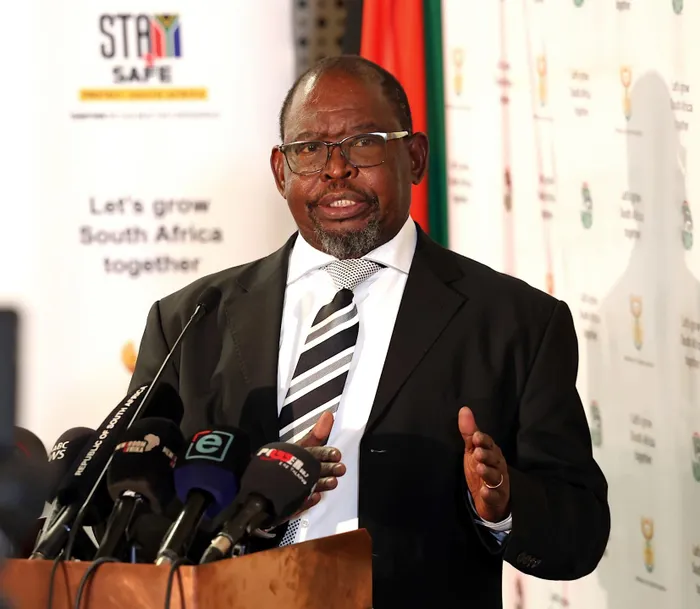
Finance Minister Enoch Godongwana Godongwana said the savings will be an ongoing and entrenched part of the budget process going forward, to weed out inefficiencies and low-performing programmes.
Image: Picture supplied
Finance Minister Enoch Godongwana on Wednesday revealed that South Africa has successfully saved R12 billion through the identification of wastage and duplicated efforts in government programmes.
This announcement was made during the tabling of the 2026 Budget in Parliament, showcasing the government's dedication to fiscal responsibility in an environment where tax increases are to be avoided whenever possible.
Godongwana introduced the Targeted and Responsible Savings (TARS) initiative in the 2025 Medium-Term Budget Policy Budget Statement, saying the initiative had forced departments to engage with efficiency and effectiveness of programmes when seeking funds for different priorities.
Tabling the 2026 Budget in Parliament, Godongwana told the Joint Sitting that the government had promised last May that spending priorities would not be funded through tax increases, if this could be avoided.
“We have kept that promise, through our commitment to finding savings from unproductive expenditure, closing leakages, and rooting out inefficiencies. I am happy to announce that R12 billion in savings have been identified over the medium term,” he said.
Godongwana said the savings will be an ongoing and entrenched part of the budget process going forward to weed out inefficiencies and low-performing programmes.
“Every programme and every allocation must demonstrate value, efficiency and accountability.”
The minister explained that these savings primarily stem from winding down underperforming programmes and reallocating funds away from the Bus Rapid Transport system and initiatives aimed at reducing fraud in the social grants payment system.
Amongst the adjustments, Godongwana noted R8.4 billion from the scaling down of the Public Transport Network Grant over the next three years.
“The grant has not improved access to public transport relative to the investments made. The grant will, however, continue to help cover indirect costs in cities that run bus services.”
He added that the enhanced targeting of social grants authentication of beneficiaries to reduce fraud in the grant system will yield R3 billion of savings.
“The South African Social Security Agency has upgraded its biometric and income verification processes, resulting in nearly 35,000 grants being identified as incorrect or fraudulent, and therefore terminated,” said the minister.
However, Godongwana said the government was committed to improving access for the many South Africans deserving and eligible for social support.
The identified savings identified in public transport grant were shifted to the Passenger Rail Agency of South Africa’s Metrorail Service, which aims to increase ridership from 116 million passenger trips in the current year to 450 million by 2028/29.
Godongwana said further savings were reallocated to strengthen state capacity in the judiciary, border management, defence and Statistics South Africa.
“Allocations are also provided to projects approved by the Budget Facility for Infrastructure.
This includes expanding the Square Kilometre Array and bulk water infrastructure in Polokwane, and restoring Transnet’s iron-ore corridor and coal capacity,” sad Godongwana.
Meanwhile, the TARS initiative is set to be cascaded down to the provincial government sphere to manage provincial government expenditure.
The National Treasury’s Budget Review document stated that the provincial departments faced significant spending pressures, particularly in compensation of employees, which crowd out service delivery and capital investment.
According to Godongwana, provinces have begun to eliminate duplication and focus resources on activities with the greatest impact for citizens.
At least three provinces plan to conduct comprehensive spending reviews in 2026.
“Provinces are tightening staffing and compensation controls (including headcount verification), closely monitoring overtime and improving efficiency in support services such as security, catering and fleet.”
Godongwana noted that several provinces have merged agencies in recent years to reduce overheads.
The Free State, KwaZulu-Natal and Mpumalanga have combined separate entities that managed gambling, liquor and/or tourism.
The Northern Cape has merged its tourism agency and the Kalahari Kid Corporation into an economic development agency.
However, Godongwana said medico-legal claims remained a significant burden for provinces, although some progress has been made in this area.
From 2023/24 to 2024/25, total medico-legal contingent liabilities declined by R4.9 billion, from R62.5 billion to R57.6 billion.
Godongwana said provinces spend an average of R1.5 billion each year on settling the medico-legal claims – funds that could otherwise support frontline health services.
“Efforts to reduce such claims include strengthening patient recordkeeping and safety systems, upgrading infrastructure, promoting mediation, conducting investigations and ensuring health staff works in their areas of expertise.”