

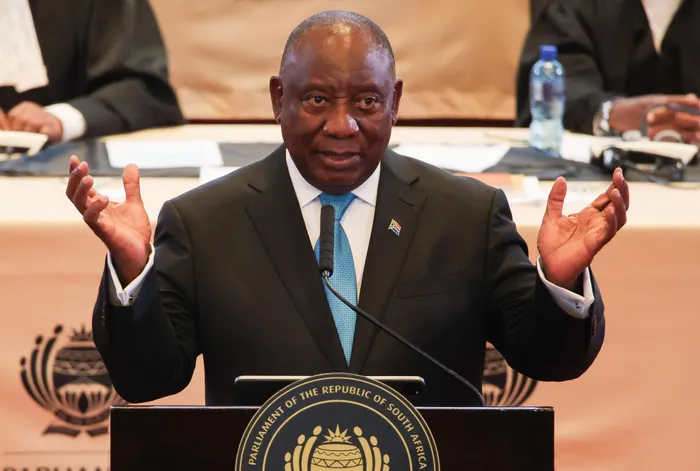
President Cyril Ramaphosa replying during the 2026 State of the Nation Address debate.
Image: IOL
President Cyril Ramaphosa on Thursday took aim at some partners in the Government of National Unity (GNU), saying the government was committed to redressing the injustices of the past.
Speaking during his reply to the State of the Nation Address debate, Ramaphosa said they could not redress without transforming the economy.
In a veiled reference to the DA and the Freedom Front Plus, which are calling for the replacement of Black Economic Empowerment, he said those who called for the scrapping of the Broad-Based Black Economic Empowerment (B-BBEE) touched a raw nerve in him.
“There are people in this House, in this debate, who tell us to get rid of the measures that we have put in place to correct this gross historical injustice.
“They say we must get rid of broad-based black economic empowerment, falsely claiming that it benefits only a few, falsely claiming that it inhibits economic growth, falsely claiming that it enables corruption.”
He defended Black Economic Empowerment, saying there have been real changes in ownership patterns, management control, enterprise development, and skills development.
“Now is not the time to abandon BEE. Now is the time to make it more effective. “
The president urged all to work together to rid the country of the injustices of the past.
“We must see Broad-Based Black Economic Empowerment not as a cost to the economy, but as an investment in the sustainable growth of our economy.
“That is why I announced in the State of the Nation Address that we are undertaking a review of our Broad-Based Black Economic Empowerment framework to ensure that it supports greater transformation and inclusive growth.”
In his response, DA leader John Steenhisen said in a statement that they rejected the protection of BEE, which has benefited only politically connected elites at the expense of the poor, who remain trapped in poverty, locked out of employment, and with little hope of climbing the opportunity ladder.
“We will continue to fight for an alternative that creates a more inclusive economy for all. It is for this reason that the DA has tabled the Economic Inclusion for All Bill. We will relentlessly pursue the replacement of BEE with a policy that truly focuses on addressing poverty,” said Steenhuisen, who is also the Agriculture Minister.
In another veiled reference to the DA, Ramaphosa warned against parties in the executive claiming easy victories.
He stated that there are no parties in the Cabinet, and every member of the executive is part of a collective.
“No minister or deputy minister should be claiming their work in the GNU as an achievement of their party.
“In many cases, the basis for their achievements was laid before they came into office, and in many cases, the work to realise their objectives will continue after they have left.”
Earlier in the address, Ramaphosa defended the progress made by the government over the last 30 years, saying the government has fundamentally improved the lives of the citizens.
He also stated that South Africa has faced some of its most difficult challenges over the past eight years.
“There can be no doubt that we have made progress.”
Ramaphosa said the government undertook a programme of institutional renewal by stabilising what was weakened through state capture, restoring integrity and accountability, and rebuilding the capacity of the state.
“We have overcome a global pandemic that led to the worst decline in our economy, where our GDP contracted by 6%.
“We stood firm in the face of an attempted insurrection that was aimed at destabilising our democracy.”
He said there have been promising signs of recovery in 2025, and said the country was turning the corner.
“Whether people like it or not, it has been there. Whether people think it's an illusion, it has been there. Whether people think we have turned the corner or not, they are blind because we are turning the corner.”
The president said the progress was modest, but the momentum of change was building.
“Our task now is to sustain this momentum, to protect and build on the progress we have made, and to ensure that it results in a tangible improvement in the life of every South African.”
Ramaphosa also said the country still has a long way to go, and his SONA outlined the steps taken by the GNU.
“We know that it will take many years for the economy to grow enough to create enough jobs for all those looking for work.”
The president also said crime and insecurity remained significant impediments to growth.
Ramaphosa confirmed that the SANDF will also be deployed to the Eastern Cape to tackle gang violence there.
He added that the most immediate impediment to faster economic growth was dysfunctionality in many municipalities.
“We are addressing this through an overhaul of our local government system through the review of the White Paper, and through direct interventions in municipalities in trouble.”
The president said this year will be a watershed moment for logistics reform and state-owned enterprises (SOEs) as private rail companies begin to operate on the freight rail network and private electricity producers provide electricity.
“Let us be clear: we are retaining public ownership of our strategic national assets,” he said in response to criticism that the SOEs were being privatised.
“Through these changes, we are strengthening the financial position and the operational performance of entities like Eskom and Transnet. We are making them more competitive and more efficient.”