

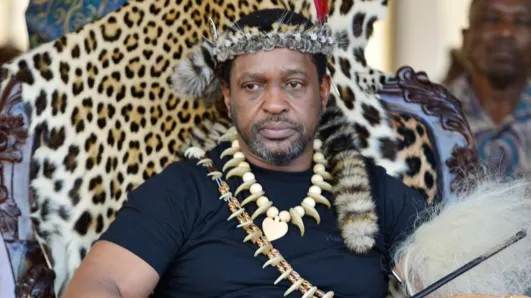
COSATU KZN warns that King Misuzulu’s opposition to mining could harm jobs and economic stability, urging urgent engagement with stakeholders to ensure a balanced approach to land and livelihoods.
Image: Independent Newspapers Archives
The Congress of South African Trade Unions (COSATU) in KwaZulu-Natal has raised concern about King Misuzulu kaZwelithini’s reported opposition to further mining in the province.
The union warned that such a position could deepen unemployment and poverty and called for urgent engagement with labour and all stakeholders.
COSATU acknowledged the king’s concerns about the “historical and ongoing destruction of land” caused by some mining operations, as well as issues like non-compliance with environmental laws and the failure of companies to meaningfully advance beneficiation and community development.
However, the federation expressed concern over the possible impact on jobs and economic stability, noting that KZN’s mining sector, while relatively small compared to other industries, still plays an important role in sustaining economic activity and supporting jobs.
The mining industry directly employs about 10,888 workers in KwaZulu-Natal and contributes approximately 1.5% to the provincial GDP.
The broader minerals and quarrying sector contributes under 2% of the provincial Gross Value Added (GVA).
COSATU warned that “any sudden policy shift in this sector may deepen unemployment and poverty in a province already battling the economic effects of COVID-19, the July unrest, and floods.”
The federation also pointed out that external shocks, such as diminishing trade support from markets like the United States, particularly concerning AGOA, had adversely affected manufacturing and export-oriented jobs.
COSATU highlighted its consistent engagement with mining companies like RBM, urging government intervention when jobs were threatened. It stressed that “workers cannot be expected to carry the burden of poor regulation and corporate greed.”
The federation also acknowledged King Zwelithini’s interest in agriculture and agro-processing, noting its support for such initiatives, provided they complement existing sectors and do not lead to job losses.
COSATU reaffirmed its long-standing, cordial relationship with the Zulu Kingdom, saying that during the 1973 Durban Strike commemoration, the union had acknowledged the king’s role in representing workers when they had no right to join trade unions.
This recognition was formalised through a bilateral engagement between COSATU leadership and King Misuzulu, further strengthening the bond between labour and the Kingdom.
COSATU emphasised that it was “not unreasonable to expect meaningful engagement with organised labour on matters affecting our members, particularly jobs and economic sustainability.”
The federation has urged King Misuzulu to urgently outline his full plan and proposed alternatives, calling for engagement with labour and all stakeholders to ensure a balanced approach that protects both the land and the livelihoods of workers.
COSATU also made it clear that it would “always avail itself for engagement with the Kingdom to better understand the King’s plans and work collaboratively towards balanced and shared outcomes that protect people, land, and economic futures.”
This comes as the African Mining Indaba takes place in Cape Town, an event that has been criticized by activists for prioritising investment over community interests.
Human rights activist Christopher Rutledge, and Executive Director of Mining Affected Communities United in Action Advice Office, argued that the Indaba was not a development forum, but rather “a place where the finite inheritance of the people of Africa is converted into short-term cash flow and sold as foresight.”
He argued that the event would be characterised by “strategy,” “confidence,” and “progress,” but that this would be misleading because “it is none of these.”
Rutledge said the mining industry’s long history in South Africa showed that extraction had not produced durable productive capacity, reduced inequality, or created resilient local economies.
He said the pattern had remained even after governments and flags changed, with minerals extracted and revenues briefly absorbed into the fiscus, only to be dispersed through consumption, debt servicing, and capital flight.
“When extraction ends, leverage ends with it. When the mine closes, the bill arrives. When the investors leave, communities remain.”
Rutledge warned that what remained were “degraded ecosystems, collapsing municipalities, and households abandoned with no transition plan, no exit strategy, no future beyond survival.
”He said the geography of the Indaba was not incidental and that decisions were made far from the harm they caused, by people who would never bear the long-term costs. He added that this was where sovereignty was not merely performed but appropriated.
Rutledge said communities were invited to consult but not to consent, and that when communities resisted, they were framed as obstacles to development.
He argued that the debate could not end with partnership slogans or ESG panels and called for stronger governance.
He said South Africa urgently needed a mandatory Public-Interest Exit Test for mining companies.
''Before any mine closure, asset sale, corporate restructuring, or foreign redomiciling is approved, companies should be required to demonstrate, publicly, how workers will be protected, how communities will be housed, how environmental liabilities will be funded, and how historic obligations will be honoured.''
He added that “investment should not be allowed to socialise loss and privatise gain,” and that “democracy should not end at the mineshaft gate.”
IOL Politics