

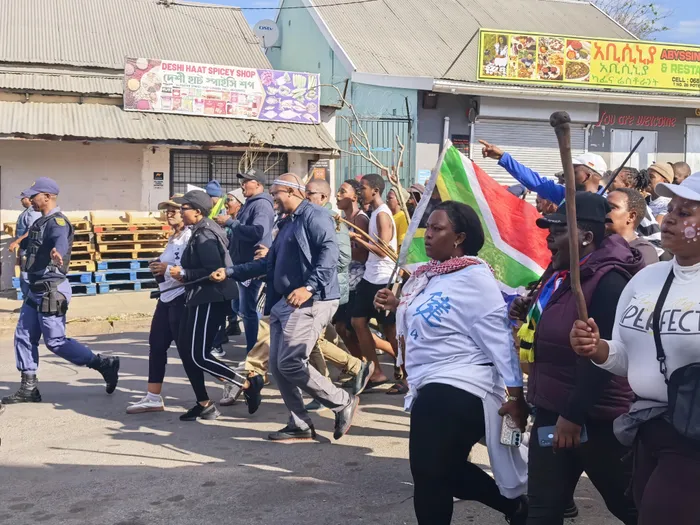
Marie Huchzermeyer writes the execution of March and March's anti-immigrant protest action needs to be subjected to legal scrutiny.
Image: Pedro Mapelo / I'solezwe lesiXhosa
On June 25, in the lead-up to what March and March announced as its end-June national shutdown, a protest against illegal migrants proceeded through my neighbourhood, Brixton. The march was accompanied by the South African Police Service, with security company backup in streets that paralleled the protest route. Police and private security warned pedestrians and traders in advance to pack up, close shop and make themselves unseen.
An officer leaning out of a private security vehicle warned me not to proceed down a side street towards the marchers, but I did. I captured pictures of the march a block away from Breezeblock Café as it passed through Caroline Street. On my photographs, the small crowd is preceded by a DST tactical response vehicle, sided by policemen and backed by two police vans. It is led by a man waving a sjambok. Others carry long wooden sticks and metal bars with bent ends.
With protesters carrying threatening instruments and chanting anti-foreigner statements it is hard to understand the political and media description of these marches as peaceful. Post June 30, there is documented evidence that in many places March and March protests emboldened people to loot and to harass, chase, threaten, attack, and evict, if not kill, individuals they have othered. This is well documented and occurred during marches and in the days and nights that followed.
In the months leading up to the end-June ultimatum set by March and March, a sustained impact on entire communities had already manifested as result of the supposedly peaceful marches. Households whose income depends on street vending and street-facing retail outlets in downtown Johannesburg and the commercial streets in neighbourhoods such as Brixton and those we call townships have been strained by the loss of wages or income as the local economy is forced to make way for the marches.
Puzzled by how the past marches and those awaiting us every Thursday going forward are officially sanctioned, I looked up legislation.
According to section 17 of the Constitution, “Everyone has the right, peacefully and unarmed, to assemble, to demonstrate, to picket and to present petitions”. The word ‘unarmed’ made me look up the Dangerous Weapons Act of 2013: “'Dangerous weapon' means any object, other than a firearm, capable of causing death or inflicting serious bodily harm, if it were used for an unlawful purpose”. This includes sjamboks, sticks and steel bars. How is it that the police officers don’t confiscate these arms before a march starts?
What about the unequivocal anti-foreigner and anti-illegal migrant messages chanted by the marchers and displayed on posters announcing the marches? The Prevention and Combating of Hate Crimes and Hate speech Act of 2023 is very clear that hate speech and hate crimes include those based on the target’s “ethnic or social origin” or “nationality, migrant, refugee or asylum seeker status”. Victim impact, according to this act, includes “physical, psychological, social, economic or any other consequences of the offence for the victim and the victim’s family member or a group of persons with whom the victim associates or supports”.
It is not difficult to compile the evidence that March and March is responsible for a very serious and widespread impact, not only on the lives of those it targets, but on their families and communities. It evidently hits the low-waged most, those who count little in the national economic narrative, allowing business analysts to announce on July 1 that all is back to normal. March and March with its network of reactionary organisations and political parties are deepening inequality. Why is the individual and collective victim impact not receiving the legal attention it deserves?
How then are the hate-filled posters permitted, and the marches officially approved? The Regulations of Gatherings Act of 1993 sets out clear procedures for the police service to follow in approving or rejecting an application for a gathering of more than 15 people. This includes consultation and negotiation.
For the responsible officer to reject an application for a gathering or march, “credible information on oath” is needed to substantiate that “there is a threat that a proposed gathering will result in serious disruption of vehicular or pedestrian traffic, injury to participants in the gathering or other persons, or extensive damage to property, and that the Police and the traffic officers in question will not be able to contain this threat”. Further consultations are needed “to consider the prohibition of the gathering”. Only if the responsible officer is convinced that amendments to the gathering or other measures cannot prevent the threat, the officer “may prohibit the proposed gathering”.
This is a cumbersome process and there is likely to be political interference, should a responsible officer attempt to comply with their legal duties. Legally, much depends on credible evidence about March and March’s record of hate speech, hate crime, flouting of peaceful and weapon-free gathering rules, and serious disruption caused by the marches. Much effort is needed by human rights organisations, anti-xenophobic movements and organisations, local communities and those in government not captured by the network March and March is part of, to lay bare the evidence, insist it be used to stop approval of the marches and to arrest the rampant hate crime that is engulfing South Africa.
On June 30, March and March national leader Jacinta Ngobese-Zuma declared that nationwide street protests would be repeated every Thursday until all undocumented foreign nationals have left South Africa. Given our laws, including the process to be followed in approving an application for a gathering of more than 15 people, Ngobese-Zuma may at best announce that her organisation intends to apply for permission weekly to each provincial commissioner for the intended marches. Whether the applications receive official approval must be dependent on the evidence those standing for the values enshrined in our Constitution are able to compile and provide.
* Marie Huchzermeyer is the Director of the Centre for Urbanism and Built Environment Studies (CUBES), School of Architecture and Planning, University of the Witwatersrand.
** The views expressed do not necessarily reflect the views of IOL.