

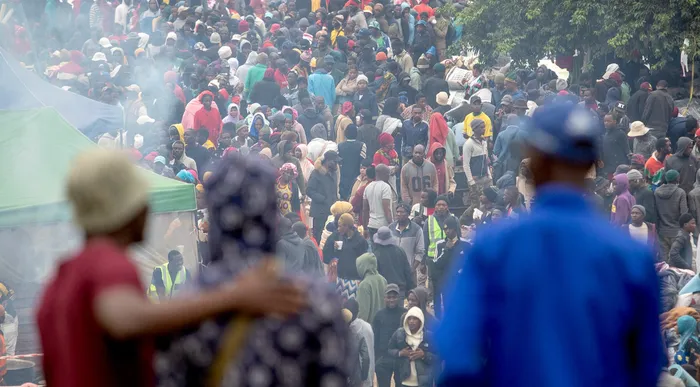
Hundreds of documented and undocumented foreign nationals are currently displaced across eThekwini (Durban) following threats and protests from armed local groups demanding they leave the country. Thousands of individuals—primarily from Malawi and Mozambique, along with other African nations—are sheltering in makeshift camps and open fields. Dr Buccus is senior research associate at ASRi and at UJ has warned that rising anti-migrant sentiment, mass displacement and growing tensions linked to an unofficial June 30 deadline could trigger further violence and deepen Durban's humanitarian crisis.
Image: Leon Lestrade / Independent Newspapers.
The xenophobia crisis in Durban has reached a critical point, with growing fears of further violence, widespread looting and even a large-scale pogrom as 30 June approaches.
More than 400 documented refugees who were driven from their homes over a month ago remain on the pavement outside the Home Affairs office on Che Guevara Road. At least 1 000 displaced people are living in similarly dire conditions in Sherwood Park.
For months, xenophobic groups and organisations have acted with apparent impunity, illegally demanding that people produce identity documents, intimidating and assaulting residents, and instructing migrants to leave South Africa by 30 June.
Numerous people have reportedly been assaulted, while businesses have been shut down, seized or looted. Although the state has formally condemned unlawful actions by xenophobic groups, it has not acted decisively against them and is simultaneously pursuing a programme of mass deportations.
The significance of the 30 June deadline should not be underestimated. Although it has no legal basis, it has acquired considerable symbolic power.
It has become a focal point for rumours, threats and intimidation. In recent months, migrants have repeatedly been told that they must leave the country by that date or face unspecified consequences. International experience shows that when vigilante groups establish deadlines and ultimatums, they can create conditions that facilitate coordinated violence.
Rather than protecting migrants who are being driven from their homes and businesses, the state has allowed mobs to operate without meaningful consequences. Once displaced, people are receiving little support to return home safely.
Instead, undocumented migrants are being compelled to leave, while documented migrants are effectively left to choose between remaining in dangerous circumstances or departing the country. For those whose governments are not arranging repatriation, the option offered is often detention at Lindela Repatriation Centre, South Africa's migrant detention facility.
While ActionSA and the Patriotic Alliance have played a damaging role in fuelling anti-migrant sentiment, March and March has also been closely associated with the uMkhonto weSizwe Party, whose members frequently participate in its activities.
Given the extensive destruction caused during the July 2021 unrest, many people in KwaZulu-Natal fear a similar outbreak of violence as the end of June approaches.
Xenophobia does not emerge spontaneously. It is organised, cultivated and directed. It flourishes when political actors find it useful to redirect public anger away from corruption, inequality, unemployment and state failure. Throughout history, political entrepreneurs have built support by identifying vulnerable minorities as enemies.
The outcome is familiar: those who benefit from inequality remain untouched while poor and working-class communities are encouraged to turn against one another. In Durban today, that process appears to be unfolding in real time.
Muslim charities have provided support to thousands of displaced people in Sherwood Park, as well as to refugees who have spent weeks sleeping outside the Home Affairs office. Their assistance has been welcomed and appreciated by displaced people of all faiths. However, far more support is required, particularly from the state.
Behind the statistics are people enduring extraordinary hardship. Children have been unable to attend school. People living with chronic illnesses have lost access to medication. Families who spent years building small businesses have seen their livelihoods destroyed.
Many of those displaced have lived in South Africa for years, and in some cases decades. Many have South African partners and children born in the country.
Yet people who have built lives, families and communities here are increasingly being treated as though they do not belong.
Municipal disaster management structures are failing to respond adequately to what has become a major humanitarian and human rights crisis. The issue is increasingly attracting international attention.
South Africa's reputation is being damaged, with potential consequences for South African businesses operating elsewhere in Africa and for musicians performing across the continent. The moral authority South Africa gained through its decision to bring a genocide case against Israel before the International Court of Justice is being steadily eroded — a development that critics of that action in Tel Aviv and Washington are likely to welcome.
As the crisis has intensified and far-right rhetoric has become increasingly normalised, only a handful of nationally prominent leaders have consistently opposed xenophobia. Among them are Julius Malema of the EFF, Zwelinzima Vavi of Saftu and S'bu Zikode of Abahlali baseMjondolo.
At a time when many public figures have remained silent, these leaders have maintained a clear and consistent stance. The conduct of others will be more difficult to justify. The South African Communist Party, which invited the MK Party to its Conference of the Left, has failed to meet the demands of the moment.
South Africa is now facing a crisis that requires a broad coalition against xenophobia. Religious organisations, NGOs, trade unions, community groups, cultural figures and intellectuals must take a clear stand against xenophobia and the organisations promoting it.
The state must move beyond rhetoric and act decisively against those driving people from their homes. It must also urgently provide safe and dignified accommodation for all displaced people. No one should be forced to sleep in the open, whether on city streets or in public parks.
While all states regulate their borders and citizenship systems, the response to organised xenophobia should not be an increasingly punitive migration regime. Efforts should instead focus on regularising the status of people who have fallen through the cracks because of corruption and administrative failures, and on creating pathways to citizenship for those who have built lives, raised families and contributed productively to South African society.
The uncomfortable reality is that South Africa's mainstream discourse on migration, as well as state policy, is in some respects further to the right than that of several European countries — a continent frequently criticised for racism and growing right-wing politics.
There is little time to act. South Africa must find the political will and the humanity needed to prevent further suffering in Durban and avert the real possibility of another outbreak of violence and looting at the end of the month.
***Dr Buccus is senior research associate at ASRi and at UJ
** The views expressed here do not necessarily represent those of IOL.
IOL Opinion
Dr Imraan Buccus has warned that rising anti-migrant sentiment, mass displacement and growing tensions linked to an unofficial June 30 deadline could trigger further violence and deepen Durban's humanitarian crisis.
Image: IOL