

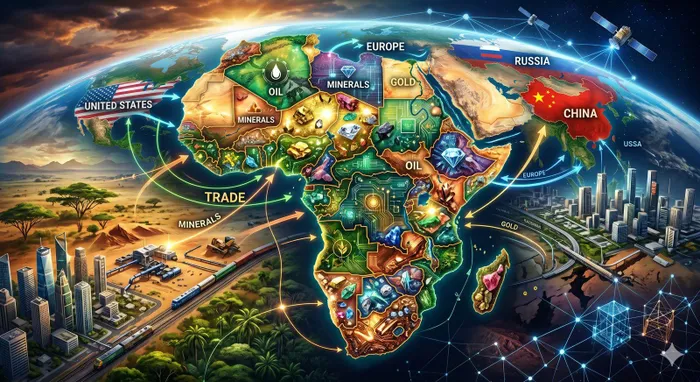
The 'fog of war' extends beyond traditional battlefields, writes Armstrong Williams, revealing the hidden conflicts that shape Africa and the world in the 21st century.
Image: IOL / Gemini AI
When most people hear the phrase fog of war, they imagine military commanders struggling to understand a battlefield filled with uncertainty. They think of armies, missiles, tanks, and soldiers. Yet in the twenty-first century, some of the most powerful wars are fought far from traditional battlefields. These conflicts are often invisible to ordinary people, but their consequences can be just as devastating.
Today, wars are fought through economics, trade, technology, energy, information, finance, and resources. Nations compete not only for territory but for influence, markets, strategic minerals, supply chains, and political leverage. The casualties are often not soldiers but working families who face rising prices, unemployment, shortages, and economic instability.
No continent better illustrates this reality than Africa.
For centuries, Africa has been one of the world’s greatest repositories of natural wealth. The continent possesses vast reserves of gold, diamonds, platinum, uranium, copper, cobalt, manganese, lithium, chromium, rare earth minerals, oil, and natural gas. These resources have helped fuel industrial revolutions, technological advancement, and economic growth across the globe.
Yet Africa’s story remains one of profound contradiction.
The continent that supplies much of the world’s raw materials is still home to many of the world’s poorest communities. The resources that enrich powerful nations often leave behind only a fraction of their value where they originate.
South Africa occupies a unique place within this global equation.
The nation sits atop some of the most valuable mineral deposits on earth. South Africa produces much of the world’s platinum, a strategic resource essential for automotive manufacturing, industrial production, and emerging energy technologies. Its mining sector remains a critical pillar of the global economy.
What happens in South Africa does not stay in South Africa.
When production slows, global markets react. When labour unrest emerges, investors take notice. When energy shortages affect mining operations, industries around the world feel the impact. South Africa’s resources are deeply woven into the economic fabric of the modern world.
This reality becomes even more significant during periods of geopolitical tension.
Consider the growing competition between the United States and China. Both nations understand that the future of technology, energy production, and advanced manufacturing depends upon reliable access to strategic minerals. Electric vehicles, artificial intelligence systems, renewable energy infrastructure, defense technologies, and semiconductor production all require resources found in abundance across Africa.
As a result, Africa increasingly finds itself at the center of a new global competition.
China has invested billions in African infrastructure, transportation networks, ports, and mining projects. The United States seeks stronger economic and strategic partnerships throughout the continent. Europe continues to rely heavily upon African resources while attempting to redefine its relationships with former colonies. Russia pursues influence through security agreements, energy partnerships, and diplomatic engagement.
Each power presents its efforts as mutually beneficial cooperation. Yet beneath the diplomatic language lies a fundamental reality: nations pursue their interests.
This is where the fog of war becomes especially dangerous.
The average citizen may see headlines about trade agreements, infrastructure investments, or diplomatic summits without recognising the larger strategic struggle unfolding behind them. The competition for resources is often disguised as development assistance. Economic pressure is presented as policy. Strategic influence is packaged as partnership.
Meanwhile, ordinary people experience the consequences.
When conflicts disrupt shipping lanes, food prices rise. When sanctions are imposed, supply chains are interrupted. When commodity markets become unstable, employment suffers. When global powers clash economically, inflation often follows. The effects ripple outward from boardrooms and government offices into neighborhoods and households.
For South Africa and the broader African continent, the challenge is not simply managing resources. It is managing power.
History demonstrates that natural wealth alone does not guarantee prosperity. Some of the world’s most resource-rich nations remain economically fragile, while countries with relatively few natural resources have achieved extraordinary success through education, innovation, entrepreneurship, and strong institutions.
The critical question is whether Africa can transform resource wealth into sustainable human development.
Can mineral wealth build world-class schools?
Can energy resources create thriving industries?
Can foreign investment strengthen local communities rather than simply extract value?
Can governments ensure that ordinary citizens benefit from the wealth beneath their feet?
These questions may ultimately determine Africa’s future more than any election, treaty, or international summit.
The next chapter of global history will not be written solely in Washington, Beijing, Brussels, or Moscow. It will also be written in Johannesburg, Cape Town, Nairobi, Lagos, Accra, Kigali, and countless communities across the African continent.
The fog of war teaches us that the most important battles are often the ones we cannot immediately see. Behind every geopolitical crisis lies a deeper struggle for influence, resources, and economic power.
Africa’s resources help sustain the world’s superpowers. They power factories, fuel industries, support technological innovation, and strengthen national economies thousands of miles away.
The challenge before Africa is ensuring that these same resources also sustain African families, African communities, and African dreams.
If the twenty-first century belongs to those who control the resources that power modern civilisation, then Africa is not standing on the sidelines of history. Africa is standing at its very centre.
The question is whether the continent will merely supply the future or help shape it.
The 'fog of war' extends beyond traditional battlefields, writes Armstrong Williams, revealing the hidden conflicts that shape Africa and the world in the 21st century.
Image: IOL
* Armstrong Williams is the manager and Sole Owner of Howard Stirk Holdings I & II Broadcast Television Stations and the 2016 Multicultural Media Broadcast Owner of the year.
** The views expressed do not necessarily reflect the views of IOL.