

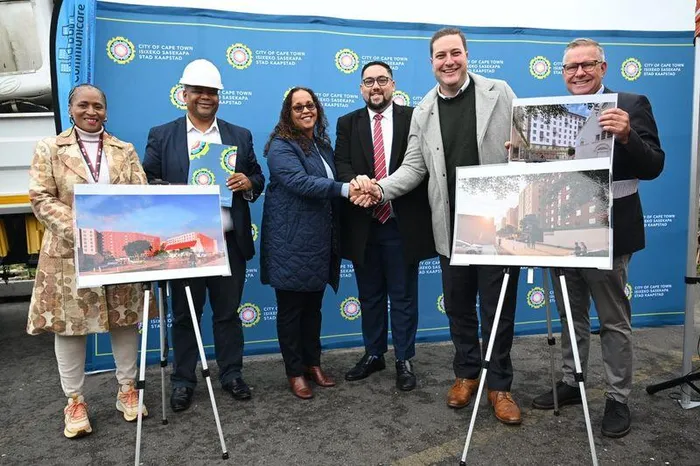
Nolwandle Gqiba, Executive Director City of Cape Town Human Settlements Directorate, Mark van Wyk, Chairperson Communicare, Anthea Houston, CEO of Communicare, Mayco Member for Human Settlements, Councillor Carl Pophaim, Cape Town Mayor Geordin Hill-Lewis, City Councillor Ian McMahon at the Salt River Market site for the construction of 970 inner-city affordable housing units by developer Communicare.
Image: Supplied
There is a growing gap in Cape Town between what residents are told and what they experience.
The City says affordable housing delivery is accelerating. Many residents waiting for housing say otherwise.
Last week, Mayor Geordin Hill-Lewis marked the handover of the Salt River Market site for an affordable housing development. The announcement was accompanied by positive headlines and renewed commitments to tackling the city's housing shortage.
However, beyond the ceremony lies a more difficult question: where are the homes?
The Salt River Market project is expected to deliver 970 housing units, of which 300 will be social housing units. The remainder are classified as market-linked affordable housing.
This raises an important question about the meaning of affordability in a city where many residents struggle to meet basic living costs.
Affordable for whom?
For pensioners dependent on state grants, security guards earning modest wages, domestic workers commuting long distances from the city's outskirts, and thousands of families living in informal or backyard accommodation, many so-called affordable housing options remain out of reach.
Critics argue that Cape Town's housing policy increasingly uses the language of affordability while delivering housing products that remain inaccessible to many low-income residents.
The scale of the challenge remains significant.
More than 450,000 people are listed on the City's housing database. Behind that figure are families, pensioners, workers, young people, people living with disabilities and others whose lives are shaped by the absence of secure housing.
The issue is not simply the existence of a housing backlog. The concern is whether housing delivery is receiving the urgency required to address it.
The City has become increasingly effective at announcing housing projects. Whether those projects are being delivered at the scale necessary to meet demand remains a matter of public debate.
Projects such as Founders Garden and other inner-city developments have been the subject of repeated announcements over several years. Each milestone is presented as progress, yet many of the underlying realities remain unchanged.
Low-income residents continue to be concentrated on the urban periphery. Transport costs remain high. Property prices continue to rise. Rental accommodation becomes increasingly expensive, while homelessness remains a visible challenge.
Supporters of the City's approach note, correctly, that housing developments require time to plan, approve and construct.
The more important question, however, is whether housing for low-income residents receives the same level of political urgency as issues affecting wealthier communities and investors.
Critics argue that when economic development and investment confidence are at stake, the City is able to move quickly. Housing delivery for the poorest residents, by contrast, often appears slower and more constrained by administrative processes.
These perceptions shape public confidence in government priorities.
Concerns have also been raised about the operation of some social housing developments.
In Goodwood, disputes involving social housing tenants, including pensioner Valerie Gates, have drawn attention to allegations relating to lease renewals, service charges and tenant treatment. Housing activists and legal organisations argue that such cases highlight broader concerns about whether social housing is adequately centred on dignity, security and affordability.
Housing cannot be measured solely by the number of units delivered. It must also be measured by stability, affordability, safety and residents' sense of belonging.
Another question deserving public scrutiny is how public land is being used.
Cape Town possesses some of the most valuable public land in South Africa. Decisions regarding that land should be assessed according to whether they primarily benefit residents who have historically been excluded from economic opportunity and well-located housing.
Many residents have become sceptical of housing announcements not because they oppose development, but because they distinguish between announcements and completed projects, between commitments and outcomes.
A site handover is not the same as housing delivery.
Cape Town has many of the resources required to address its housing crisis. It has land, planning expertise and access to funding mechanisms.
What remains contested is whether there is sufficient political will to challenge a development model that often treats housing primarily as a market commodity rather than a constitutional right.
Ultimately, the housing crisis reflects political choices about priorities, public assets and who benefits from urban development.
Mayor Hill-Lewis frequently speaks of building a city of hope. Hope matters. But hope must be matched by delivery.
Residents want more than announcements, artist impressions and ceremonies. They want tangible results.
Until housing is delivered at a scale that reflects the magnitude of the crisis, every ribbon-cutting ceremony and site handover will be judged against a simple reality:
Hundreds of thousands of Capetonians are still waiting for a place to call home.
But working-class Capetonians cannot live inside a press release.
The fundamental question remains brutally simple:
Where are the homes?
Not the plans.
Not the promises.
Not the developers.
Not the renderings.
Not the speeches.
The homes.
The Democratic Alliance wants the public to believe it is leading a housing revolution.
The evidence suggests something very different.
The reality is that Cape Town has become exceptionally good at facilitating private property development while remaining exceptionally poor at housing poor people.
That is the truth.
The cranes dominate the skyline.
Luxury apartments multiply.
Property prices soar.
Developers celebrate.
Estate agents prosper.
But the housing waiting list continues growing.
The backyard population continues growing.
Informal settlements continue growing.
Homelessness continues growing.
If the Mayor’s housing strategy was working, why is the housing crisis getting worse?
That is the question nobody in the Civic Centre wants to answer.
The truth is that housing has never been the priority.
Property values have been the priority.
Investment confidence has been the priority.
Development facilitation has been the priority.
Protecting Cape Town’s global brand has been the priority.
The poor have been expected to wait.
And wait.
And wait.
And wait.
For decades.
Today, a domestic worker from Khayelitsha spends hours travelling into the city to clean homes she could never afford to live near.
A security guard from Delft protects buildings he could never rent in.
A waiter from Mitchells Plain serves customers in neighbourhoods that have effectively become economically inaccessible.
A pensioner survives on a grant while being crushed by service charges disguised as affordability.
This is not an accident.
This is the result of political choices.
The City talks endlessly about “well-located affordable housing”.
Yet the numbers reveal the deception.
At Salt River Market, the flagship project now being celebrated, only a fraction of the units are genuine social housing.
The majority are market-linked units.
In other words, housing for people who already have considerably more income than the poorest residents.
The DA calls this affordable.
Ask a cleaner earning R5,000 a month whether a R7,000 or R8,000 rental unit is affordable.
Ask a pensioner.
Ask an unemployed youth.
Ask a single mother.
The answer is obvious.
The City has redefined affordability to suit developers rather than residents.
And this is where the hypocrisy becomes impossible to ignore.
The same administration that constantly lectures national government about delivery has repeatedly failed to spend portions of its own housing budget.
Year after year questions emerge about delayed projects, underspending, slow implementation, planning bottlenecks and missed targets.
Yet somehow the public relations machine never misses a deadline.
The cameras are always ready.
The speeches are always polished.
The announcements are always grand.
The delivery is always somewhere in the future.
Always coming.
Never arriving.
For all the rhetoric about spatial justice, apartheid geography remains largely intact.
Cape Town remains one of the most unequal cities on Earth. FACT
The wealthy continue to occupy the most economically valuable land.
The poor continue to be pushed to the margins.
The transport burden remains unbearable.
The housing backlog remains staggering.
The land question remains unresolved.
And the Mayor wants applause because another site has been handed over.
No.
Capetonians should not applaud.
Capetonians should demand answers.
Why does a city with one of the largest municipal budgets in South Africa still have hundreds of thousands waiting for housing?
Why are public land parcels taking years and sometimes decades to become actual homes?
Why are social housing tenants reporting unaffordable charges and insecurity?
Why is the City more comfortable talking about developers than tenants?
Why is there no wartime-style housing emergency plan?
Why is there no visible political urgency equal to the scale of the crisis?
The answer is uncomfortable.
Because housing the poor requires political courage.
It requires confronting powerful interests.
It requires challenging speculative property markets.
It requires treating land as a public good rather than a commodity.
It requires choosing people over profit.
And that is where this administration has failed.
The housing crisis is not a technical problem.
It is a political problem.
There is enough land.
There is enough expertise.
There is enough money.
What is missing is political will.
The poor of Cape Town do not need another announcement.
They need a government that wakes up every morning obsessed with reducing the housing waiting list.
They need a government that treats homelessness as an emergency.
They need a government that measures success in families housed, not press releases issued.
They need a government that understands that housing is not a property transaction.
Housing is dignity.
Housing is opportunity.
Housing is freedom.
Housing is belonging.
Housing is justice.
Mayor Hill-Lewis must decide who he wants to be remembered as.
The Mayor who managed Cape Town’s property boom?
Or the Mayor who finally confronted Cape Town’s housing shame?
Right now the answer is becoming clearer by the day.
The City has become highly efficient at producing housing headlines.
It remains dangerously ineffective at producing housing justice.
And the people of Cape Town know the difference.
The poor cannot sleep in announcements.
The homeless cannot live in artist impressions.
And working-class families cannot build a future on promises.
Enough with the ceremonies.
Enough with the marketing.
Enough with the spin.
Build the houses.
Or stop pretending.
* Faiez Jacobs is a former Member of Parliament, founder of The Transcendence Group, Capetonian, Activist, and Servant of the People.
** The views expressed do not necessarily reflect the views of IOL or Independent Media.
IOL Opinion