

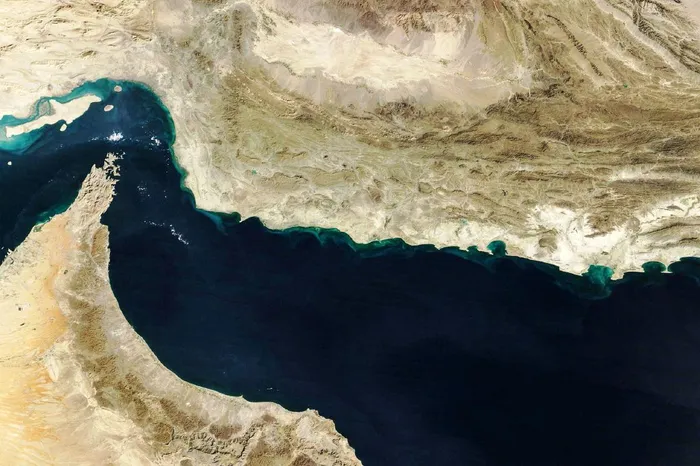
Iran’s Tasnim News Agency reported that Iran and the “Axis of Resistance” had placed the closure of the Strait of Hormuz and the activation of other fronts—including the Bab el-Mandeb Strait—on their agenda as part of their response to Israel and its supporters.
Image: Nasa Earth Observatory / AFP
As Iran continues to threaten maritime navigation through the Strait of Hormuz, the United Nations warned on Tuesday, June 2, 2026, that global humanitarian supply chains disrupted by the war in the Middle East will not recover before 2027, even if the conflict were to end immediately.
Legal experts stress that closing the Strait of Hormuz constitutes a clear violation of international law. In this context, Dr. Majid Boudin, Professor of International Law in Paris, stated that any attempt by a state or entity to close waterways or obstruct the movement of vessels amounts to an explicit breach of international law, emphasising that such routes are “the property of all humanity.”
In remarks to the media, he added that maritime navigation is governed by well-established rules, beginning with “customary international law codified over thousands of years,” extending through the principles of international law and modern treaties such as the United Nations Convention on the Law of the Sea. He noted that this extensive legal framework prevents any party from exercising absolute control over seas and oceans and guarantees freedom of navigation for vessels across all global waterways.
Meanwhile, UNICEF’s Chief of Global Transport and Logistics, Jean-Cédric Meeus, stated that “the disruption of global humanitarian supply chains is affecting children around the world, amid congestion along supply routes and rising costs.”
Speaking from the Somali capital, Mogadishu, the UN official explained that “what begins as a disruption to shipping routes into the Middle East, particularly through the Strait of Hormuz, quickly turns into a humanitarian crisis.” He added that “persistent delays and rising operating costs, combined with the global funding crisis,” have already begun forcing UNICEF into making “extremely difficult choices.”
He pointed out that every additional dollar spent on transportation means less funding available for children’s assistance programs, noting that “air cargo capacity has declined across the Middle East, while several airlines have suspended flights to destinations in Africa, as port congestion continues to spread across parts of the continent.”
In a related development, the United Nations Conference on Trade and Development (UNCTAD) reported that oil price shocks resulting from the conflict are having significant consequences for developing countries, which increasingly find themselves forced to choose between financing essential imports and meeting other critical priorities.
According to UNCTAD spokesperson Marcelo Rizzi, “a geopolitical shock becomes a development shock for countries least capable of absorbing it.” He added: “Even if a ceasefire or peace agreement is reached, the effects will persist. They do not simply disappear; in some cases, they evolve into structural impacts.”
The World Health Organization has also warned of a continued decline in fuel availability and in the resilience of healthcare systems.
WHO spokesperson Christian Lindmeier stated that “the most severe repercussions are being recorded in Cuba, Gaza, South Sudan, Somalia, Ethiopia, Sudan, and Yemen.” He noted that “the recurring fuel shortage crisis—particularly diesel shortages—remains the greatest threat to healthcare operations, given the dependence of health systems on generators, cold-chain networks, ambulances, water systems, and humanitarian logistics.”
In an unprecedented development, two sources familiar with U.S. intelligence reports told CNN that Iran has already begun deploying naval mines in the Strait of Hormuz, one of the world’s most strategically important energy corridors through which nearly one-fifth of global oil trade passes.
The sources indicated that Iran had deployed several dozen naval mines. Although limited in scale, the move is seen as a signal of Tehran’s readiness to expand its operations in the strait should military tensions in the region escalate further.
The deployment of naval mines has a significant impact on maritime traffic, as it can disrupt both commercial and military vessels and necessitate complex and lengthy demining operations. Reports emphasize that any disruption to navigation through the Strait of Hormuz could directly affect global energy markets, given that vast quantities of crude oil and liquefied natural gas transit daily through this maritime corridor from Gulf states to markets in Asia and Europe.
Approximately 20–25 percent of global oil supplies and 20 percent of global LNG shipments pass through the strait, making any disruption a major threat to global supply chains.
Last May, US Central Command (CENTCOM) announced that Iran had attacked American warships and commercial vessels transiting the Strait of Hormuz.
In April, the United Kingdom Maritime Trade Operations (UKMTO) reported that at least three container ships had come under fire in the strait. The agency stated that the captain of one vessel reported the approach of an Iranian military craft northeast of Oman. The ship subsequently came under gunfire and rocket attack, sustaining significant damage to its bridge, though no casualties or environmental damage were reported.
Two other vessels reported coming under fire approximately eight nautical miles west of Iran, also without casualties. In its preliminary reports, UKMTO did not identify the perpetrators of those incidents.
Days ago, Iran’s Tasnim News Agency reported that Iran and the “Axis of Resistance” had placed the closure of the Strait of Hormuz and the activation of other fronts—including the Bab el-Mandeb Strait—on their agenda as part of their response to Israel and its supporters.
Statements by members of Iran’s negotiating team regarding the “activation of other fronts, including Bab el-Mandeb,” as options available to Tehran for pressure and bargaining, reveal a reality that Yemen’s Houthi militia has long sought to deny or obscure: namely, that decisions regarding war and peace, escalation and de-escalation, are not made by the militia itself but in Tehran, according to former Yemeni minister Moammar Al-Eryani.
In a post on social media, he stated: “The most dangerous aspect of these remarks is not merely the inclusion of Bab el-Mandeb among Iran’s pressure tools, but the manner in which Iranian officials speak about the strait as though it were a negotiating card over which they possess authority. This confirms that the Houthi militia can no longer conceal the reality of its dependency, as Revolutionary Guard leaders now openly issue statements concerning Yemeni sovereignty and national interests.”
He added: “Even more alarming is that Tehran is no longer content with financing and arming the Houthis; it now speaks on behalf of Yemen itself and treats Bab el-Mandeb as though it were part of its sphere of influence. Every statement of this kind confirms that those for whom the Revolutionary Guard speaks—and whose escalation and de-escalation strategies it dictates—cannot credibly claim to represent Yemen or defend the interests of its people. Bab el-Mandeb is a sovereign Yemeni maritime passage, not an Iranian bargaining chip.”

Iran’s Tasnim News Agency reported that Iran and the “Axis of Resistance” had placed the closure of the Strait of Hormuz and the activation of other fronts—including the Bab el-Mandeb Strait—on their agenda as part of their response to Israel and its supporters, writes Bayethe Msimang.
Image: IOL
* Bayethe Msimang is an independent writer, analyst and political commentator.
** The views expressed do not necessarily reflect the views of IOL.