

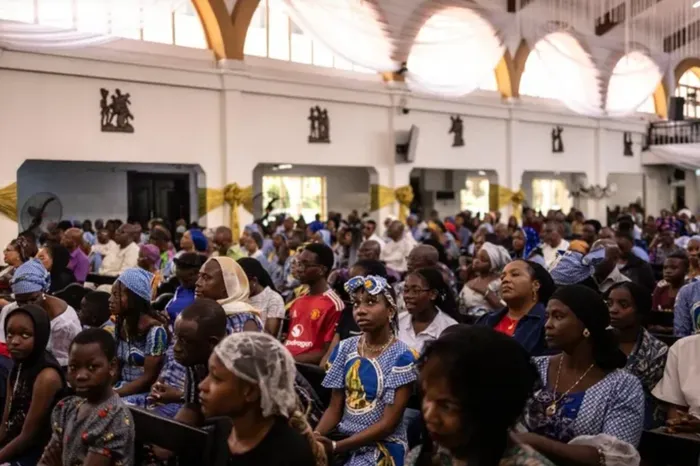
Catholics gather for a mass at the Church of the Assumption in Lagos on April 21, 2025. An unknown number of pupils have been abducted from a Catholic school in central Nigeria, an official said on November 21, 2025, in the second such incident in less than a week.
Image: Internal
In May 2026, bandits stormed three schools in Oriire Local Government Area, Oyo State, beheading a teacher named Michael Oyedokun in front of his students before abducting children into the forest. The bandits then invaded Baptist Nursery and Primary School, Community Grammar School, and L.A. Primary School in a coordinated attack. This was not an isolated horror. It was the latest entry in a ledger that has been filling since 2014. Nigeria does not have a kidnapping problem. It has a governance collapse that expresses itself, most visibly and most shamefully, through the bodies of little children.
Nigeria has recorded over 20 major school kidnapping incidents since the 2014 Chibok abduction, with more than 1,700 students and staff abducted, showing how insecurity has become seriously embedded in the country's social system, particularly in northern and central regions. These are not episodic failures. They are a pattern so consistent it constitutes policy through inaction.
According to Save the Children, at least 10 school kidnapping attacks happened in less than two years between January 2024 and late 2025, affecting more than 670 children. In November 2025 alone, 25 schoolgirls were abducted from the Government Girls Comprehensive Secondary School in Kebbi State, and just three days later, 303 students and 12 teachers were seized at St. Mary's Catholic School in Papiri, Niger State. The expansion of mass school raids into the southwest now marks a dangerous new chapter.
What makes this unconscionable is not only the frequency of these attacks, it is what happens thereafter. Nigeria's Minister of Education, when asked about the wave of kidnappings on national television in December 2025, did not speak about children or policy failure. He accused critics of trying to "embarrass the government" and invoked President Tinubu's name as assurance. Two days after the May 2026 attacks, that same minister was in London at the Education World Forum, meeting the Duke of Edinburgh. Let that sit. Children were being held in forests. Their minister was networking in Mayfair.
One can say that critics who reduce this crisis to Boko Haram or religion are missing the machinery entirely. Bandit gangs initially emerged in Zamfara, one of Nigeria's poorest states, in the 2010s, and a patchwork of poorly policed forest reserves across the northwest provided them safe spaces to expand into structured criminal networks financed through ransom payments, control of local resources, and the taxation of communities.
This is now an industry. In some areas, banditry has become the primary economic activity, more lucrative than farming, herding, or petty trade. Merchants profit. Informants collect fees. Negotiators take commissions. An entire ecosystem has formed. It is estimated that ransom payments were worth around $15 million between 2017 and 2025, producing indirect GDP declines across entire regions, a ransom economy feeding on the state's deliberate indifference.
Academic analysis using political economy frameworks argues that kidnapping-for-ransom in Nigeria is both a product and driver of broader governance and development failures, a feedback loop where weak institutions create the conditions for banditry, and banditry further hollows those institutions.
The government's signature response to the November 2025 abductions was to close schools. The federal government shuttered 47 Federal Unity Colleges nationwide and Niger State closed all its schools until 2026, for a country that already holds the grim distinction of having 18.3 million out-of-school children, the highest in the world according to UNICEF. The state's answer to children being taken from schools was to remove children from schools. This means that abductors barely had to do the work.
Compare this to Colombia in the 1990s and early 2000s, where FARC kidnappings similarly terrorised rural communities and completely paralysed civic life. The eventual slow, imperfect reduction of that crisis required sustained rural investment, judicial reform, and political negotiations that treated the problem as systemic, not episodic. Nigeria's government hasn't even reached the diagnosis stage.
Nigeria is a $400 billion economy, significant oil revenues, and a security budget that has expanded year after year. What it lacks is the political will to direct those resources toward the northwest's collapsing rural economy, toward functional intelligence infrastructure, toward schools that are anything more than soft targets in ungoverned territory.
"We cannot continue in the abduction, negotiation, release and re-abduction game," one Nigerian education consultant told journalists this year. "We are toying with people's lives and destinies.”
He is right. But "toying" implies carelessness. What is happening in Nigeria's schools is something more deliberate than carelessness. It is the consequence of an elite political class that has made a rational calculation: that the children of the northwest are expendable, that the international community's outrage has a short half-life, and that a minister can fly to London two days after a massacre and suffer no political consequences whatsoever.
Until that calculation changes , at the ballot box, in the courts, in the streets , no child in a boarding school north of Abuja is safe. And a country that cannot protect its children in classrooms has already failed at the most fundamental task of statehood.
Written by:
*Sesona Mdlokovana
Associate at BRICS+ Consulting Group
Africa Specialist
**The Views expressed do not necessarily reflect the views of Independent Media or IOL.
** MORE ARTICLES ON OUR WEBSITE https://bricscg.com/
** Follow @brics_daily on Twitter for daily BRICS+ updates and instagram @brics_daily