

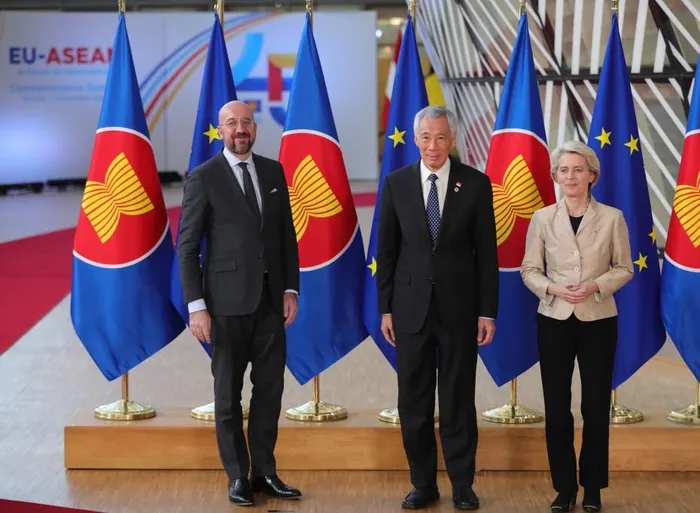
European Council President Charles Michel (L), Singaporean Prime Minister Lee Hsien Loong (C), and European Commission President Ursula von der Leyen pose for a photo at the welcome ceremony of the EU-ASEAN commemorative summit at the EU headquarters in Brussels, Belgium
Image: XINHUA
It is an untold truth, that those who control global banking systems and major investors are globally informed and advantaged regarding critical junctures on a scale between global catastrophe and global triumph. Often decision-making influence is said to reside in this portion of global society. We look at regions in the world and its investment trends, a snapshot of Donald Trump starting his second term in 2025 to 2026 (specifically the period of Israel-US-Iran at war). It is believed that looking at these investment changes beyond trends provide a global map for power concentration and global order changes.
The following index is an interpretive geopolitical investment model using 2025 as a base year (100), designed to illustrate directional capital movement trends during the conflict period:
Africa and the Asia-Pacific recorded the sharpest investment contractions during the US-Israel-Iran conflict, declining by approximately 13% and 28% respectively. Unlike North America, Europe, and the Middle East; which benefited from safe-haven capital flows, defence spending, and energy market gains; both regions were more exposed to global uncertainty, disrupted trade routes, and investor caution.
Africa’s decline reflected heightened global risk aversion, with investors shifting capital away from frontier markets toward the United States and Europe. Structural concerns including debt pressures, currency volatility, weak industrial diversification, and governance instability in parts of the Sahel and Horn of Africa further weakened investor confidence. Intensifying competition between Western powers, China, and Russia for influence on the continent also contributed to uncertainty over future trade and strategic alignments.
The Asia-Pacific experienced a steeper decline due to its deep integration into global manufacturing and shipping networks. Rising oil prices, trade disruptions, and fears over supply chain instability triggered substantial capital outflows from export-driven economies. Political tensions surrounding China-US relations, Taiwan, and the South China Sea further heightened investor anxiety, raising fears of simultaneous geopolitical flashpoints across the Middle East and East Asia.
North America experienced a significant rise in investment activity from 118 to 132 as investors viewed the United States as the primary global safe-haven economy during escalating geopolitical tensions. Increased defence spending and Washington’s strategic role in the Middle East strengthened capital inflows.
Europe’s increase from 105 to 121 reflected stronger investor confidence linked to NATO-aligned security priorities, expanding military expenditure, and efforts to diversify energy sources amid global instability.
The Middle East recorded the largest surge, climbing from 96 to 140 as the region became central to global energy and security calculations. Elevated oil prices and strategic control over supply routes attracted major investment despite ongoing conflict risks.
Latin America rose from 101 to 114 as several economies benefited from relative neutrality while capitalising on increased global demand for commodities and energy exports.
The investment shifts observed during the 2025–2026 conflict period illustrate how global capital increasingly follows geopolitical security, strategic energy access, and military influence rather than traditional growth fundamentals alone. Regions perceived as politically stable, resource-secure, or central to global power competition attracted stronger inflows, while regions vulnerable to instability, trade disruption, or external dependence faced sharper capital withdrawals.
Written By
Cole Jackson
Director of International Relations
Sekunjalo Group Africa Holdings
**The Views expressed do not necessarily reflect the views of Independent Media or IOL.
** MORE ARTICLES ON OUR WEBSITE https://bricscg.com/
** Follow @brics_daily on Twitter for daily BRICS+ updates and instagram @brics_daily