

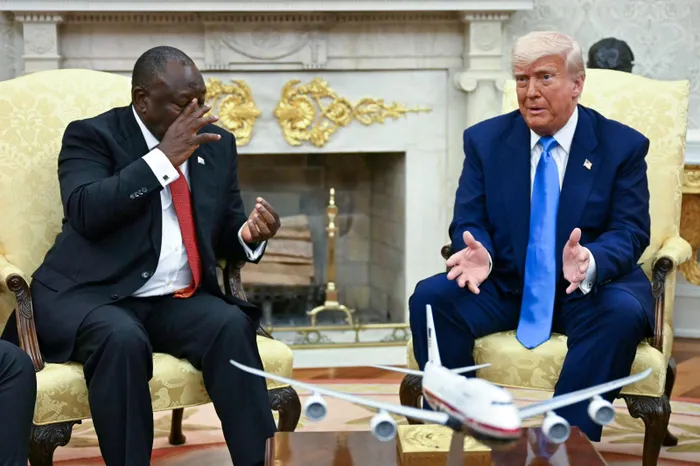
As global alliances face new challenges, the US-South Africa relationship is at a critical juncture, rooted in shared values but strained by recent tensions, writes Armstrong Williams.
Image: AFP
At a moment when global alliances are being tested by shifting power dynamics, economic uncertainty, and competing narratives, the relationship between the United States and South Africa stands at a crossroads. It is a relationship with deep roots moral, economic, and strategic but also one that has experienced strain in recent years. The question now is not whether the partnership matters. It does. The question is whether both nations are willing to do the disciplined work required to rebuild trust while strengthening what has always made the relationship valuable.
The historical foundation between these two nations is not easily dismissed. The United States played a meaningful role in supporting the end of apartheid, aligning itself with the moral clarity of figures like Nelson Mandela, whose legacy still shapes the democratic identity of South Africa today. That period established more than diplomatic ties it forged a shared language around freedom, justice, and the rule of law. Those principles remain a powerful point of alignment, even when political disagreements emerge.
Yet relationships, especially between sovereign nations, are not sustained by history alone. They require continuous engagement and, at times, recalibration. Tensions in recent years whether over foreign policy positioning, trade disagreements, or perceptions of alignment with global rivals have introduced friction. South Africa’s posture on international conflicts and its engagement with blocs such as BRICS have, at times, raised concerns in Washington. Conversely, there is a perception within South Africa that the United States does not always fully appreciate its independent role on the global stage.
These differences are real, but they are not insurmountable.
If anything, they underscore the importance of approaching this relationship with maturity rather than reaction. South Africa is not a client state, nor should it be treated as one. It is a regional leader on the African continent, with its own strategic interests and internal pressures. At the same time, the United States remains a global economic and security anchor, with expectations tied to stability, transparency, and alignment on core issues. The path forward lies not in forcing uniformity, but in building clarity understanding where interests converge and where they diverge, and managing both with respect.
There are, importantly, areas where the relationship remains not only intact but strong.
Trade and investment continue to be a central pillar. The United States is one of South Africa’s largest trading partners, and programs like the African Growth and Opportunity Act (AGOA) have provided preferential access that supports South African exports and jobs. American companies maintain a significant presence in South Africa, contributing to sectors ranging from finance to technology. This economic interdependence creates a practical incentive for stability one that neither side can afford to ignore.
Security cooperation is another enduring strength. While not always visible to the public, collaboration on counterterrorism, maritime security, and regional stability remains important. South Africa’s geographic and political position makes it a critical partner in addressing broader challenges across the African continent. The United States benefits from that partnership, and South Africa benefits from shared intelligence, training, and resources.
Equally important though often underestimated are the human and cultural ties. Educational exchanges, business networks, and diaspora connections continue to bind the two nations in ways that extend beyond policy. American universities host South African students. South African leaders and entrepreneurs engage with US markets and institutions. These relationships build familiarity and trust over time, often outlasting political cycles.
So how does the relationship move forward from here?
First, there must be a recommitment to direct, high-level dialogue. Not statements through media channels, not assumptions based on third-party narratives but consistent, face-to-face engagement. Misunderstanding thrives in distance. Clarity emerges through conversation.
Second, economic cooperation should be expanded, not merely preserved. As global supply chains shift and emerging markets compete for investment, both nations have an opportunity to deepen collaboration in energy, infrastructure, and technology. South Africa’s need for reliable energy solutions and economic growth aligns with American innovation and capital. That alignment should be leveraged with urgency.
Third, both countries must approach areas of disagreement with discipline rather than escalation. Differences over foreign policy whether involving China, Russia, or Middle Eastern conflicts should be addressed through candid diplomacy, not public posturing. Strong relationships are not defined by the absence of disagreement, but by the ability to manage it without rupture.
Fourth, there must be an emphasis on shared values without imposing uniformity. Democracy, accountability, and the rule of law remain common ground. Reinforcing those principles through support for institutions, transparency initiatives, and civil society engagement strengthens both nations internally and collectively.
Finally, leadership matters. Rebuilding trust requires leaders who are willing to prioritise long-term stability over short-term political gain. That means resisting the temptation to score points at the expense of partnership and instead investing in the quiet, often unrecognised work of diplomacy.
The relationship between the United States and South Africa is too important to drift. It sits at the intersection of history and future opportunity, shaped by shared values but tested by modern realities. What remains strong economic ties, security cooperation, and human connection provides a solid foundation. What needs rebuilding trust, clarity, and alignment requires intention.
In the end, this is not about forcing agreement. It is about recognizing mutual interest and acting on it with discipline. If both nations are willing to do that, the partnership will not only endure it will evolve into something even more consequential in a world that increasingly demands steady, reliable alliances.

As global alliances face new challenges, the US-South Africa relationship is at a critical juncture, rooted in shared values but strained by recent tensions, writes Armstrong Williams.
Image: IOL
* Armstrong Williams is the manager and Sole Owner of Howard Stirk Holdings I & II Broadcast Television Stations and the 2016 Multicultural Media Broadcast Owner of the year.
** The views expressed do not necessarily reflect the views of IOL or Independent Media.