

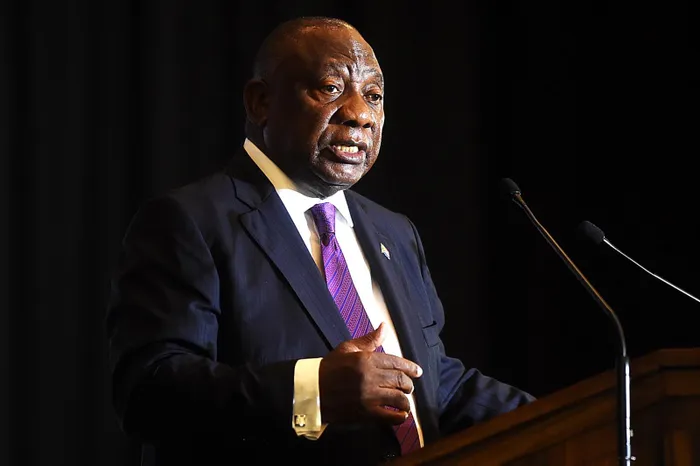
President Cyril Ramaphosa will deliver the State of the Nation Address on Thursday in Cape Town.
Image: Itumeleng English / Independent Newspapers
On Thursday, as the country prepares to listen to the President deliver the State of the Nation Address at 7pm, there is a quiet, reflective space that sits between expectation and experience. It is a moment that comes every year, but it never arrives the same way. The mood of the country shifts, the pressures change, the priorities evolve. And yet, there is something constant about SONA. It is one of the few moments where the nation pauses together and asks a simple but profound question: Where are we now, and where are we going?
For those of us who have lived through the full arc of the democratic era, the State of the Nation Address has always been more than a speech. It has been a mirror, sometimes a compass, sometimes a comfort, and sometimes a wake-up call. It reflects the country’s aspirations, its struggles, its progress and its contradictions. Over the past thirty years, SONA has told the story of a nation still in the process of becoming.
In the early years of democracy, the tone was one of construction and possibility. The focus was on building institutions, stabilising a new political order, and laying the foundations of a society where dignity could be restored to millions who had been excluded for generations. There was a deep sense that the country was starting from a difficult place, but that it was moving forward together. The language was hopeful, determined, and often deeply moral.
As the years went by, the emphasis shifted. Infrastructure, service delivery, economic participation, education, healthcare and housing moved to the centre of the national agenda. These were not abstract ideas. They were about water coming from a tap, electricity lighting a home, a child sitting in a classroom, and a community beginning to feel seen by the state. These were real gains. We must say that clearly. The expansion of access to services, social grants, and public infrastructure changed millions of lives.
But something else began to emerge alongside those gains. The complexity of governing a modern state became more visible. Delivery became harder. Institutions had to be protected. Systems had to be maintained. Capacity mattered. Accountability mattered. And slowly, almost quietly at first, a gap opened between what was promised and what was experienced.Over time, that gap became a national conversation.
Unemployment, especially among the youth, became the defining question of our era. Crime began to shape daily life in too many communities. Municipal systems, which are the frontline of the state, started to struggle. Water systems failed. Wastewater plants broke down. Roads deteriorated. Trust, which had once been high, began to thin.
And yet, through all of this, the country did not collapse. It adapted. It corrected. It argued. It voted. It debated. It endured. There were years of serious institutional damage. There were years of recovery. There were moments when we feared we were going backwards. And there were moments when we could see that important corrections were being made.
That is why tonight’s SONA sits in a very particular place in our national story. We are no longer at the beginning of democracy. We are no longer in a moment of pure transition. We are also not in a moment of collapse. We are in a moment of decision.
The past few years have been about stabilisation. The country has had to deal with energy insecurity, economic pressure, infrastructure backlogs, and global shocks. Some areas have improved. Others remain fragile. There is a sense that the worst may have been avoided, but there is also a strong feeling that avoiding the worst is not enough. People are asking deeper questions now.
These are not hostile questions. They are honest questions. They come from people who want this country to work.When one looks across three decades of State of the Nation Addresses, certain themes appear again and again. Jobs. Growth. Infrastructure. Safety. Education. Healthcare. Corruption. Transformation. Social cohesion. These themes do not repeat because leaders lack imagination. They repeat because they sit at the heart of what it means to build a just and inclusive society.
But the conversation has matured. Today, the focus is not only on what must be done. It is on how it will be done.
People are listening differently now. They are listening for clarity. They are listening for direction. They are listening for signs that priorities are being narrowed, that plans are being sequenced, that delivery systems are being strengthened. They are listening for realism. They are listening for signs that the country is moving from managing crises to shaping a future.
There is also a growing awareness that economic growth alone is not enough. Growth must translate into real opportunities. It must create jobs. It must support families. It must make communities safer and more stable. It must open doors for young people. It must make life more predictable.
At the same time, the country is beginning to understand that stabilising the economy, while important, is only a foundation. Stability creates the conditions for progress, but it does not guarantee it. Progress requires intention. It requires coordination. It requires investment in infrastructure, in skills, in health, in safety, in local government capacity. It requires an economy that produces, not just consumes.
There is a growing conversation about the need to channel our national resources — minerals, finance, labour, policy energy — towards productive sectors that can create large numbers of jobs. There is also recognition that infrastructure is not just about roads and bridges. It is about public transport that connects people to work. It is about water systems that function. It is about digital connectivity that reaches every corner of the country. It is about building the foundations for sustained growth.
Equally important is the understanding that social investment is not charity. Education, training, healthcare, and safety are part of building a capable workforce. They shape the productivity of a nation. They determine whether opportunity can be taken up when it appears.
There are also deeper questions emerging about how we measure progress. If the economy grows, but unemployment remains high, is that success? If infrastructure expands, but inequality deepens, is that progress? If services are delivered, but trust declines, what does that tell us? People are beginning to ask whether we need broader ways of understanding national wellbeing, beyond the numbers that dominate economic reports.
At the same time, there is recognition that all of this requires resources. A state cannot invest in infrastructure, skills, safety and services without a strong revenue system. That means collecting what is due, reducing leakages, strengthening institutions that safeguard public finances, and making sure that resources are used where they make the biggest difference.
We also live in a world that is shifting quickly. Trade relationships are changing. Regional cooperation is becoming more important. Supply chains are being redrawn. Climate change is forcing new ways of thinking about development. South Africa cannot stand still in that environment. It must diversify its markets. It must strengthen its place in Africa. It must think strategically about where growth will come from over the next two decades.
All of this brings us back to tonight.A State of the Nation Address does not change reality overnight. But it sets a tone. It establishes direction. It signals priorities. It invites the country into a shared conversation. And then, over the months that follow, Parliament, departments, provinces, municipalities and communities begin the work of translating those words into action.
That is where the real test begins.After tonight, committees will examine plans. Budgets will be aligned. Targets will be set. Reports will be requested. Site visits will take place. Questions will be asked. Progress will be measured. That is the machinery of accountability. That is how a speech becomes a programme.
But there is another layer as well. The public listens. People talk. Families discuss what they heard. Young people ask what it means for them. Communities ask whether things will change. Business asks where opportunities lie. Civil society asks what it must do. That collective reflection is part of democracy.
So perhaps the most important thing tonight is not to ask whether the speech is perfect. It is to ask what it opens up.
We should listen not only for promises, but for direction. Not only for plans, but for signs of coordination. Not only for ambition, but for realism.
Thirty years into democracy, South Africa remains a work in progress. There is much that has been achieved. There is much that remains difficult. But there is also something powerful about the fact that, year after year, the country still gathers to ask the same central question: how do we build a society that works for everyone?
Perhaps tonight’s SONA is another step in answering that question. Not the final answer. Not a miracle moment. But part of a long journey.
And maybe the real task is for all of us to keep asking, keep thinking, keep engaging — not with anger, not with blame, but with a shared determination to understand where we are, and what it will take to move forward together.
* Faiez Jacobs is a former Member of Parliament, founder of The Transcendence Group, Capetonian, Activist, and Servant of the People.
** The views expressed do not necessarily reflect the views of IOL or Independent Media.