

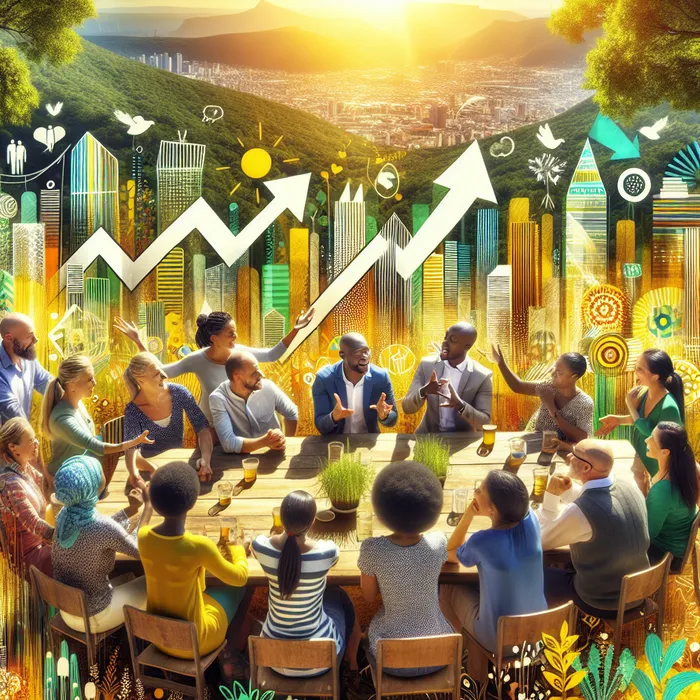
Amidst a sea of despair on social media, Daryl Swanepoel reflects on South Africa's challenges and highlights the importance of rational hope in fostering a constructive national dialogue.
Image: IOL / Ron AI
Over the holiday season I found myself doing something that, on reflection, I probably should do less often: I fell into the social-media scroll. Not for research. Not for work. Just out of that peculiar human impulse to check in, to engage, to feel connected to the buzzing hive of public opinion. And what struck me, almost immediately, was not only the volume of commentary, but the tone: a chorus of despair, resignation and a kind of collective gloom that passed for analysis.
Every policy was a disaster. Every reform was dismissed before it was understood. Every headline was a harbinger of doom. In that saturated stream of negativity, rationality seemed to evaporate. Not just disagreement, which is the lifeblood of democratic conversation, but an almost reflexive pessimism in which everything was broken and nothing could be fixed. People weren’t engaging, they were performing despair. And in doing so, they were robbing themselves, and our nation, of the very thing we need most right now: clear thinking about possibility amid difficulty.
It’s important to say upfront: South Africa faces enormous challenges. The trauma of state capture was real. Mismanagement and poor decision-making have left scars on our institutions and on the confidence of our people. A citizenry that has lived through years of corruption and crisis has every right to be weary. But what I observed in that digital river of complaints was not weariness met with reflection, it was surrender masquerading as insight. And that is dangerous.
Because if we convince ourselves that nothing works, then we stop seeking what does. If we assume that every institution is corrupt, then we cease to hold any institution accountable in a constructive way. If we frame our national story as irredeemably tragic, we lose the capacity to imagine a different ending.
But let’s talk honestly about where we are, and where there are real signs of progress.
There are facts, not fantasies, that point toward recovery:
These are not sweeping triumphs. They do not erase poverty, unemployment or inequality. They do not make our problems small. But they do matter. They matter because they signal that the engine of our society, our economy, our markets, our institutions, has not seized up entirely. It has hiccupped, sputtered, and strained, but it continues to turn.
This is where the philosophical reflection comes in.
There is a difference between pessimism and realism, and there is an equally vital difference between hope grounded in evidence and folly rooted in wishful thinking. True realism acknowledges obstacles without collapsing into despair. It recognises that recovery is neither linear nor guaranteed, but it also refuses to treat slight improvements as mere footnotes.
Hope, in this sense, is not a luxury. It is a civic necessity.
In the ancient Greek tradition, phronesis, practical wisdom, was seen as the virtue that allows people to navigate the space between blind optimism and paralysing pessimism. It’s not that we must pretend everything is fine, it’s that we must cultivate the intellectual discipline to see both the fractures and the fragments of strength, to hold them in a coherent view, and to act accordingly.
Real hope does not deny reality. It refuses despair as a default position.
And here is the critical point: collective narratives shape collective action. If South Africans, whether on social media or off, insist that the country is hopeless, then we will act as though there is nothing left to strive for. But if we recognise the complexity of our condition, the pain alongside the progress, then we can begin to make judgment, rather than capitulation, our guiding principle.
We do need accountability. We do need reform. We do need criticism to be sharp, informed and targeted. But criticism that assumes failure as destiny is not critique, it is abdication of responsibility.
Let us refuse that abdication.
Let us instead insist that our conversations, especially the loud ones in the digital public square, are rooted in both facts and dignity. Let us argue fiercely about policy without dismissing every increment of improvement. Let us reach for the kind of hope that says: We are wounded, but we are not finished, we are challenged, not defeated.
This is not cheap optimism. This is a call to thoughtful resolve. Because nations do not turn themselves around through lamentation. They turn themselves around through disciplines of critique and hope, combined.
And that, at this moment in South Africa’s story, is the conversation we urgently need.
* Daryl Swanepoel is the Chief Executive Officer of the Inclusive Society Institute.
** The views expressed do not necessarily reflect the views of IOL or Independent Media.