

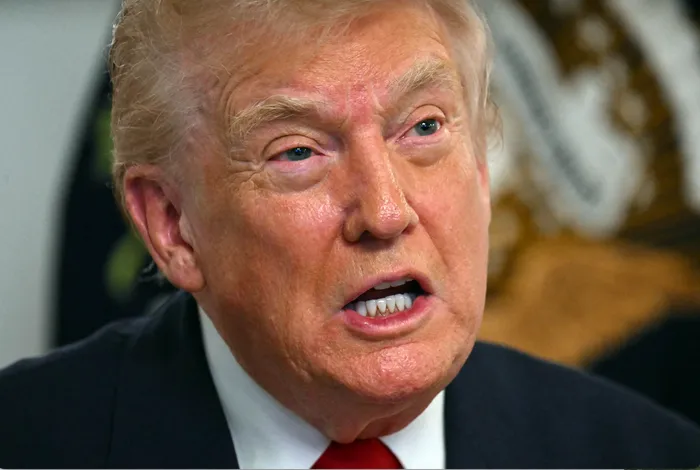
US President Donald Trump. AGOA has long been seen as a tool for African development, but it often acts as a geopolitical leash, imposing conditions and oversight that undermine true independence, writes Gillian Schutte.
Image: Jim Watson / AFP
AGOA has been framed for decades as development assistance, yet its structure functions as a geopolitical leash. Access arrives with conditions. Eligibility arrives with oversight. Renewal arrives with a list of demands. The programme cultivated a psychology of gratitude while engineering a practical architecture of control. African states received tariff preferences while surrendering the right to independent policy direction. Washington never hid the leverage; it hid the intent beneath diplomatic tone and the vocabulary of partnership.
AGOA institutionalised the idea that Africa must continually prove itself to the United States. Governance, transparency, cooperation — concepts that matter in any society — were defined through American self-reference and selectively enforced. The same state that claims oversight over African democracy conducts regime change as foreign policy, protects allies regardless of atrocities, and interprets international law through the prism of its own interests. AGOA normalised this asymmetry. Africa became a subject of evaluation. The evaluator remained immune to critique.
The system created dependency and called it preference. Entire sectors calibrated themselves to the renewal cycle. Jobs rose and fell to the rhythm of US committee hearings. Investors tracked the moods of foreign legislators. Domestic labour lived with consequences shaped by a country that has no obligation to its well-being. Low-value production fed US supply chains and preserved US price stability. African potential was framed through the language of opportunity, while every opportunity remained hostage to political temperament in Washington.
The colonial economy extracted with force; AGOA extracts with uncertainty. It manages through dangling access rather than deploying troops. The plantation model demanded obedience through physical control; the preference model secures compliance through unpredictable approval. In both, the power lies with those who grant permission.
The rhetoric of democracy under AGOA shaped a narrative in which African legitimacy arises from external certification. Liberation struggle becomes footnote. Indigenous knowledge becomes peripheral. Political memory becomes inconvenient. The underlying message suggests that freedom lacks meaning without endorsement from the very power structure that once defined Africa as an exploitable frontier.
The economic consequences stretch beyond tariffs and quotas. When an industry grows for external demand, it weakens internal resilience. When wages depend on foreign preference, they can be depressed without negotiation. When agricultural land is organised around export, food sovereignty erodes. When policy is shaped to avoid disapproval, the continental imagination contracts.
AGOA treated African sovereignty as a variable. The act expired in September 2025, leaving South Africa outside the programme and confronting the full weight of MFN tariffs layered with punitive reciprocal measures. No guarantees of re-entry exist. Renewal discussions revolve around alignment with US geopolitical objectives. The signal is unmistakable. Trade operates as soft power. Exclusion frames compliance.
Africa now stands before a decision disguised for decades as inevitability. The collapse of AGOA participation clarifies what was always present beneath the surface. Dependency does not create development. It creates fragility. It produces states that plan according to the expectations of others. It distracts leaders and bureaucracies with the performance of eligibility instead of the construction of internal capacity.
Continental trade, regional value chains, food sovereignty, and multipolar diplomacy offer a completely different orientation — one grounded in collective strategy rather than unilateral approval. The African Continental Free Trade Area becomes more than infrastructure; it becomes a philosophical reversal. It suggests that value stays where it is produced. It proposes that labour deserves dignity grounded in local planning rather than foreign sentiment. It restores agency that has been traded away in exchange for uncertain access.
AGOA revealed its truth in its expiry. The continent gains nothing from waiting in eligibility queues for approval from a distant power that views Africa through transactional eyes. Sovereignty grows when decisions are made by those who inhabit the consequences. The next chapter begins when Africa stops asking permission to build its own future.

AGOA has long been seen as a tool for African development, but it often acts as a geopolitical leash, imposing conditions and oversight that undermine true independence.
Image: IOL
* Gillian Schutte is a South African writer, filmmaker, poet, and uncompromising social justice activist. Founder of Media for Justice and co-owner of handHeld Films, she is recognised for hard-hitting documentaries and incisive opinion pieces that dismantle whiteness, neoliberal capitalism, and imperial power.
** The views expressed do not necessarily reflect the views of IOL or Independent Media.